
Pest Expert Overview: Yellowjackets in Bryan & College Station
The first yellowjacket nest I treated sat in a wooded part of a customer’s yard. I was creeping toward the entrance with the customer directly behind me. After a few steps, I stopped and told him I wasn’t sure this arrangement was safe. If the colony came after me, I would probably plow straight through him while trying to get away.
Luckily, the treatment was uneventful. Still, even the best entomologist knows when to run for his life.
That wasn’t false bravery or excessive caution. Yellowjackets defend a colony as a group, respond to vibration and alarm signals, and can sting repeatedly. A nest hidden in the ground gives someone very little warning before workers begin emerging.
Around Bryan, College Station, and the rest of Brazos County, correct identification and nest location matter more than the number of wasps visiting a flower or trash can. A forager and a guard may belong to the same species, but they create very different risks.
The Yellowjacket Customer Was Standing in My Escape Route
The wooded setting made that first nest difficult to read. The entrance looked like a small opening in the ground, while the colony remained hidden below. I needed to approach closely enough to work without blocking my own retreat.
Having the customer directly behind me created the bigger problem. If guard wasps poured from the entrance, neither of us would have a clear path out. My warning was funny because it was honest. Under those circumstances, instinct and professional judgment would both favor immediate distance.
The quiet outcome doesn’t make the concern excessive. Colony response varies with species, nest size, temperature, vibration, and how directly someone disturbs the entrance. One treatment can proceed without drama while another nest reacts to a mower passing several feet away.
That unpredictability explains why a hidden social wasp nest deserves more respect than a solitary wasp flying through the yard.
How to Recognize a Yellowjacket
Yellowjackets have compact bodies with bold black and yellow or cream markings. They lack the fuzzy appearance of honey bees and the long, dangling legs of many paper wasps. Most look sturdy and smooth, with a short waist compared with the more slender paper wasp shape.
Several Texas wasps carry similar colors. A cicada killer is much larger, often reaching well over an inch, and lives as a solitary hunter. Paper wasps build open comb nests under eaves and ledges. Yellowjackets build enclosed paper nests in cavities, commonly underground or inside protected structural spaces.
The eastern yellowjacket, Vespula maculifrons, and southern yellowjacket, Vespula squamosa, occur in Texas. Texas A&M AgriLife Extension notes that eastern yellowjackets usually build below ground, while southern yellowjackets can use ground or aerial sites.
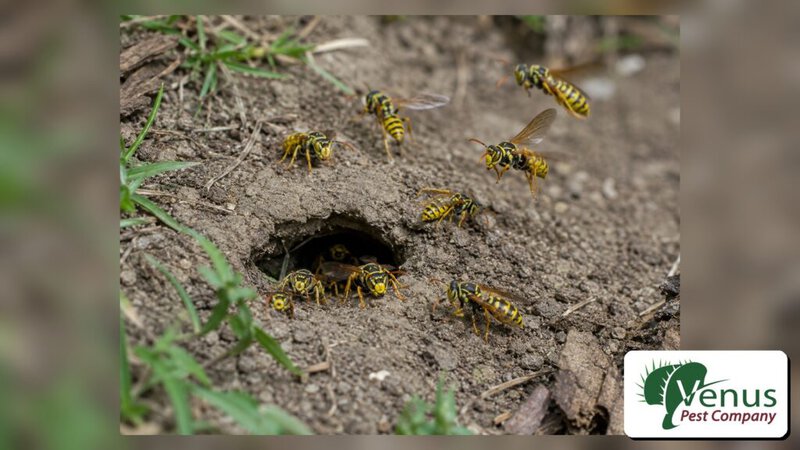
Don’t rely on color alone. Watch from a safe distance for repeated traffic entering one small opening. A steady stream of wasps using a hole in soil, a wall gap, a tree cavity, or a landscape feature strongly suggests a nest.
A Hidden Paper Nest
Workers chew wood fibers and mix them with saliva to build a layered paper nest. The outer covering protects horizontal combs where the colony raises young. When the nest sits underground, the soil hides all of that construction except the entrance.
An abandoned rodent burrow provides an ideal starting cavity. Yellowjackets can also use hollow trees, wall spaces, landscape timbers, equipment, and other sheltered voids. The visible opening may sit several feet from the main nest chamber.
That distance creates a control challenge. The entrance doesn’t always reveal the size, depth, or exact position of the colony. Closing the opening without addressing the colony can force workers to search for another exit. In a wall, that new route may lead indoors.
For homeowners, the useful sign is traffic. Repeated arrivals and departures from one point matter more than finding a papery structure.
How the Colony Changes Through the Year
A fertilized queen survives winter in a protected site and begins a new colony as temperatures warm. She builds the first cells, lays eggs, and feeds the first larvae. After workers emerge, they take over foraging, construction, nest defense, and care of the young.
The colony grows through spring and summer. More workers mean more food collection, more nest traffic, and a stronger defensive response. By late summer and fall, a mature nest may contain many hundreds or even thousands of wasps.
The colony also produces new queens and males late in the season. Those reproductives leave and mate. Cold weather usually kills the workers and founding queen, while new queens seek winter shelter and begin the cycle again the following spring.
Texas weather can shift this schedule. Warm conditions extend activity, and protected nests may remain active longer than a calendar based summary suggests.
Why Food Becomes a Fall Problem
Yellowjackets provide real ecological value. Workers capture caterpillars, flies, and other arthropods, then bring protein back to developing larvae. Their hunting can help reduce plant pests.
Adults also need sugar. Flowers, ripe fruit, soft drinks, spilled syrup, and open trash provide easy energy. Late in the season, changing colony needs can make workers especially persistent around picnics, outdoor dining, tailgates, and garbage areas.
A wasp circling a soda can isn’t defending its nest. It wants food. Texas A&M AgriLife Extension explains that foraging wasps usually aren’t aggressive away from the colony. Swatting and trapping one against skin still creates a sting risk.
Cover drinks, keep trash closed, and look before sipping from an unattended can. That advice sounds simple because the ugly version of this story is a yellowjacket inside a drink where nobody can see it.
Nest Defense Changes Everything
Workers treat vibration, impact, and movement near the entrance as possible threats. Lawn mowers, string trimmers, tractors, pets, children, and people moving logs can alarm a colony without anyone seeing the nest first.
Yellowjackets can sting more than once because they don’t leave a barbed stinger behind like a honey bee worker. They can also release alarm chemicals that recruit nestmates to the disturbance.
If several attack, leave the area immediately and enter a vehicle or building. Protect your face and eyes while moving, but don’t stop beside the nest to swat at individual wasps. Distance and solid shelter matter more than winning an argument with each worker.
This is the same calculation I made with the customer behind me. A safe approach includes a clear escape route before anyone disturbs the colony.
Stings and Allergic Reactions
A normal sting causes sharp pain, redness, and localized swelling. Some people develop a large local reaction that extends well beyond the sting site. A smaller number experience anaphylaxis, a serious allergic reaction that can progress rapidly.
Call emergency services for difficulty breathing, swelling of the tongue or throat, dizziness, fainting, widespread hives, or other signs of a severe reaction. Anyone with a prescribed epinephrine device should follow their medical plan.
Multiple stings create another concern even without an allergy. Children, older adults, and anyone receiving many stings should receive prompt medical guidance.
Unlike a honey bee sting, a yellowjacket sting usually leaves no stinger to scrape out. Wash the area and monitor symptoms. Medical professionals, not a pest control article, should guide treatment for concerning reactions.
Yellowjackets Versus Other Local Wasps
Paper wasps build exposed combs beneath eaves, porch ceilings, and similar shelter. They defend the nest but usually have much smaller colonies and an obvious structure.
Black and yellow mud daubers build mud tubes and work alone. They pay little attention to people and don’t defend a social colony.
Cicada killers dig conspicuous burrows and look enormous. Females can sting, but they rarely defend the nesting area with yellowjacket intensity. Males may fly toward people but cannot sting.
Honey bees look hairier and collect pollen on their legs. A honey bee colony can also defend itself forcefully, but bee relocation may remain possible in situations where yellowjacket nest treatment makes more sense.
What Homeowners Should Notice
Watch for repeated flight into one opening rather than following individual wasps through the yard. Observe from far enough away that workers don’t begin circling or contacting you.
Keep children and pets away from a suspected nest. Mark the general area from a distance so a technician can locate it, but don’t place an object beside the entrance or block it.
Avoid mowing, trimming, digging, or moving nearby material until someone identifies the nest. A colony that tolerated ordinary foot traffic may react strongly to vibration.
Don’t seal a structural opening while wasps remain active. Trapped workers may enter occupied rooms while searching for another route.
Professional Yellowjacket Control
Texas A&M recommends professional help for established yellowjacket colonies because the workers defend aggressively and can sting repeatedly. Professional planning considers the species, nest site, traffic, colony size, people nearby, and available escape routes.
Venus Pest Company provides yellowjacket inspection and nest treatment in Brazos County. Service details depend on whether the colony sits in soil, a tree, a wall, or another cavity. We discuss the site and risk before beginning work.
We don’t publish pesticide products, active ingredients, application rates, or homeowner treatment instructions. A hidden social wasp colony isn’t a good place for experimentation based on an internet shopping list.
Local Help When the Nest Is Too Close
Venus Pest Company has served local homes and businesses since 2001. Our founder, Dr. Scott Lingren, holds a PhD in entomology. That education helps identify the wasp, but experience also teaches a simpler lesson: always leave yourself room to run.
If yellowjackets are entering the ground, a wall, or another cavity near people, call or text 979-774-0486, or email service@venuspest.com. Tell us where you see the traffic and what activities occur nearby. Please don’t stand behind the technician when he approaches the nest.
Common Questions
Are they aggressive everywhere they fly?
No. Foragers visiting flowers, food, or trash usually focus on collecting resources. Workers near a nest respond much more defensively because they protect the queen and developing young.
How can I find the nest entrance?
Watch from a safe distance for repeated traffic into one opening. Don’t walk close enough to disturb the area, and don’t place a marker beside the entrance.
Do they always nest underground?
No. Eastern yellowjackets usually nest below ground, but southern yellowjackets can use ground or aerial cavities. Wall spaces, hollow trees, and other protected voids may also support colonies.
Why do they bother people at fall picnics?
Workers seek sugar and protein. Soft drinks, ripe fruit, meat, desserts, and open trash provide concentrated food when the colony has reached its seasonal peak.
Can one sting more than once?
Yes. Yellowjackets don’t normally leave their stinger behind, so one worker can deliver repeated stings.
What should I do if several attack?
Leave immediately and enter a vehicle or building. Protect your face while moving, but don’t stop near the nest to swat at individual wasps.
Should I seal a wall opening they use?
Not while the colony remains active. Blocking the entrance may send workers through another route, including one that leads inside the building.
Does Venus treat yellowjacket nests?
Yes. We inspect and treat yellowjacket nests in our Brazos County service area. The plan and price depend on the nest location, access, and risk.