
Pest Expert Overview: Paper Wasps in Bryan & College Station

These wasps aren’t looking for people. Away from the nest, they hunt caterpillars and visit flowers. Near the colony, their behavior changes because workers defend the developing young.
Around Bryan, College Station, and the rest of Brazos County, a paper wasp nest can grow through the warm season. Location determines whether it provides useful insect predation or creates an unacceptable sting risk.
How to Identify Paper Wasp Nests
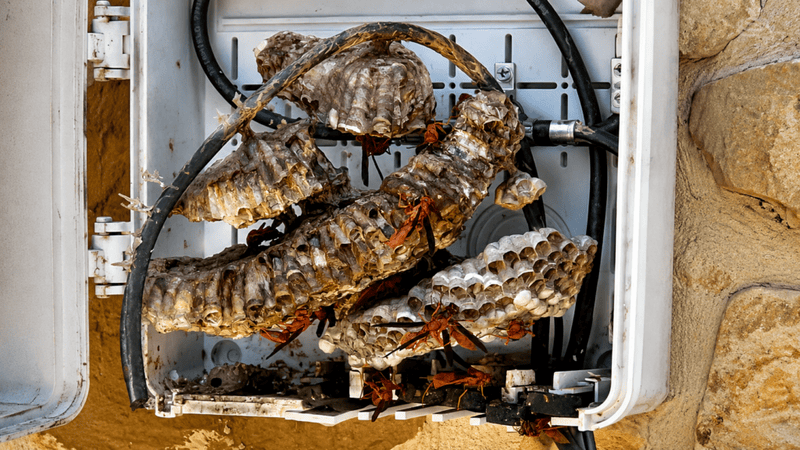
Paper wasps scrape weathered wood and plant fibers, chew the material, and mix it with saliva. The finished nest consists of exposed hexagonal cells attached to a surface by a narrow stalk.
The uncovered cells provide the clearest field mark. A paper wasp nest looks like a small upside down umbrella or a single honeycomb without an envelope around it.
Texas A&M’s paper wasp guide describes adults as slender wasps about three quarters to one inch long. Their wings fold lengthwise at rest, and long legs often hang below the body during flight.
Several Species Share the Name
“Paper wasp” refers to members of the genus Polistes, not one species. Color varies enough that people often assume red and yellow individuals belong to entirely different types of wasps.
The Guinea paper wasp, Polistes exclamans, has a brown body with yellow markings. The red paper wasp, Polistes carolina, appears mostly reddish brown. Polistes metricus commonly has a reddish head and thorax with a darker abdomen.
Color helps, but the open comb nest and slender body matter more for deciding what kind of wasp colony occupies a structure.
How to Separate Common Wasp Nests
Nest construction provides a quick way to distinguish several wasps found around Brazos County buildings.
| Wasp | Nest | Typical behavior near people |
|---|---|---|
| Paper wasp | Exposed paper comb hanging from a stalk | Usually calm away from the nest but defensive close to it |
| Yellowjacket | Enclosed nest in soil, a cavity, or another protected void | Strong colony defense and repeated stings |
| Black and yellow mud dauber | Mud tubes or cells attached to a surface | Solitary and generally uninterested in people |
An exposed comb full of visible larvae isn’t a hornet nest. An old mud structure on brick isn’t evidence of an active paper wasp colony. Identification keeps a beneficial solitary wasp from receiving the response meant for a social nest beside a doorway.
One Queen Starts the Colony
A mated female survives winter in a protected crack, beneath bark, inside an attic, or within another sheltered space. She emerges as temperatures warm and selects a nest site.
This foundress builds the first cells, lays eggs, and feeds the first larvae by herself. The early nest may contain only a few cells and one adult. She tends to retreat rather than risk the colony before workers emerge.
The first adult daughters take over foraging, nest construction, brood care, and defense. The queen then concentrates on laying eggs while the colony expands.
In fall, newly mated paper wasp queens leave their colonies and look for protected places to spend the winter. Attics provide plenty of sheltered gaps and voids. When temperatures warm in late winter or spring, the queens become active and try to return outdoors so they can start new nests. They naturally move toward light, but a queen in an attic may follow light coming through a recessed fixture or another ceiling opening and end up inside the house instead. Finding one or two slow moving paper wasps indoors during this period usually means overwintering queens have taken a wrong turn. It does not necessarily mean an active nest exists inside the house.
Paper Wasp Behavior Changes as the Nest Grows
A young spring nest and a mature late summer nest don’t present the same problem. More workers mean more defenders, and the nest contains a larger investment of developing larvae and pupae.
Paper wasps recognize rapid movement and vibration near the comb. Lawn equipment, slamming doors, construction, pressure washing, and someone brushing the nest can trigger defense. Workers can sting repeatedly because their stingers don’t remain in the skin.
Wasps flying across a yard or visiting flowers usually ignore people. The defensive zone centers on the nest, which makes nest location more important than the mere presence of a wasp.
Caterpillar Hunters With a Useful Role
Adults collect caterpillars and other soft bodied insects, chew the prey into a pulp, and feed it to developing larvae. The adults obtain energy from nectar and other sugary liquids.
This hunting benefits gardens, trees, and landscapes. A small nest high in a tree or on an unused outbuilding may deserve to remain. The same colony above a front door, beside a pool, or beneath playground equipment creates a predictable collision with people.
Our goal isn’t to remove every paper wasp from the property. We focus on nests whose location creates a practical sting risk.
What Happens When Autumn Arrives
Colonies produce males and new reproductive females later in the season. Mated females leave to find protected winter shelter. The workers, males, original queen, and developing colony die as cold weather arrives and food declines.
Paper wasps don’t reuse the old nest the following year. A new foundress may choose the same protected corner because the location remains attractive, but she builds a new comb.
Warm winter days can wake overwintering females inside attics and wall spaces. They may follow light into living areas. A slow wasp at a window in winter usually isn’t defending a hidden active nest, although handling can still result in a sting.
When a Paper Wasp Nest Needs Attention
Consider the height, traffic, colony size, and people using the area. A nest above a rarely used shed door presents less risk than one beside a school entrance or where a child plays.
Don’t stand beneath an active nest to inspect it closely. Keep children and pets away, and avoid striking the structure or blocking the wasps’ flight path. A mature nest can respond faster than someone can retreat from a ladder.
Customers sometimes discover nests while trimming shrubs, opening electrical panels, moving patio furniture, or reaching beneath railings. Looking before placing a hand into a sheltered space prevents many stings.
Reducing Nesting Around Structures
Seal practical gaps that allow overwintering females into attics and wall spaces. Repair screens and door seals, and close openings around vents or eaves without blocking required airflow.
Watch sheltered surfaces during spring when nests remain small. Regular observation catches activity before dozens of workers occupy the site. Remove abandoned nests when practical for appearance and easier future inspection, while remembering that old combs don’t produce new colonies.
Food and drink spills can attract foraging wasps even when the nest sits elsewhere. Cover waste containers, clean sugary spills, and manage outdoor food during gatherings.
Professional Paper Wasp Control
Venus Pest Company includes paper wasps in Basic Pest Control. Our HomeGard, HomeGard Plus, and TotalGard plans build on that coverage and include winter wasp nest removal. Standard commercial pest control can also include paper wasps, with qualifying exterior nest retreatment available under the service agreement.
We evaluate whether the insects are paper wasps, yellowjackets, mud daubers, or another species before acting. Nest location, colony size, access, height, and nearby activity determine the safe response.
We don’t publish pesticide products, active ingredients, rates, mixing instructions, or directions for treating nests. Wasp work can put a person on a ladder within the colony’s defensive range. That combination deserves professional judgment.
Local Help Across Brazos County
Venus Pest Company has served local homes and businesses since 2001. Founder Dr. Scott Lingren holds a PhD in entomology, and our approach preserves beneficial wasps where they don’t create a conflict while controlling nests that threaten occupied areas.
If a nest appears above a door, patio, play area, or commercial entrance, call or text 979-774-0486, or email service@venuspest.com. A photo taken from a safe distance can help us identify the nest before arrival.
Common Questions
Are paper wasps aggressive?
Away from the nest, paper wasps usually avoid people. Workers become defensive when movement or vibration threatens the comb and developing young.
Can they sting more than once?
Yes. A paper wasp’s stinger doesn’t remain in the skin, so one wasp can deliver multiple stings during nest defense.
What does the nest look like?
It has a single exposed comb of open hexagonal cells attached by a narrow stalk. There is no outer paper envelope covering the cells.
Do they use the same nest next year?
No. The colony dies, and the old nest remains empty. A new queen may choose the same favorable location but constructs a new comb.
Why is one flying inside during winter?
An overwintering female may have awakened in an attic or wall space during warm weather and followed light into the room. She isn’t usually defending a colony in that situation.
Are they beneficial?
Yes. They collect caterpillars and other insects to feed their larvae and also visit flowers. A remote nest can provide useful predation without creating much risk.
How are they different from yellowjackets?
Paper wasps build visible open combs and generally show less defensive intensity. Yellowjackets usually nest in soil or cavities and can mount a much stronger group response.
Does Venus service cover them?
Yes. Basic Pest Control, every HomeGard family plan, and standard commercial coverage include paper wasps. Coverage applies to qualifying nests within the service scope and agreement.