

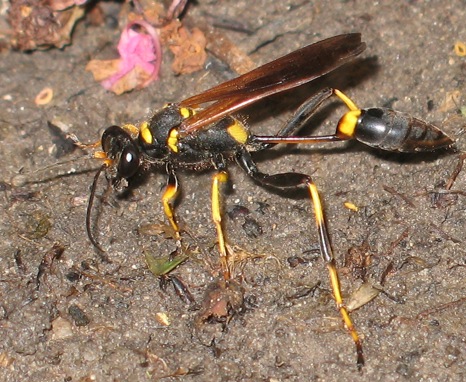
Black and yellow mud daubers look designed to make people nervous. They have long legs, bold markings, a threadlike waist, and a habit of flying directly past anyone between a spider, wet soil, and the nest. Their close flight seems aggressive, but the wasp usually isn’t interested in the person.
These solitary wasps are common around Bryan, College Station, and the rest of Brazos County. Females build in sheltered places, stock each cell with paralyzed spiders, lay an egg, and seal the chamber. The larva gets fresh food. The homeowner gets a lumpy patch of dried mud nobody requested.
Black and yellow mud daubers can sting, but they rarely do. They don’t defend their nests like social wasps. Most encounters need identification more than control.
Why Black and Yellow Mud Daubers Scare People
People understandably react to the shape and color before they study the wasp’s behavior. Anything black and yellow with a stinger gets filed mentally beside yellowjackets and paper wasps. A mud dauber also flies with a busy, slightly erratic style that can look like an attack run.
The important difference lies in what the wasp is trying to accomplish. A female mud dauber works alone. She doesn’t have a queen, workers, or a social colony behind her. She gathers one load of mud at a time, makes repeated trips to the same nest, hunts spiders, and provisions individual cells for her offspring. If you happen to occupy the most direct flight path, she may treat you like an inconvenient tree.
That indifference can feel personal. It isn’t. She has a job to finish and doesn’t appear impressed by our belief that the patio belongs to us.
The Nap I Lost to a Nest Builder
The sound of nest construction surprises people almost as much as the wasp’s close flights. A female can make a remarkably loud buzz while working mud into place. The sound carries well when the nest sits against siding, trim, or another surface that resonates.
Last summer, one chose a spot near where I was trying to take a weekend afternoon nap. Every attempt ended with that loud construction buzz. I knew exactly what she was and knew she had no interest in stinging me. None of that made the noise less effective. It was like having a tiny masonry crew operating beside my head.
That experience also explains why homeowners sometimes report a wasp that seems unusually persistent. She isn’t patrolling the porch. She has committed to a building site and keeps returning with material.
How to Identify This Long Waisted Wasp
The black and yellow mud dauber, Sceliphron caementarium, belongs to the thread waisted wasp family Sphecidae. Adults measure about three quarters of an inch to one inch long. Yellow markings vary, but the extremely long, narrow waist makes the species recognizable.
The Texas A&M Field Guide to Common Texas Insects describes mud daubers as solitary wasps that build and provision their own nests. It also notes that they rarely act aggressively even though females can sting.
People use “mud dauber” or “dirt dauber” for several species. The metallic blue mud dauber, Chalybion californicum, may renovate an old nest. The pipe organ mud dauber, Trypoxylon politum, builds long parallel tubes. Nest shape and the adult together provide a better identification than either clue alone.
A Solitary Wasp Is Different From a Social Nest
Social wasps live in colonies containing a queen and many workers. Those workers defend shared brood and a common nest. One alarmed paper wasp or yellowjacket can recruit nestmates, which makes activity near an occupied social nest risky.
A female builds for her own offspring. Others may choose the same sheltered area, but they don’t form a colony. Several nests can represent independent wasps rather than hundreds of workers defending one entrance.
Solitary life changes the cost of aggression. An injured female may leave every unfinished cell without a provider, so avoiding conflict makes biological sense.
This doesn’t make a sting impossible. A female may sting if someone grabs her, traps her against skin or clothing, or handles an active nest roughly. People with sting allergies should treat any stinging insect with appropriate caution. Under ordinary conditions, however, mud daubers don’t chase people away from the nest.
How a Black and Yellow Mud Dauber Builds a Nest
The female visits a damp patch of exposed soil, gathers a small ball of mud, and carries it to a sheltered surface. Trip by trip, she shapes the material into a cylindrical cell. After completing the chamber, she leaves to hunt spiders.
She paralyzes each spider with her sting rather than killing it immediately. The immobilized spiders remain suitable food for the larva. She places several spiders inside the cell, lays one egg, seals the opening, and begins another chamber. A completed nest may contain several cells under an additional outer layer of mud, giving it a rough or lumpy appearance.
The egg hatches inside the sealed chamber. The larva eats the spiders and eventually spins a cocoon. It may remain inside through winter and emerge during warm weather. A round exit hole shows that an adult wasp or another occupant has emerged.
Spiders Become Food for the Young
Adult mud daubers visit flowers and feed on nectar. Their larvae need protein, so the females hunt spiders to stock the cells. Common prey can include orb weavers, crab spiders, jumping spiders, and other species small enough to carry.
People associate mud daubers with black widows. Blue mud daubers often collect widows and reuse existing mud nests. Black and yellow mud daubers take a wider range of spiders. A mud nest doesn’t prove that a home has a black widow infestation.
The mother never feeds the larva directly after sealing the cell. Everything the young wasp needs must fit inside at the beginning. Her repeated hunting trips explain why she flies with such purpose and why she may pass through the same narrow space again and again.
A Predator of a Predator
Most people consider an insect beneficial when it eats something they dislike. Mud daubers certainly qualify as spider predators. The ecological answer gets more interesting because spiders also prey on flies, moths, leafhoppers, mosquitoes, and many other insects.
So is a wasp that kills spiders beneficial? Usually, yes, but not because every spider needs to disappear. Mud daubers form one part of a larger food web. They keep some spider populations in check, visit flowers for nectar, and provide food for other animals. Meanwhile, the spiders that escape keep hunting insects. Neither predator needs to win completely.
The phrase “beneficial insect” can make nature sound like it exists to perform free services for people. A better way to think about these wasps is that they belong here and usually create little risk. Their spider hunting gives us another reason to tolerate them when the nest location doesn’t create a practical problem.
Why They Fly Right Past People
A hunting female travels among the nest, prey, and mud source. People, furniture, doors, and pets may stand between those points. She changes course just enough to avoid a collision and keeps going.
That behavior differs from defensive flight. A social wasp defending a nest may face a person, circle, follow, bump, or sting. A mud dauber generally passes by and returns to the same small patch of mud or the same nest opening. Watching where the wasp goes often reveals the purpose of the flight.
No one has to enjoy a large wasp repeatedly crossing the porch. Still, understanding the behavior lowers the temperature of the encounter. Swatting at a wasp that wasn’t threatening anyone creates more risk than letting her complete the trip.
Where Mud Dauber Nests Appear
Females prefer surfaces protected from rain, including porch ceilings, eaves, window frames, garages, sheds, attics, barns, and carports. They may also build inside equipment, electrical boxes, or stored items.
Nearby water and exposed soil make a property more attractive. Irrigation leaks, air conditioning condensate, muddy garden edges, pond margins, and puddles can supply building material. The wasp may collect mud some distance from the nest, so the source isn’t always obvious.
Old nests remain attached long after the adults leave. Blue mud daubers and other insects may use abandoned cells, which complicates identification.
When a Nest Becomes a Nuisance
Most nests cause a cosmetic problem. Mud can stain siding, stucco, brick, trim, and porch ceilings. Removal may lift weak paint or leave an outline. Several generations can create a messy accumulation.
Location matters. A nest inside a frequently used cabinet, vehicle, electrical component, play structure, or doorway deserves more attention than one high under an outbuilding eave. Repeated close flights may also make a porch unpleasant even when the actual sting risk remains low.
Before assuming the nest belongs to a harmless mud dauber, confirm the insect. Paper wasps build exposed paper comb, while yellowjackets often enter a concealed cavity or ground opening. Those social wasps defend nests and require a different level of caution. Venus has separate guides to paper wasps and yellowjackets for comparison.
Prevention Without Treating Every Wasp as a Threat
Regular inspection prevents old nests from accumulating. Check sheltered corners, garages, porch ceilings, and stored equipment during cooler weather. Sealed cells may still contain developing wasps, so nest removal also interrupts the next generation instead of merely cleaning up old mud. The University of Maryland Extension identifies knocking down the nests as the most effective control method.
Screens and repairs can keep females out of attics, garages, sheds, and wall spaces. Closing garage doors reduces access. Correcting a persistent wet spot may remove one convenient mud source, although wasps can collect mud elsewhere.
These steps won’t make a property wasp free, nor should that be the goal. The practical objective is to keep nests away from sensitive surfaces and enclosed spaces while leaving harmless activity alone where possible.
Professional Mud Dauber Service
Large numbers of mud nests can point to a favorable site rather than an infestation in the usual sense. A professional inspection can confirm the species, separate current activity from old nests, identify entry points, and determine whether another stinging insect shares the area.
Our technicians knock down accessible mud nests during Venus quarterly pest control and HomeGard plan visits. We do this because the young develop inside those sealed cells and newly emerged adults often return to the same favorable areas to nest. Regular removal reduces the number emerging at the structure and prevents years of nests from accumulating on the same surfaces.
I have found that treating the nesting surface rarely stops them for long. Iowa State University Extension similarly reports no proven method for discouraging mud daubers from building in sheltered areas. My working theory is that mud coating the wasps’ tarsi, or feet, may reduce their contact with a treated surface. Their brief, repeated contact while building may also play a role. I haven’t found research that proves either mechanism, so I treat this as a field observation rather than settled science. The practical result remains clear: physical nest removal works more reliably for us than treating the surface.
Venus Pest Company doesn’t publish pesticide products, application rates, or do it yourself pesticide instructions. These wasps rarely justify broad pesticide use. When service makes sense, it should address the nests and the conditions allowing repeated buildup.
Local Help Across Brazos County
Venus Pest Company has served Brazos County since 2001. Sometimes the most useful thing we can tell a customer is that the frightening wasp on the porch has almost no interest in them. Other times, nests have accumulated in a garage, damaged a finish, or appeared where the family can’t reasonably ignore them.
If you’re unsure what built a nest or whether the wasps present a real sting risk, call or text 979-774-0486, or email service@venuspest.com. A clear photo of the wasp and nest can often help with the first step: getting the identification right.
Mud Dauber Questions
Can a black and yellow mud dauber sting?
Females can sting, but rarely do unless grabbed, trapped against skin, or handled roughly. They don’t mount the coordinated nest defense seen in social wasps.
Do mud daubers attack people near the nest?
Normally, no. A female may fly close because someone stands between the nest, mud source, and hunting area. Passing close isn’t the same as targeting you.
Why does nest construction sound so loud?
The wasp buzzes and vibrates while carrying, pressing, and shaping wet mud. A nest attached to siding or trim can make those vibrations more noticeable. One busy female can sound much larger than she is.
What do the larvae eat?
The female stocks each cell with paralyzed spiders, lays an egg, and seals the chamber. The larva eats the stored prey. Adults feed mainly on nectar.
Does a nest mean I have black widow spiders?
No. Black and yellow mud daubers collect several kinds of spiders. Blue mud daubers often hunt black widows, but even their presence doesn’t establish that a structure has an infestation.
Do they live together in a colony?
No. Each female builds and provisions her own cells. Several females may use the same favorable area, but they don’t cooperate as one colony or mount a group defense.
Will they reuse an old nest?
Black and yellow mud daubers usually build with fresh mud, but other insects may use abandoned cells. Blue mud daubers commonly renovate old nests. Open exit holes and different colored occupants can make an old nest’s history surprisingly complicated.
Should every nest be removed?
No. An isolated nest in an out of the way location creates little risk. During quarterly pest control and HomeGard visits, however, we remove accessible nests from the structure because the developing young can emerge and return to the same favorable areas. Regular removal also prevents mud and staining from accumulating year after year.