
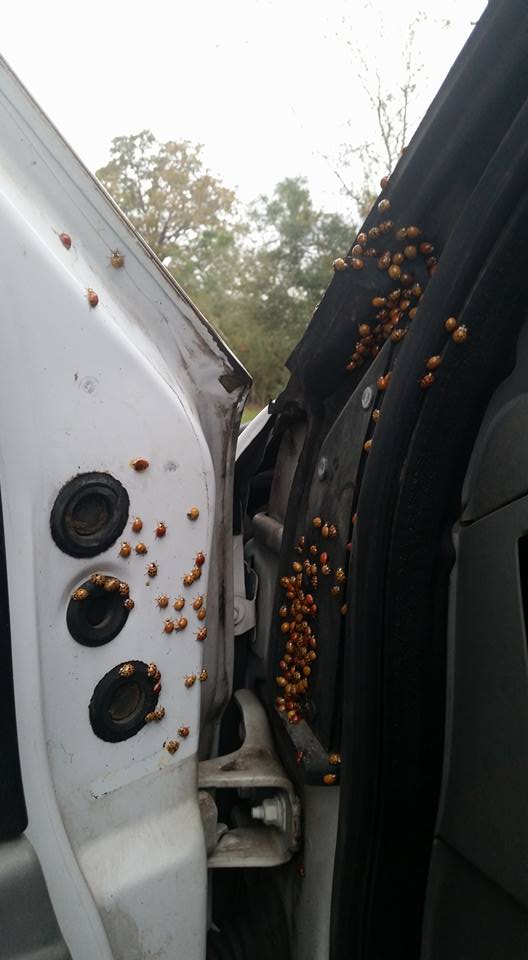
The beetles that invade homes around Bryan, College Station, and the rest of Brazos County each fall are usually multicolored Asian lady beetles. Their scientific name is Harmonia axyridis. They are genuine lady beetles and excellent predators of plant pests, but their habit of spending winter inside buildings makes them a seasonal nuisance.
These beetles do not move indoors because they want food, wood, fabric, or people. They are searching for a protected place to survive the winter. Understanding that behavior explains why they gather on certain walls, why they reappear on warm winter days, and why prevention works better before the fall migration begins.
Ladybug, Lady Beetle, or Ladybird Beetle?
Ladybug, lady beetle, and ladybird beetle all refer to members of the beetle family Coccinellidae. They are not birds, and entomologically speaking, they are not true bugs either. True bugs belong to a different insect order. Lady beetles belong to Coleoptera, the order that contains beetles.
Most people use “ladybug” because it is familiar. Entomologists usually say “lady beetle” because it describes the insect more accurately. Either name works in an ordinary conversation as long as we remember that it covers many species rather than one standard red beetle with a fixed number of spots.
Texas supports numerous native and introduced lady beetles. They can be red, orange, yellow, gray, or black, with spots that vary by species and sometimes by individual. Texas A&M’s lady beetle guide shows several forms found in Texas and explains their role as predators.
Why the Name Has a Religious History
The “lady” in ladybird and ladybug is generally traced to the Virgin Mary, often called Our Lady. The familiar seven spotted European species was red like Mary’s cloak in early artwork, and its seven spots became associated with her seven joys and seven sorrows.
Europeans carried variations of the name across different languages. English speakers used ladybird, Americans eventually favored ladybug, and entomologists made the whole thing less charming but more accurate by settling on lady beetle.
That name belongs to the entire group. It does not mean every lady beetle is red, has seven spots, or behaves like the species that inspired the old story.
How to Identify Asian Lady Beetles
The full common name, multicolored Asian lady beetle, provides an important warning: color alone will not identify it. Adults may look yellow, mustard, orange, red, or occasionally very dark. Some have many black spots. Others have faint spots, only a few, or none at all.
The most useful clue sits on the pronotum, the shieldlike section directly behind the head. A pale or white background often surrounds a black marking shaped roughly like an M when viewed from the front. The mark may look thick, thin, broken, or closer to a W from the opposite direction.
Adults usually measure around one quarter to one third inch long and have the familiar rounded lady beetle shape. University of Minnesota Extension provides useful photographs showing their wide color range, variable spots, and M shaped marking.
Behavior adds another clue. A large fall gathering on a sun warmed building, followed by beetles at windows during winter, strongly points toward this species. Most other lady beetles do not routinely invade homes in such noticeable numbers.
They Are Beneficial Outside
Both adults and larvae eat aphids and other soft bodied insects. Their prey can include scale insects, whiteflies, mealybugs, mites, and insect eggs. In gardens, landscapes, and agricultural fields, that appetite makes lady beetles valuable natural enemies.
The larvae do not look like miniature adults. They have long, dark, somewhat alligator shaped bodies with orange markings and small projections. People sometimes mistake them for dangerous pests even while the larvae are eating aphids from a plant.
This beneficial role creates an odd relationship with homeowners. The same beetle that helps protect a crape myrtle or garden during the growing season can become unwelcome when it arrives at the house with a few thousand relatives.
Why Asian Lady Beetles Enter Homes in Fall
In their native range, these beetles spend winter in protected rocky places and similar shelters. In North America, a wall, attic, soffit, or window frame can provide the same basic protection.
As days shorten and temperatures cool, adults gather on prominent surfaces warmed by the sun. Light colored buildings and walls with strong light and dark contrast often attract large groups. Southern and western exposures usually receive the most afternoon warmth, so one side of a house may hold hundreds while the shaded side has almost none.
The beetles then test every seam and opening they can find. Gaps around windows, doors, fascia, soffits, vents, siding, utility lines, and roof transitions can lead into wall voids or attics. Texas A&M AgriLife Extension describes this species as unusual among major lady beetles because it routinely invades buildings in fall.
What Happens After Asian Lady Beetles Get Inside
The beetles settle into protected voids and become inactive. They do not establish a breeding infestation inside the home. They do not eat lumber, clothing, carpet, stored food, or the structure.
Warm Brazos Valley weather can interrupt their rest. Sunlight may heat a wall or attic enough to make some beetles active during winter. Instead of finding their way back outdoors, they follow light and warmth toward windows, ceilings, and living areas.
That is why a homeowner may see no beetles for weeks and then find dozens around a window on a warm January afternoon. They did not hatch inside that day. They entered during fall and simply woke up.
In spring, surviving adults try to leave and return to plants where they can find prey. Some escape outdoors. Others become trapped near windows or die inside inaccessible spaces.
Why They Smell and Leave Stains
When threatened or crushed, a lady beetle may release yellowish defensive fluid from its leg joints. Entomologists call this reflex bleeding. The fluid has an unpleasant odor and can leave yellow or orange stains on walls, curtains, upholstery, and other light surfaces.
This defense explains why crushing or sweeping large numbers creates more trouble than the beetles themselves. Even a vacuum may retain the odor when many insects reach the bag or canister.
The stain does not mean the beetle fed on the wall or damaged the material. It is a defensive secretion released during handling.
Can They Bite People?
Asian lady beetles do not sting, inject venom, or feed on blood. Some will pinch exposed skin with their chewing mouthparts while searching for moisture or food. The sensation can be surprisingly sharp for such a small insect, but the discomfort usually passes quickly.
Large indoor accumulations can also bother people who react to beetle particles or defensive secretions. Anyone with persistent respiratory symptoms, widespread irritation, or another concerning reaction should consult a medical professional.
For most households, however, these beetles remain a nuisance rather than a health threat.
Prevention Has to Begin Before the Migration
Once beetles settle behind siding or inside wall voids, retrieving every one is rarely practical. Prevention works best before they gather on the building.
Inspect the exterior for openings around windows, doors, fascia, soffits, vents, utility penetrations, and places where different construction materials meet. Repair damaged screens and weather stripping. Preserve required drainage and ventilation while correcting gaps. The broader principles in our guide to pest conducive conditions also apply to seasonal invaders.
Timing matters. Sealing work performed after beetles have entered may trap them inside and push more of them toward living spaces. Exterior corrections made before fall migration reduce the number that can reach protected voids.
Even careful exclusion may not stop every beetle. They can use remarkably narrow seams, and some structures offer hundreds of potential entry points. The realistic goal is a substantial reduction, not a promise that one will never appear indoors.
Removing Beetles Without Making a Bigger Mess
Avoid crushing beetles against walls, curtains, or furniture. A vacuum removes them with less staining, but large numbers can leave odor inside the machine. Empty or replace the collection container promptly where escaped beetles will not return directly into the house.
Do not rely on indoor spraying to empty beetles from wall voids. It cannot reach every hidden aggregation and may leave dead insects in inaccessible spaces. Once the migration has ended, physical removal of the beetles that emerge indoors is usually the most practical response.
The activity eventually declines. Beetles that entered in fall either leave, remain hidden until spring, or die. Seeing them on warm days does not mean a new generation is developing indoors.
Professional Help for a Seasonal Invasion
A useful inspection focuses on where beetles gather and how they reach the building. The sunniest walls, roof transitions, soffits, window frames, vents, and utility openings often reveal the pattern.
Professional service works best when scheduled before the migration or when it supports a broader exclusion plan. After beetles have settled deep inside the structure, no responsible company should promise to retrieve every hidden insect.
Venus Pest Company offers several residential pest control services, but Asian lady beetle coverage depends on the service agreement and the condition of the property. Ask us to confirm coverage rather than assuming every occasional invader belongs to a standard plan. Commercial buildings with large sunny walls may also need a property specific evaluation through our commercial pest control service.
We do not publish pesticide products, active ingredients, rates, or homeowner application instructions. Building construction, timing, entry points, and the stage of migration all affect the responsible approach.
Local Help Across Brazos County
Venus Pest Company has served Bryan, College Station, and Brazos County since 2001. Founder Dr. Scott Lingren holds a PhD in entomology and understands why a beneficial predator can become an aggravating seasonal houseguest.
If beetles cover your exterior walls or keep appearing around windows, call or text 979-774-0486, or email [email protected]. A photograph and the location where they gather can help us confirm the identification and explain what response makes sense.
Common Questions
Are Asian lady beetles the same as ladybugs?
They are one species within the larger group commonly called ladybugs, ladybirds, or lady beetles. Not every ladybug is an Asian lady beetle, and most other species do not invade buildings in such large fall aggregations.
How can I recognize this species?
Color and spot count vary too much to work alone. Look for the pale section behind the head with a black M shaped marking, the rounded body, and the habit of gathering on sunny buildings during fall.
Why are Asian lady beetles in my house?
They entered while searching for a protected place to spend winter. Warm walls and sunny windows can wake them later and draw them into living areas.
Do Asian lady beetles reproduce indoors?
No. They use buildings as winter shelter but do not establish a reproducing household infestation. Beetles seen during winter or spring usually entered during the previous fall.
Will they damage my home or belongings?
They do not eat wood, fabric, carpet, or stored food. Their defensive fluid can stain light surfaces, and dead beetles may accumulate in hidden spaces.
Can they bite or sting?
They cannot sting. Some may pinch skin with their chewing mouthparts while searching for moisture or food. The discomfort is normally minor and short lived.
What causes the yellow or orange stain?
The beetle releases defensive fluid from its leg joints when threatened or crushed. This reflex bleeding produces the odor and colored residue.
What should I do when they appear indoors?
Avoid crushing them. A vacuum usually removes visible beetles with less staining, although the machine should be emptied promptly because accumulated beetles can smell unpleasant.