

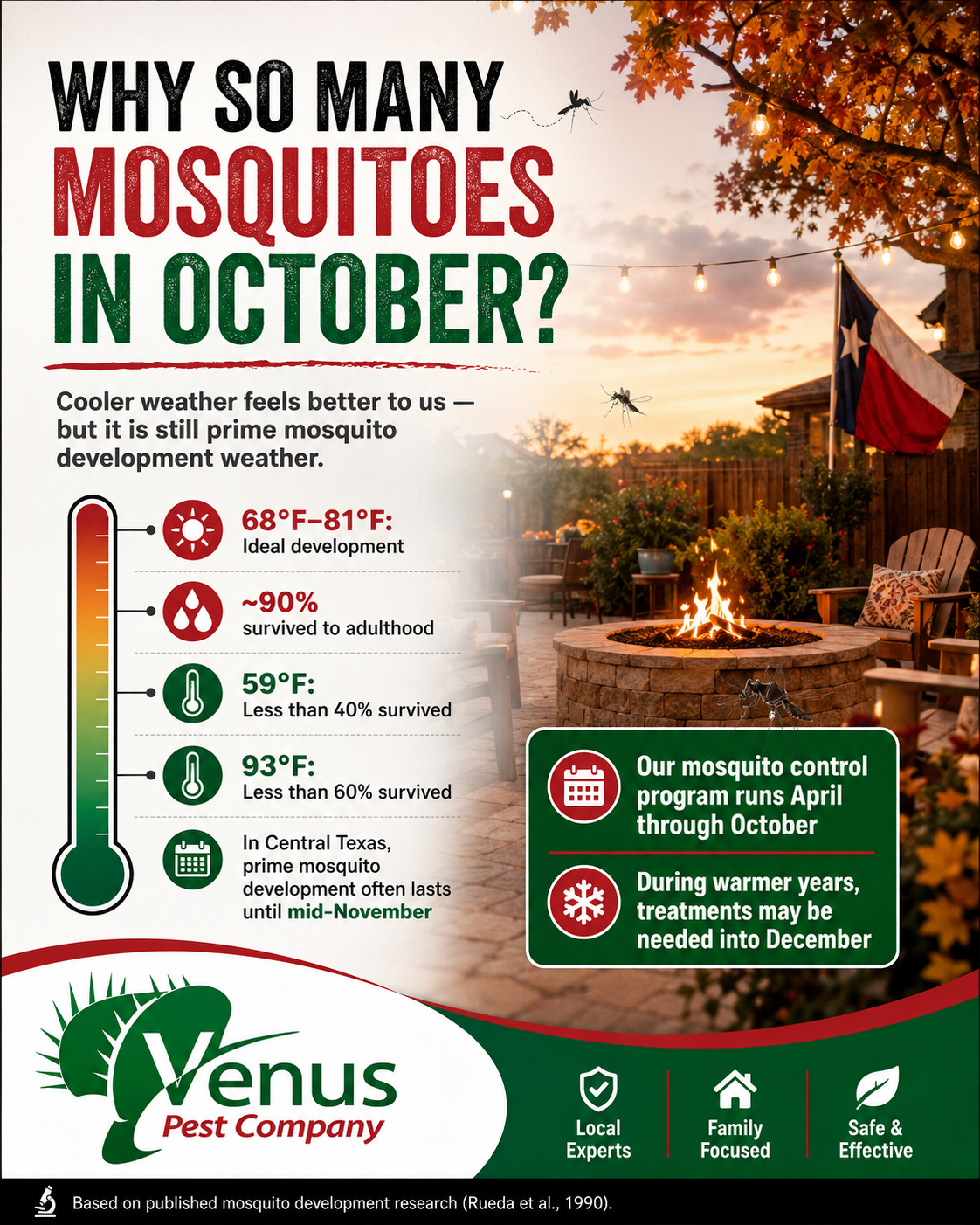
Mosquitoes in fall surprise people because cooler weather should mean fewer insects. Eventually, it does. The first pleasant weeks of fall around Bryan, College Station, and the rest of Brazos County often remain warm enough for mosquito development and activity. In fact, early fall temperatures may suit some mosquitoes better than the extreme heat of midsummer.
That is why Venus Pest Company often receives a new wave of mosquito calls just as everyone wants to spend more time outside.
October Weather Feels Better to Mosquitoes Too
Mosquitoes do not regulate their body temperature the way people do. The temperature around them affects how quickly they develop, how active they become, and how well they survive.
A change from 100 degrees to the upper 70s feels like a major seasonal shift to us. It does not create winter conditions for a mosquito. Warm afternoons, mild nights, humidity, and available water can keep the life cycle moving.
Extreme heat does not automatically help mosquitoes. Shallow water can become very hot, dry out, or turn into a poor larval habitat. Adults also lose water and seek cool, shaded places during the hottest part of the day. Moderate fall weather can remove some of that heat stress while leaving plenty of warmth for development.
The Temperature Research Explains the Fall Surge
The original version of this article cited a useful 1990 laboratory study by L. M. Rueda, K. J. Patel, R. C. Axtell, and R. E. Stinner. The researchers studied the southern house mosquito, Culex quinquefasciatus, and the yellow fever mosquito, Aedes aegypti, at six constant temperatures.
The published study in the Journal of Medical Entomology found that southern house mosquito survival from egg hatch to adult emergence reached 85 to 90 percent between 68 and 86 degrees Fahrenheit. Survival dropped to 38 percent at 59 degrees and 42 percent at 93 degrees.
The yellow fever mosquito followed a somewhat different pattern, which is an important reminder that mosquito species do not all respond alike. Its survival reached 92 percent at 68 degrees and 90 percent at about 81 degrees. Only 3 percent survived to adulthood at 59 degrees in that study.
Laboratory temperatures remain constant, while a Brazos Valley yard warms and cools every day. The study does not predict the exact number of mosquitoes in a particular backyard. It does show why a comfortable October afternoon can still fall within a highly favorable range for mosquito development.
Rain Can Produce Another Generation
Temperature is only part of the story. Mosquito eggs, larvae, and pupae depend on water. A fall rain can fill plant saucers, toys, buckets, clogged gutters, tarps, corrugated drainpipe, and low places around a yard.
Some mosquito eggs wait on the walls of containers until water covers them. The CDC explains that Aedes eggs can survive dry conditions for months. Rain or irrigation can flood those eggs and start a new generation.
Other mosquitoes lay eggs directly on standing water. Southern house mosquitoes often use stagnant water with organic material. Storm drains, neglected pools, ditches, birdbaths, and containers can all contribute. Under favorable conditions, development from egg to adult may take little more than a week.
That creates a delay people often miss. Mosquito numbers may jump several days after a rain, even if the weather stayed dry during the week when the biting became noticeable.
More Time Outside Means More Encounters
Fall weather changes human behavior too. During August, many Brazos Valley residents retreat indoors during the hottest part of the day. By October, they stay outside longer and spend more time outdoors near dusk.
That overlaps with the activity period of several mosquitoes. Southern house mosquitoes generally become most active from dusk through dawn. Asian tiger mosquitoes and some other container breeders often bite during the day. The mosquito population may have increased, but our increased time outside also makes the problem much more obvious.
This distinction matters. A sudden rise in calls does not always mean the mosquito population doubled overnight. Better weather may simply bring more people and mosquitoes into the same yard at the same time.
One Cool Front Does Not End Mosquito Season
A cool morning can slow mosquito activity. It rarely ends the season by itself. Protected adults can rest in shrubs, groundcover, drainage systems, garages, and other sheltered places. Warm afternoons may bring them back out.
The pattern usually continues until sustained cold weather interrupts development and adult activity. Around Brazos County, that often happens well after the calendar says fall has begun. A warm year can stretch noticeable mosquito activity into November or even December.
This is also why one cold front may create a quiet week without solving the underlying problem. If warm weather returns and water remains available, mosquito activity can return with it.
Different Mosquitoes Create Different Problems
The word mosquito covers many species with different habits. Some develop in small containers close to homes. Others come from ditches, floodwater, storm drains, or larger bodies of water. Some bite during the day, while others become active after sunset.
The southern house mosquito deserves attention in our area because it can transmit West Nile virus. Our article about why West Nile virus peaks in August explains that seasonal pattern in more detail. High mosquito activity in October does not mean October carries the same disease risk as August. Bite counts alone cannot tell us whether mosquitoes carry a virus.
Correct identification and knowledge of the source still matter. The Venus mosquito guide covers mosquito biology, common breeding sites, and the differences homeowners are most likely to notice.
What Homeowners Can Do About Fall Mosquitoes
Start with water. Walk the property after rain or irrigation and look for anything that holds it. Empty containers, clean birdbaths and pet bowls, correct clogged gutters, and turn over items that do not need to hold water. Scrubbing containers matters because some eggs remain attached above the old waterline.
Look beyond obvious buckets. Water can hide in the folds of a tarp, the base of a patio umbrella, a wheelbarrow, a child’s toy, a plant saucer, or a section of corrugated drainpipe. Our guide to pest conducive conditions explains how standing water and heavy vegetation can support mosquito activity around a property.
Removing water on one property may not eliminate every mosquito. Some species can fly in from neighboring yards or larger breeding areas. Still, source reduction removes the mosquitoes a property produces and gives any broader mosquito program a better chance to work.
Why Our Mosquito Season Runs Through October
Venus Pest Company schedules its regular mosquito control program from April through October because those months cover the main period of mosquito pressure in the Brazos Valley. The service is available on its own and through our YardGard and TotalGard plans.
April and October often bring the most pleasant outdoor weather of the year. They can also remain warm enough for active mosquitoes. Ending a program at Labor Day would ignore a large part of the season when customers actually want to use their yards.
Warm years do not follow a perfect calendar. We sometimes receive requests well beyond October. In those cases, we consider current mosquito activity, weather, water, vegetation, and how people use the property. Commercial properties may need a different schedule, so we evaluate those through our commercial pest control service.
Venus has served Bryan, College Station, and Brazos County since 2001. Our mosquito program grew from Dr. Scott Lingren’s experience using mist blowers in agricultural tree and vine research, adapted for the places adult mosquitoes rest around local properties.
If fall mosquitoes keep you from enjoying the yard, call or text 979-774-0486, or email [email protected].
Common Questions About Mosquitoes in Fall
Why do mosquitoes seem worse when fall begins?
Early fall often brings moderate temperatures, available water, and more people spending time outside. Those conditions can support mosquito development while making biting activity more noticeable.
What temperature stops mosquitoes?
There is no single temperature that immediately stops every species. Cool weather slows activity and development, but sheltered adults may become active again when afternoons warm. Sustained cold matters more than one chilly morning.
Can extreme summer heat reduce mosquito survival?
Yes. Excessive heat can reduce survival, dry out shallow habitats, and force adult mosquitoes into protected resting areas. Moderate fall temperatures may create better conditions for some species.
How long after rain do mosquito numbers increase?
The timing depends on temperature and species. Under favorable conditions, some mosquitoes can develop from egg to adult in roughly 7 to 10 days. That is why a population increase may appear about a week after rain.
Do mosquitoes breed in grass and shrubs?
No. The immature stages require water. Adult mosquitoes often rest in shaded grass, shrubs, groundcover, and other humid vegetation, which can make those areas appear to be the source.
Does one cold front kill all the mosquitoes?
Usually not. Activity may fall sharply during the cold period, but protected adults and dormant eggs can remain. Mosquitoes may return when warm weather does.
Can mosquitoes remain active into November in Brazos County?
Yes. Warm afternoons and mild nights can support activity into November. Venus has even received service requests during December in unusually warm years.
What is the most useful thing to check around my yard?
Look for standing water after every rain and irrigation cycle. Small containers often produce mosquitoes close to the places where people sit, play, and work.