
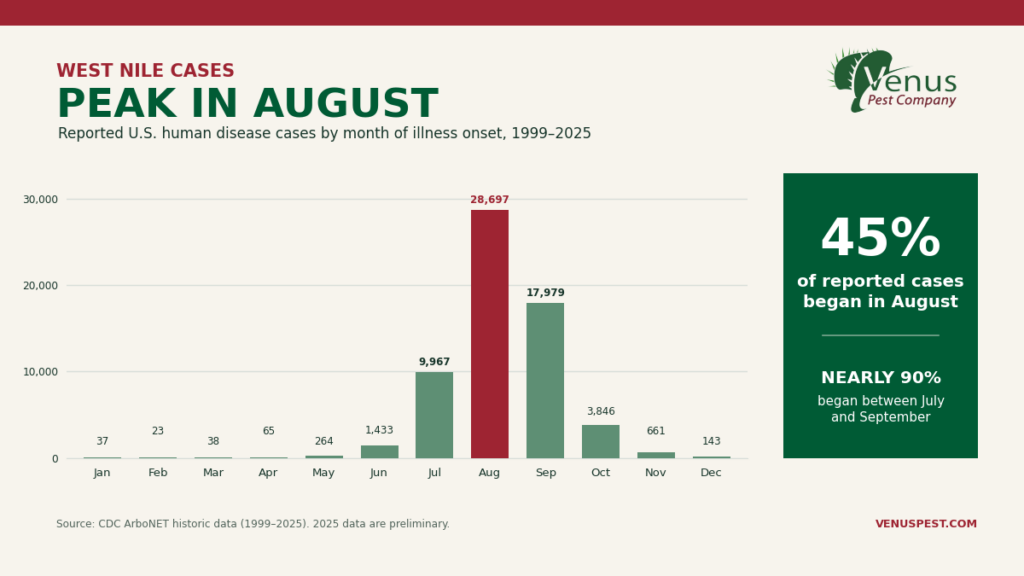
West Nile virus peaks in August across Central Texas, and College Station, Bryan, and the rest of the Brazos Valley are right in the middle of it. I’ve been watching mosquito patterns and disease data around here long enough to know the rhythm, and August is consistently the month when everything lines up for higher risk.
How the Virus Actually Works (Without the Medical Textbook)
West Nile is a bird-mosquito cycle that occasionally spills over to people and horses. Certain Culex mosquitoes—especially the southern house mosquito, Culex quinquefasciatus—pick up the virus from infected birds. After a short incubation period, those mosquitoes can pass it along when they bite.
Most people who get bitten by an infected mosquito never know it. About 80% have no symptoms at all. Roughly 20% get the classic West Nile fever: fever, headache, body aches, joint pain, sometimes nausea or fatigue. A very small percentage—less than 1%—develop the serious neuroinvasive form that can affect the brain and spinal cord. That’s the version that can leave people with lasting weakness, paralysis, or worse.
The virus has been established in Texas since 2002. It’s not new, and it’s not going away. What changes is the intensity from year to year and, more importantly, the time of year it hits hardest.
Why August?
A few things have to line up, and they usually do right about now.
First, the virus needs time to amplify. In spring and early summer the cycle is building in birds and mosquitoes. By late July and into August, a higher percentage of the mosquitoes out there are carrying it. More infected mosquitoes means more chances of a human bite that matters.
Second, our weather cooperates a little too well. Warm nights, leftover moisture from earlier rains, and those classic Central Texas evenings keep Culex mosquitoes active and breeding. These particular mosquitoes like the night shift—dusk through the early morning hours—which happens to be when a lot of us are still outside watering plants, walking the dog, or sitting on the patio.
Third, mosquito numbers themselves tend to be high. The life cycle speeds up in during the warm nights, and any standing water left around becomes a factory. Flowerpot saucers, clogged gutters, birdbaths that haven’t been dumped, low spots in the yard—none of it looks like much until you realize how many mosquitoes one neglected container can produce.
State data from the Texas Department of State Health Services and years of local surveillance in Brazos County back this up. July and August are the peak risk months for human cases. The big 2012 outbreak in Texas peaked in mid-August. Local trapping programs here routinely start finding positive mosquito pools in July, and the numbers climb into August.
Local Stories That Stick With You
This isn’t just abstract data. People in our own community have lived it.
In 2024, a 78-year-old College Station man was bitten twice by mosquitoes while working near his garage. He was a cancer survivor who had been active. Within days he had body aches, severe joint pain, weakness, and fever. He ended up hospitalized and had to relearn how to walk. His daughter shared the story publicly so others would take the risk seriously. Long recovery is common with the more severe cases.
Another well-known local case involved a former Bryan police officer. In 2006, he woke up with a stiff neck that progressed over several days into full paralysis from the chest down. He spent months in the hospital and years in rehab. He still walks with a cane and has been open about his experience in interviews over the years, including recent ones, encouraging people to speak up if symptoms don’t feel like a regular flu.
These aren’t scare stories. They’re real people from right here who went from normal daily life to a long, difficult recovery because of a mosquito bite during peak season. That should get our attention.
What You Can Actually Do
You don’t have to live in a bubble. A few practical steps make a real difference:
– Dump standing water every few days. Be ruthless about it.
– Use an EPA-registered repellent (DEET, picaridin, or oil of lemon eucalyptus) when you’re outside, especially at dusk and dawn.
– Wear long sleeves and pants if you’re going to be out during peak mosquito hours. Light colors help.
– Keep window and door screens in good shape.
– If you have a yard that stays damp or a lot of vegetation, consider professional mosquito control timed for this part of the season.
Source reduction—getting rid of the breeding sites—is still the most effective long-term move. Everything else works better when the mosquitoes have fewer places to start.
How We Handle It at Venus Pest
We’ve been dealing with mosquitoes in this area for a long time. Our approach is straightforward: inspect the property for breeding sites, treat the ones that can’t be eliminated with Mosquito Dunks and apply barrier treatments monthly to the vegetation and harborage areas where adult mosquitoes rest.
We don’t pretend mosquito control is magic. It’s biology plus consistent work. When customers stay on a reasonable schedule during peak season and we knock down the breeding pressure, the difference is noticeable. We usually achieve 85%+ reduction in bites for 3 weeks after a treatment.