Find that source and the problem ends. Kill only the larvae you can see, and the source may continue producing more.
Homes across Bryan, College Station, and Brazos County provide plenty of opportunities for flies during warm weather. One spilled food container, a dirty trash-can seam, or a dead rodent hidden in a wall can support a surprisingly large number of larvae.
Maggots Are Young Flies
“Maggot” is the common name for the legless larval stage of many flies. It does not identify one species. House flies, blow flies, flesh flies, soldier flies, and other groups produce larvae that people may call maggots.
Most begin as eggs placed on moist food that the larvae can consume immediately after hatching. Flesh flies differ because the female deposits live larvae rather than laying eggs at the source. Either route can produce a sudden mass of pale, crawling larvae.
The adult fly provides an important clue. Dull gray flies may point toward house flies or flesh flies. Metallic green, blue, or copper flies usually belong to the blow-fly group and often indicate meat waste or a dead animal.
Why They Crawl Away From the Source
People often search the exact spot where they find the larvae and see nothing that could feed them. That happens because mature maggots leave the wet breeding material and crawl toward a drier, protected place to pupate.
The University of Minnesota Extension fly guide explains that fly larvae search for a dry location after completing development. Blow-fly maggots can move through gaps in walls or ceilings and drop onto a floor after leaving a hidden carcass.
That movement can put them several feet from the source. Larvae along a baseboard may have emerged from beneath an appliance. Maggots falling from a ceiling opening may have developed on a dead animal in the attic or wall. A trail across the floor often points backward toward the place they left.
Start With the Trash Can
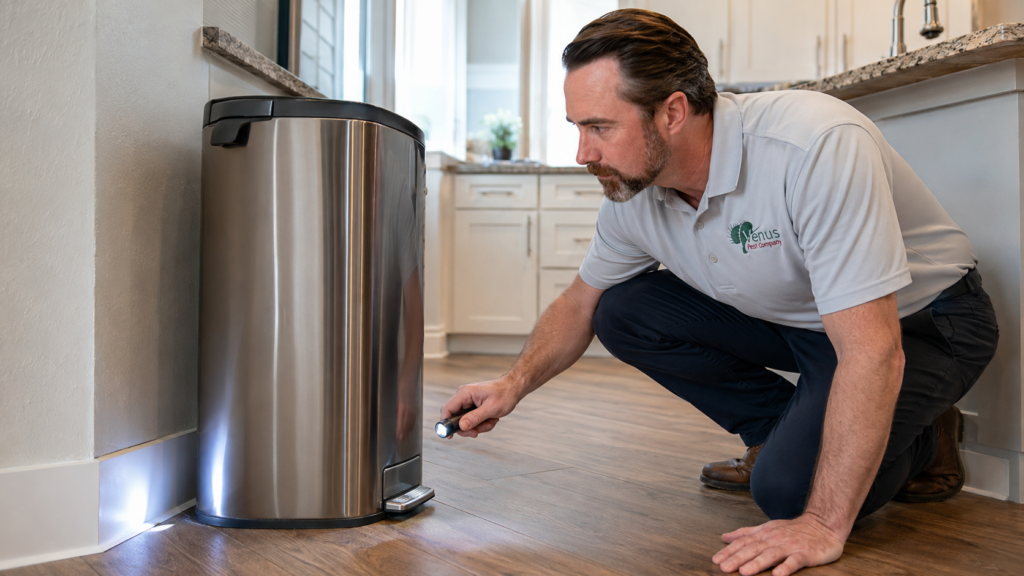
Kitchen trash remains the most common source. A bag can leak meat juice, gravy, pet-food residue, or another liquid into the bottom of the can. Food may lodge between the bag and container where no one sees it.
The problem becomes noticeable when someone lifts the bag and finds larvae underneath or sees them crawling onto the floor. Replacing the liner does not remove residue trapped in the bottom rim, handle openings, lid hinge, or floor beneath the container.
Outdoor carts create the same problem on a larger scale. Loose garbage, torn bags, pet waste, and food residue can support continuous breeding during hot weather. Adult flies move between the outdoor cart, doors, patios, and indoor waste containers.
Forgotten Food Can Hide Almost Anywhere
One piece of food can support more larvae than people expect. Potatoes, onions, meat scraps, pet food, spilled beverages, and food carried away by children can disappear behind stored items or beneath furniture.
Look beneath and behind appliances, pantry shelving, rolling carts, recycling containers, pet-feeding stations, and furniture near eating areas. Check lunch bags, reusable grocery bags, coolers, and boxes that recently held food.
A pristine room does not rule out a food source. In our experience with small-fly investigations, the difficult cases often involve one forgotten item hidden in an otherwise immaculate home. The search succeeds when someone stops judging the overall cleanliness and starts following the insects.
A Dead Animal Creates a Different Pattern
A roof rat, house mouse, bird, squirrel, or other animal can die in an attic, chimney, wall void, crawlspace, or inaccessible gap. Blow flies and flesh flies locate that material quickly.
The first clue may be odor. Adult flies may then appear at windows, followed by mature larvae moving away from the carcass. In some cases, the maggots show up before the homeowner discovers where the animal died.
Location helps narrow the search. Larvae dropping from a ceiling fixture suggest a source above the room. Activity near a fireplace may point toward a chimney. A concentrated line emerging beneath a baseboard can indicate a wall void or a carcass beneath cabinetry.
Our roof-rat guide and house-mouse guide explain how these rodents enter buildings and where their activity commonly appears. Removing the carcass solves the immediate breeding source when it can be reached. Closing entry points helps prevent the next animal from creating the same problem.
Pet Areas, Compost, and Other Sources
Animal waste, wet pet food, dirty bedding, and material caught beneath kennels can support flies. Check areas where food and moisture remain long enough for larvae to develop.
Compost piles should decompose material, so larvae there do not automatically indicate a problem. They become a household concern when compost sits too close to an entry or receives meat and other materials that attract nuisance flies.
Dark, leathery larvae near compost or decaying vegetation may be soldier flies rather than the pale larvae people usually picture. The Texas A&M soldier-fly guide notes that mature larvae may wander several yards before pupating. They are harmless, but their presence still points toward wet, decaying organic material.
Damaged sewage lines and heavily contaminated drains can support some fly larvae, although the small larvae associated with drain flies usually create a different problem from a mass of large house-fly or blow-fly maggots. Correct fly identification prevents an unnecessary search in the wrong place.
What Their Location Tells You
Maggots clustered beneath a kitchen trash bag usually came from food residue in or around that container. Larvae spreading from beneath a refrigerator or stove point toward hidden food or another organic source under the appliance.
Activity at a ceiling, wall opening, fireplace, or attic access raises concern about a dead animal. Large numbers of metallic adult flies strengthen that suspicion.
Dark, flattened larvae traveling across a patio or garage may be mature soldier-fly larvae leaving compost, spilled feed, or decaying vegetation. Tiny larvae inside drain film belong to another fly group and require inspection of the plumbing environment.
The larvae may not sit on their food source when you find them. Treat their direction and concentration as evidence rather than assuming the floor itself caused the problem.
Removing the Source Ends the Life Cycle
Remove spoiled food, leaking garbage, animal waste, or another accessible source. Clean the container, floor, seams, and nearby surfaces so no moist residue remains. If a dead animal is accessible, remove it and inspect the area for contamination.
Vacuum or collect wandering larvae and pupae after addressing the source. Empty the vacuum outdoors into a sealed bag. Adult flies already developing in pupal cases may continue emerging for a short period, so a few later flies do not always mean the source remains active.
An inaccessible carcass may produce a temporary wave that ends after the larvae consume the available material. Odor, staining, sanitation concerns, or continued activity can still justify professional investigation.
We do not publish pesticide products, active ingredients, rates, mixtures, or homeowner application recommendations. Surface treatment does not remove a trash leak, dead rodent, or forgotten food item. Finding and correcting the breeding site provides the lasting answer.
When a Professional Inspection Helps
Call for help when larvae continue appearing after obvious food and garbage sources have been removed. Activity from ceilings, wall voids, attics, crawlspaces, commercial kitchens, or inaccessible areas often requires a broader inspection.
Venus can identify the type of larva or adult fly, interpret where it appears, and inspect for plausible sources. Rodent removal, exclusion, sanitation, building repair, or another service may require separate work depending on what we find.
For restaurants and other businesses, the search may include waste flow, food-storage areas, floor-wall joints, equipment gaps, dumpsters, plumbing, and delivery practices. Our commercial pest-control service builds the response around the actual breeding source and operating environment.
Call or text 979-774-0486, email [email protected], or request an inspection. Save several larvae or adult flies in a sealed container when possible. Identification can shorten the search considerably.
Questions About Maggots Indoors
Does finding maggots mean my house is dirty?
No. A single hidden food item, leaking trash bag, or dead animal can support larvae in an otherwise clean home. The location and source matter more than the overall appearance of the house.
Can maggots come out of the floor?
They do not develop from flooring. Mature larvae may crawl from beneath an appliance, wall gap, cabinet, or baseboard and then cross the floor while searching for a dry place to pupate.
Why are they falling from the ceiling?
A dead bird, rodent, or other animal may be present in the attic, ceiling, chimney, or wall void. Mature larvae can leave the carcass and move through small openings.
Why did they appear after I removed the trash?
Some larvae may have already crawled away from the bag, while residue remains in the can or on the floor. Clean the entire container and surrounding area rather than replacing only the liner.
Are all maggots house-fly larvae?
No. Blow flies, flesh flies, soldier flies, and many other fly groups have maggot-like larvae. Adult flies, larval appearance, location, and food source help identify the group.
Will killing the visible larvae solve the problem?
Not by itself. More eggs, larvae, or pupae may remain around the breeding material. Removing the organic source breaks the life cycle.
How long will flies continue emerging?
Adults may emerge from pupae that completed development before the source was removed. Activity should decline as those remaining stages finish. Continued or increasing numbers suggest that a source may still exist.
Does regular pest control include this problem?
Maggot and fly situations depend on the source. Identification and inspection determine whether the answer involves sanitation, rodent or wildlife removal, exclusion, plumbing repair, or a separately quoted fly service.