
Pest Expert Overview: Roof Rats in Bryan & College Station
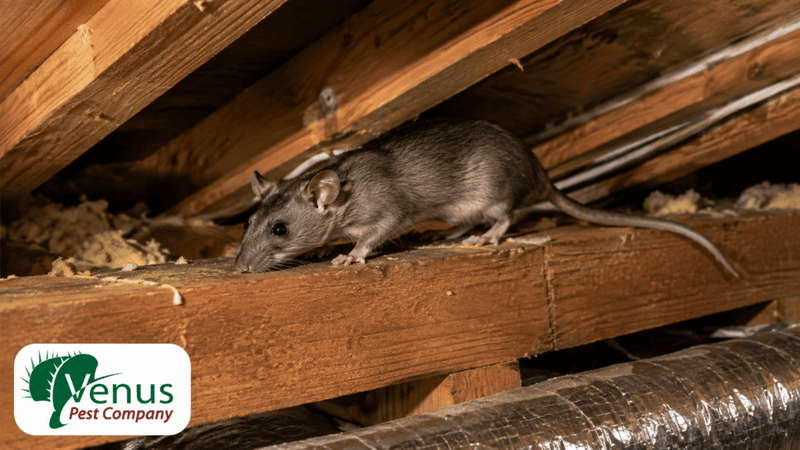
Roof rats earn that disconnect. They are nocturnal, cautious, quiet when they need to be, and remarkably comfortable moving above our normal line of sight. A population may travel through trees, across fence tops, along utility lines, and into an attic while the people below never see an entire animal.
Most homeowners discover the evidence first. They hear movement over the ceiling, find droppings, notice gnawing, or catch a quick blur near a wall. By the time someone sees a roof rat clearly, it may already know the property better than they do.
Venus Pest Company provides rodent control throughout Bryan, College Station, and Brazos County. We approach the problem through identification, trapping, exclusion, outdoor population management, and continued monitoring. Killing one rat without closing the building doesn’t finish the job.
The Animal You Usually Hear Before You See
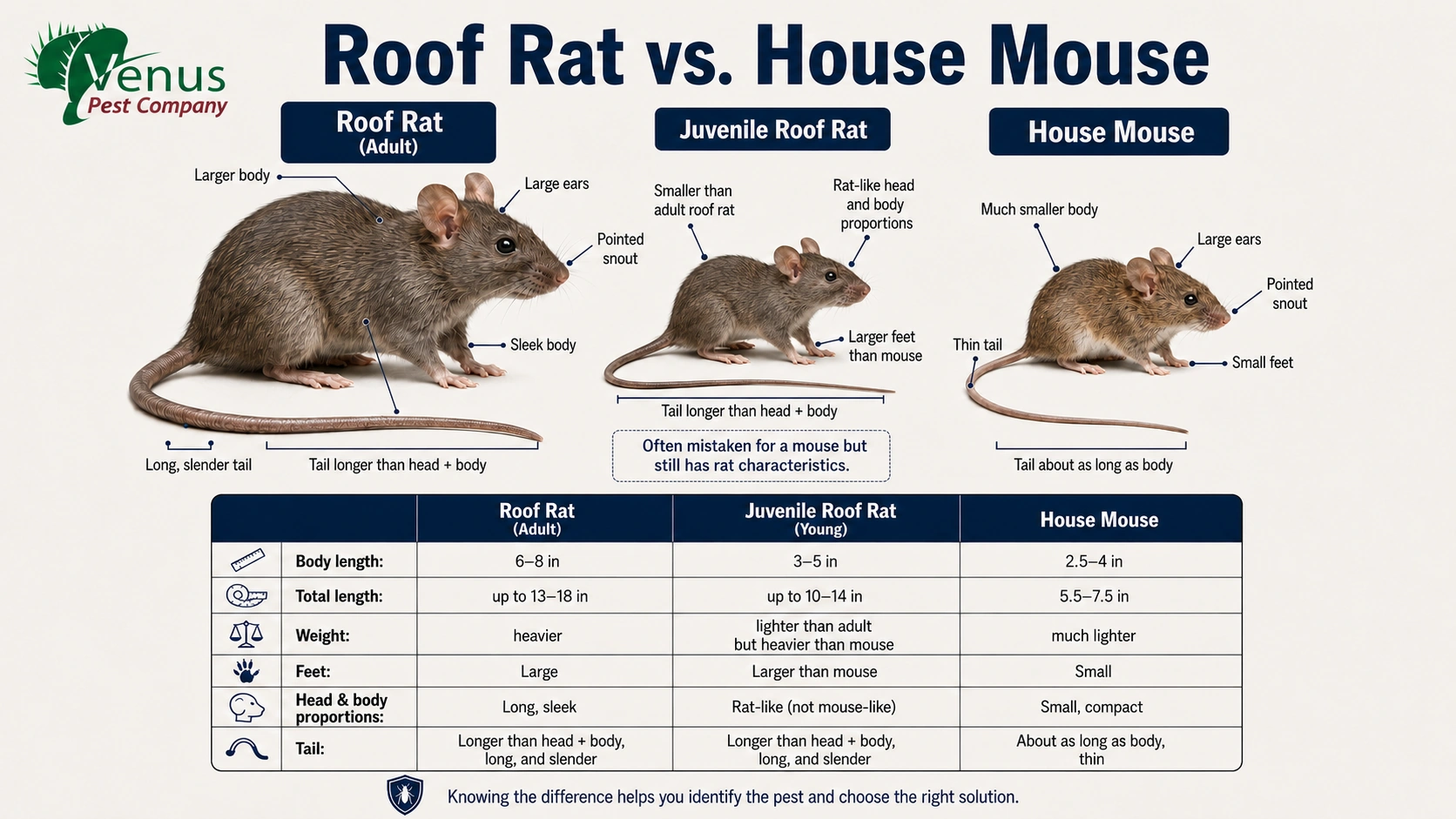
Roof rats, Rattus rattus, are also called black rats or ship rats. Despite the black rat name, their fur may look dark brown, gray, or nearly black. Adults have slender bodies, pointed noses, large ears, and long, mostly hairless tails.
That tail provides the easiest comparison with a Norway rat. A roof rat’s tail generally extends longer than its head and body combined. A Norway rat looks heavier and stockier, with a blunter nose, smaller ears, and a shorter tail.
Young roof rats can also be mistaken for mice. Body size alone won’t always settle the identification. The proportions, droppings, travel routes, and location of the activity provide a more dependable answer.
Roof rats prefer elevated nesting and travel areas. They may live in trees, dense vines, sheds, attics, wall voids, soffits, or ceilings. The University of Arizona Cooperative Extension describes them as agile runners and climbers that readily scale trees and rough vertical surfaces.
The Snake Tail in My Shed
Shortly after I started Venus, I was cleaning my backyard shed when I noticed what looked like a little snake tail disappearing behind something. Snakes don’t scare me, so I reached toward it.
At the last second, I realized it wasn’t a snake tail. It was a rat tail.
I was mortified. I went from casually moving an animal out of the way to trying to catch a roof rat in a cluttered shed. The rat had every advantage. It could climb, change direction, squeeze behind stored items, and disappear into spaces that didn’t seem large enough to hold it. I never caught it that day.
That encounter taught me something I have seen repeatedly since: a roof rat doesn’t move through a building the way we expect a ground animal to move. It uses the entire three dimensional space. Shelves, rafters, pipes, wall corners, stored boxes, and overhead framing all become travel routes.
Their Climbing Ability Changes the Inspection
People often search the floor for a rat that entered through the roof. They place all their attention near baseboards while the active runway sits above cabinets, along attic framing, or behind a soffit.
I once watched a roof rat “Jackie Chan” its way up the inside corner behind a cooktop in a gas station food preparation area. It bounced between the two walls and climbed straight out of sight. That movement looked almost impossible until the rat did it.
Another roof rat can live in a neighbor’s landscaping, run along the shared fence, climb a tree, and enter your roofline. Research summarized by the Internet Center for Wildlife Damage Management notes that roof rats may travel 100 to 300 feet for food and commonly use fences or overhead lines.
An effective inspection therefore follows the rat’s likely route in three dimensions. We look at fence connections, tree limbs, vines, utility lines, rough brick, gutter downspouts, roof returns, soffits, vents, pipe penetrations, and construction gaps. A walk around the foundation at ground level won’t reveal every opportunity.
A branch does not have to touch the roof to help a rat reach it. Roof rats can climb the branch and jump the final gap. They may also reach a roof edge by climbing a textured wall, downspout, or inside corner. We inspect the entire roofline, including elevated vents and chimney details, even when no obvious route reaches them from the ground.
Signs That Deserve Attention
Scratching, scampering, or gnawing above the ceiling often begins after dark. Roof rats typically leave the nest shortly after sunset and return before morning. Sound can travel through framing, so the place where you hear activity may not sit directly beneath the nest or entry point.
Droppings provide another common clue. Roof rat droppings are dark, elongated, and often somewhat pointed. Their size overlaps with droppings from other animals, so we consider location and surrounding evidence instead of identifying them from one pellet.
Look for greasy rub marks along repeated routes, gnawed wiring or food packages, damaged insulation, nesting material, hollowed fruit, and food moved into hidden caches. Fresh evidence matters more than an old dropping in a dusty attic. When safely cleaned evidence returns, the structure still has active rodent traffic.
Occasional noises don’t always mean rats. Squirrels tend to make more noise during daylight. Mice create lighter activity and smaller droppings. Tree limbs can scrape a roof, and expansion noises can come from the building itself. Inspection keeps an unsettling sound from turning into an incorrect treatment.
If You Think You Saw Something, You Probably Did
Experience has taught me not to dismiss a brief movement at the edge of my vision. If you genuinely think something skittered behind an appliance or through a doorway, investigate it.
When I first moved into my current house, I thought I saw something cross near the laundry room. I couldn’t prove it, but the movement looked wrong. I set every appropriate trap I had on hand and started a movie.
About 15 minutes later, the thunderous clap of a snap trap nearly shot me into the ceiling. Yes, my new house came preinfested with a roof rat.
That was the only rat we found inside, but my neighbors and I have seen plenty running along the fence tops outside. The distinction matters. Roof rats living in a neighborhood don’t automatically mean every house has an indoor infestation. A home becomes part of the problem when an opening gives them access to protected shelter.
Roof Rat Droppings or Gecko Droppings?
Many calls about supposed rat droppings turn out to involve Mediterranean house geckos. Both animals may leave dark, elongated waste near walls, cabinets, garages, or storage areas.
Gecko droppings usually have a distinct white or cream colored tip. That pale section is urate. Rat droppings normally look uniformly dark and tend to appear with additional evidence such as gnawing, rub marks, nesting material, or a repeated pattern along a runway.
Our gecko poop versus rat poop guide gives homeowners a close comparison. A white tip strongly favors a gecko, but old or broken droppings may lose the most useful piece. When the identification remains uncertain, inspect the surrounding area before assuming a rat has entered the house.
How They Enter an Attic
A rat can enter through an opening about half an inch wide. The gap doesn’t need to look like a hole. A lifted roof return, damaged vent screen, open construction joint, loose soffit, or space around a pipe may provide enough room.
Roof rats also gnaw exposed edges to enlarge marginal openings. Materials that look solid from the ground may have separated with age, weather, repairs, or roof movement.
The entry point may sit far from the indoor evidence. A rat can enter at one roof corner, cross the attic, descend through a wall void, and appear near the kitchen. Sealing the opening nearest the sighting won’t help if that opening lies inside the travel route rather than at the exterior boundary.
This is why exclusion requires a full exterior and roofline inspection. A low opening may attract immediate attention, but a small defect above a porch roof, beside a chimney, or behind a gutter can provide the actual entrance. Texas A&M’s rodent IPM guidance places exclusion, sanitation, and habitat modification at the center of rat management.
Food May Be Several Yards Away
Roof rats eat a broad diet but often prefer fruit, nuts, seeds, and other plant material. They also eat pet food, bird seed, insects, snails, slugs, stored food, and whatever a commercial kitchen or trash area makes available.
A rat doesn’t need to eat inside the house where it sleeps. It may nest in an attic, feed from a neighbor’s fruit tree, drink from an outdoor source, and use several fence lines along the way. That range can make one property look spotless while rats remain active around it.
Fallen fruit, accessible pet food, bird feeders, open compost, poorly closed trash containers, and dense vegetation can support local populations. Correcting those conditions reduces pressure, but it doesn’t replace trapping and exclusion when rats already occupy the structure.
Damage and Contamination
Rodent incisors grow continuously, so rats gnaw throughout their lives. Inside a house, that behavior can damage wiring, ductwork, plastic, stored belongings, wood, and insulation. Nesting and repeated travel may compress insulation or contaminate it with urine and droppings.
Food contamination creates another concern. A rat that moves through an attic, trash area, pet food bowl, and kitchen carries material between those environments. Rodents may spread disease directly through urine, droppings, saliva, bites, or contaminated food, and indirectly through fleas, ticks, or mites.
That doesn’t mean every rat carries every disease associated with rodents. It means wild rodent waste deserves careful handling and an active infestation deserves control. The CDC’s rodent guidance explains the health risks without requiring homeowners to panic over a single dropping.
Clean Droppings Without Making Dust
Don’t sweep or vacuum dry rodent droppings. That can place contaminated particles into the air. Wear gloves, thoroughly wet the material with a household product labeled as a disinfectant, allow the required contact time, and wipe it up with paper towels.
The CDC provides complete rodent cleanup instructions, including guidance for attics, sheds, dead rodents, contaminated insulation, and heavy infestations. Large accumulations or contamination in air ducts deserve professional evaluation.
Why One Captured Rat May Not End the Problem
A trap confirms that a rat used a particular route. It doesn’t prove that the building holds only one rat, and it doesn’t close the opening that allowed entry.
Roof rats also show strong caution toward new objects. Wildlife professionals call this neophobia. A rat may avoid a newly placed trap or station for several days, especially when it has another comfortable route to food. Trap location and patience matter as much as the device itself.
Once trapping reduces or removes the active indoor population, exclusion blocks the exterior entries. The order matters. Closing every visible opening without understanding current activity can trap an animal inside or drive it into another part of the structure.
Lasting control also considers rats living outside. A neighborhood population can test a repaired house again, which is why ongoing monitoring and maintenance strengthen the exclusion work.
Training Changed How We Approach Wildlife
Entomology gave me a strong foundation in pest biology and Integrated Pest Management, but roof rats aren’t insects. I am grateful that both Ken and I completed the National Wildlife Control Operators Association’s two day Wildlife Control Operator Training Course.
The course covers animal biology, inspection, handling, safety, and practical wildlife management. That training reinforced a lesson roof rats teach quickly: control comes from understanding how an animal uses a structure, not simply placing a device where a person hopes it will walk.
Before Venus, roof rats weren’t even on my personal radar. Today, inspections, trapping, exclusion, and lasting rodent prevention make up a major part of our work. Formal training and thousands of local observations now support each other.
Professional Roof Rat Control
Our comprehensive rodent program begins with an inspection. We identify the rodent, locate active areas, trace likely routes, document exterior openings, and note food, water, or shelter that may sustain the population.
We use indoor traps to remove rats from the structure. Tamper resistant stations outside help manage continuing exterior pressure. After we gain control of the indoor activity, we close accessible entry points with materials suited to the opening and construction.
The program includes visits twice a year to maintain the exterior stations and check for new vulnerabilities. Roofs move, materials age, trees grow, and contractors sometimes create new openings while installing utilities or completing repairs. A house that was tight several years ago may not remain tight forever.
Our HomeGard, HomeGard Plus, and TotalGard plans include exterior rodent prevention. An active roof rat infestation may require additional elimination work through our rodent program. Businesses can add rat and mouse coverage to a customized commercial pest control proposal.
We don’t provide pesticide names, active ingredients, rates, or homeowner rodenticide recommendations. Product selection and placement require attention to the label, property layout, children, pets, wildlife, and the possibility that a rat could die in an inaccessible space. The public article should explain the process without becoming a treatment recipe.
What You Can Change Around the Property
Trim branches and heavy vines away from the roof where practical. Inspect fence connections, roof edges, vents, soffits, utility penetrations, and repairs for gaps or gnawing. A rat can use an opening about half an inch wide, so small construction defects matter.
Store pet food, bird seed, grass seed, and pantry goods in containers that resist gnawing. Pick up fallen fruit and nuts. Keep trash and compost closed, clean food residue around outdoor cooking areas, and reduce dense clutter that provides protected travel or nesting space.
Don’t rely on a cat, ultrasonic device, or a few casually placed traps to secure the building. A roof rat’s route may never cross the floor where those traps sit. The combination of population control, exclusion, sanitation, and monitoring produces the durable result.
Local Help for Rats in the Attic
Venus Pest Company has served Bryan, College Station, and the rest of Brazos County since 2001. Dr. Scott Lingren developed our rodent program from formal training, field testing, and the roof rat behavior we see in Central Texas homes and businesses.
If you heard movement overhead, found droppings, or caught a quick glimpse near a wall, call or text 979-774-0486, email service@venuspest.com, or request service online. We will determine what is active, how it is using the property, and what needs to change to keep it outside.
Questions About Noises, Droppings, and Attics
How can I tell a roof rat from a mouse?
Adult roof rats have larger bodies, proportionally larger ears, pointed noses, and tails longer than their head and body combined. Young rats may resemble mice, so droppings, track size, gnawing, and travel routes help confirm the identification.
Why do I hear movement only at night?
Roof rats are primarily nocturnal. They usually leave protected nesting areas after sunset to feed and return before daylight. Rats can remain active during the day when populations are crowded or food becomes scarce, so timing alone doesn’t identify the animal.
Does one rat mean there are more?
One sighting proves that at least one rat used the area. It doesn’t reveal the full population. Inspection, monitoring, fresh droppings, and capture results help determine whether the building holds one animal or continuing activity.
Can they climb walls?
Yes. Roof rats climb trees, fences, pipes, utility lines, textured walls, and inside corners. Their balance and agility let them use elevated paths that homeowners rarely think to inspect.
How small an opening can a rat use?
A rat can enter through a gap about half an inch wide. Roofline defects, vent damage, loose soffits, and utility openings may provide access even when the house looks sealed from the ground.
Should I vacuum rat droppings?
No. The CDC advises against sweeping or vacuuming dry droppings because that can place contaminated particles into the air. Wear gloves, wet the waste thoroughly with a labeled household disinfectant, allow its required contact time, and wipe it up.
Why did the rat ignore my trap?
Roof rats often avoid unfamiliar objects. The trap may also sit away from the animal’s actual runway or compete with familiar food. Professional trapping uses evidence and travel routes rather than assuming a rat will explore every device.
What does Venus’s rodent program include?
The program combines inspection, indoor trapping, tamper resistant outdoor stations, exclusion of accessible entry points, and twice yearly monitoring. The exact work depends on the structure, active routes, and conditions found during inspection.