
Pest Expert Overview: Carpenter Ants in Bryan & College Station
Termites tend to work quietly. Carpenter ants advertise.
That doesn’t mean you should ignore them. Carpenter ants nest in wood and can enlarge their galleries over time. It does mean that ant evidence and termite evidence tell two different stories. The season, body shape, wings, frass, and way the insects move usually let us separate them quickly.
Venus Pest Company identifies and controls carpenter ants throughout Bryan, College Station, and Brazos County. Our local service history also gives us a seasonal clue that broad identification guides often miss.
The Ant Behind Many Termite Scares
The call often begins with a homeowner finding a pile of sawdust beneath a window frame, wall opening, or roofline. Sometimes large ants are walking nearby. In winter, a cluster of winged insects may suddenly appear at a window.
Those signs look serious because they are visible and connected with wood. Homeowners reasonably think termites first. In our area, carpenter ants often create the more dramatic evidence.
Carpenter ants belong to the genus Camponotus. Texas A&M records 18 species in Texas. Their size and color vary, but all carpenter ants share traits that distinguish them from termites and most other household ants.
The Texas A&M carpenter ant guide notes that southern species generally cause less structural damage than the carpenter ants found in northern and northwestern states. They often take advantage of existing cavities or damp, softened wood instead of excavating extensive galleries through sound lumber. An established colony still deserves attention, especially when moisture or repeated frass shows that the ants are nesting inside the structure.
January Ants and March Termites
Season gives us one of the best local clues. During more than two decades of Venus service in the Brazos Valley, we have only documented carpenter ant swarms in January and February. Our common subterranean termites usually swarm in March and April.
That timing isn’t a substitute for identification. An unusually warm winter, a heated building, or a different species can shift insect activity. Still, a house full of very large winged insects in January points us toward carpenter ants long before we put a specimen under magnification. A swarm during a warm, humid period in March or April makes subterranean termites more likely.
Texas A&M describes the broader carpenter ant swarming period as late winter and early spring. The narrower January and February window reflects what we have actually encountered around Bryan and College Station.
Why an Indoor Swarm Matters
Winged ants are reproductive males and females leaving a mature colony to mate and start new colonies. Hundreds may emerge during a short period, then collect around windows because they fly toward light.
A large indoor emergence usually means the colony occupies the building or a connected structural space. One winged ant near an open door tells us much less. It could have flown in from an outdoor colony.
Termite swarmers also gather at light, which explains much of the confusion. Save a few specimens or take close photographs before cleaning everything up. The wings break off easily, and an intact insect provides much better evidence than a blurry picture of a loose wing.
How to Identify Carpenter Ants
Carpenter ants rank among the largest ants around Texas homes, and the winged queens can reach about half an inch. The carpenter ant workers we encounter around Bryan and College Station are monomorphic. The colony does not produce the conspicuous major and minor worker forms people notice in fire ant colonies. Size alone still does not provide a dependable identification because different carpenter ant species and life stages can vary.
Fire ants show the obvious range of worker sizes among the household ants we routinely see here. Big headed ants produce two distinct worker forms, which entomologists describe as dimorphic, but we encounter them only rarely around the Brazos Valley.
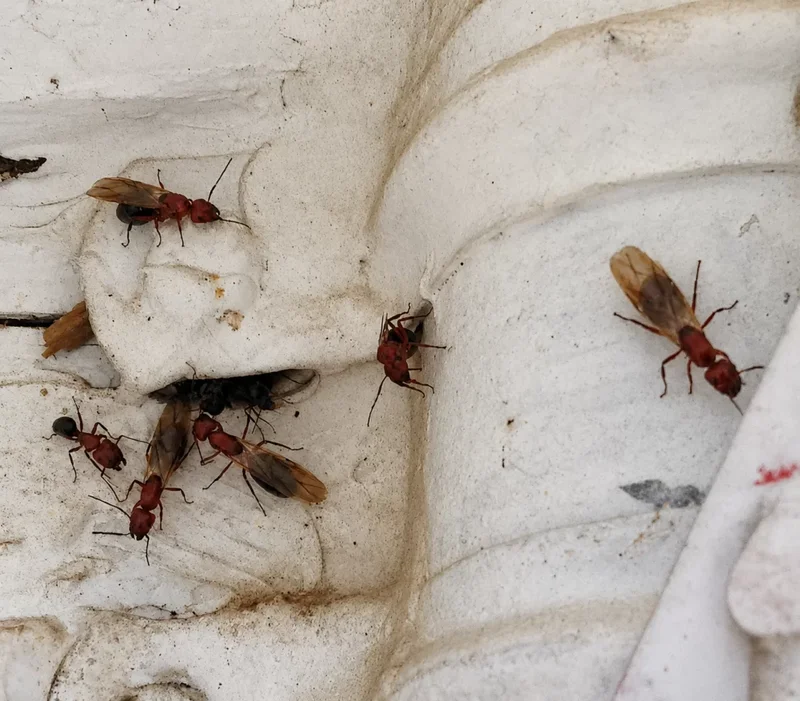
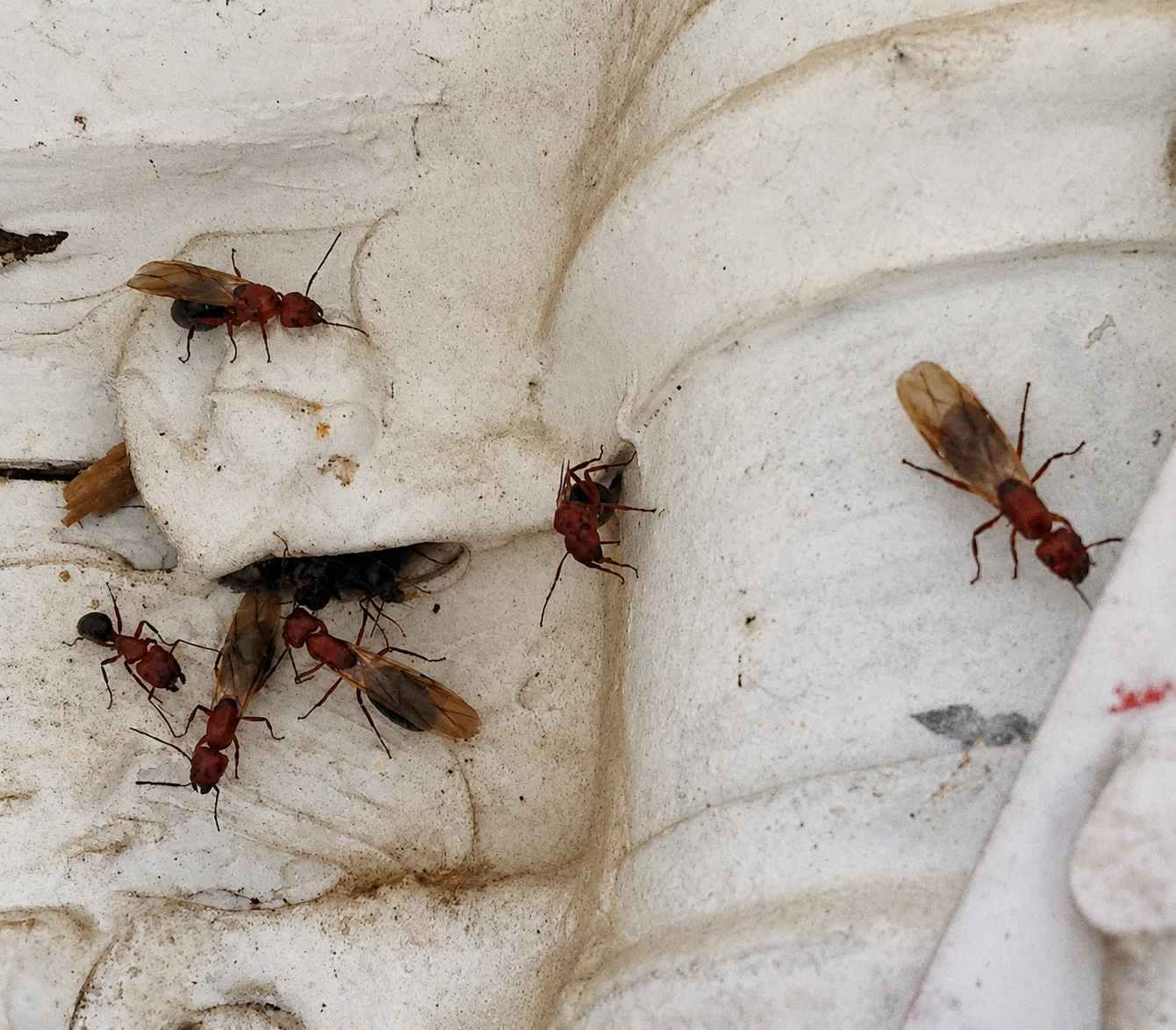
The species we most commonly find around College Station has a reddish brown head and thorax with a black abdomen. At a glance, it resembles an oversized fire ant. We also occasionally encounter solid black and reddish species.
Look at structure rather than color alone. Carpenter ants have elbowed antennae, a narrow waist with one node, and an evenly rounded thorax when viewed from the side. Workers have no wings. Reproductive males and females carry two pairs of wings, with the front pair longer than the rear pair.
They often forage after dark. A trail may run along a fence, tree limb, roof edge, utility line, or foundation before disappearing into a small structural opening. Their size makes them easier to follow than tiny household ants, but the visible trail may connect an indoor satellite nest with a parent colony outdoors.
Ant Swarmers Versus Termite Swarmers
The body provides a more reliable answer than the calendar.
Carpenter ant swarmers have a pinched waist, elbowed antennae, and front wings longer than their rear wings. Their dark bodies look distinctly segmented. They may walk around in the open after the swarm.
Termite swarmers have a broad waist, straight antennae, and four wings of approximately equal length. All four wings extend well beyond the body and detach easily. Wingless termite workers look pale and soft bodied, avoid light, and usually remain hidden in wood or soil tubes.
Our subterranean termite guide explains the mud tubes, swarm conditions, and hidden damage associated with the termites most often found here. Drywood termites leave hard fecal pellets, but they remain far less common across most of the Brazos Valley than subterranean termites.
What Frass Tells Us
Carpenter ants keep their galleries clean. Workers carry excavated wood, dead ants, insect fragments, and other debris to a small opening and push it outside the nest. That material forms a loose pile called frass.
The wood portion often looks like coarse sawdust or tiny shavings. Mixed insect pieces can give the pile a less uniform appearance. If fresh material returns after cleanup, a nearby nest remains active.
Frass can reveal a nest opening, but gravity and hidden wall spaces sometimes move it away from the actual gallery. Material emerging above a window may come from the header, wall void, soffit, or another cavity farther up. We follow the evidence instead of assuming the pile sits directly beneath the colony.
Subterranean termites don’t push sawdust from their galleries. They consume wood and typically leave mud tubes, damaged wood lined with soil, or shed swarmer wings. Drywood termite pellets look harder and more uniform than carpenter ant debris. When the evidence isn’t clear, an inspection beats guessing.
They Excavate Wood but Don’t Eat It
The name “carpenter ant” describes construction, not diet. These ants use powerful mandibles to remove wood and create smooth nesting galleries. They don’t digest the wood as termites do.
Carpenter ants eat insects and other sources of protein. They also seek plant nectar, fruit, household sweets, and honeydew produced by aphids and scale insects. Workers may travel a considerable distance from the nest, so ants at a kitchen counter don’t prove that the colony sits inside the kitchen wall.
The galleries usually follow softer portions of damp or damaged wood. Southern carpenter ants also use ready made cavities in hollow doors, wall voids, insulation, and structural gaps. Their ability to occupy an existing space helps explain why a colony may produce conspicuous frass without causing major structural damage.
Moisture Usually Starts the Story
Carpenter ant queens need a protected place to begin a colony. Damp wood near a roof leak, damaged window frame, plumbing problem, poorly ventilated area, or decaying tree gives them a favorable starting point.
Once established, ants may extend into adjacent dry material or move workers and developing ants into a satellite nest. Finding carpenter ants therefore raises two questions: Where is the colony, and what condition made that location useful?
The moisture problem can matter more to the building than the ant damage. A leaking roof or window may rot wood for years before the frass finally attracts attention. In that sense, carpenter ants sometimes act like an alarm for a condition that already needs repair.
Our conducive conditions guide explains how damp wood, heavy foliage, poor ventilation, and other property conditions support termites, ants, cockroaches, and additional pests.
Parent Colonies and Satellite Nests
The main colony often occupies a tree, stump, root, fence post, landscape timber, or other outdoor wood. It contains the queen, eggs, young larvae, and workers. The moisture in decaying wood helps support those vulnerable life stages.
As the population grows, workers may establish satellite nests in drier places. Wall voids, attics, insulation, hollow doors, roof spaces, and sound structural cavities can hold workers, older larvae, and pupae. Ants travel between those sites along regular trails.
This arrangement can make an indoor infestation seem unpredictable. Workers disappear into one area but emerge somewhere else. Treating the first visible opening may miss the outdoor parent colony or another satellite nest.
How Much Damage Can They Cause?
Texas carpenter ants usually cause less damage than termites. They don’t consume wood, and many local colonies use cavities or wood that moisture already softened. We often find superficial excavation rather than extensive structural loss.
Time changes the calculation. A colony that expands inside the same part of a structure for several years can remove more wood, especially when moisture damage continues. The ants also qualify as wood destroying insects, so evidence may appear on a Wood Destroying Insect Report during a real estate transaction.
Finding frass doesn’t mean the house faces imminent failure. It does justify locating the nest, inspecting the wood, and correcting any leak or decay. The inspection should determine the scale of the problem rather than allowing the size of the ants to determine the size of the panic.
A Bite I Remember Very Clearly
Carpenter ants don’t sting, but their mandibles do real work. I learned that in a particularly memorable way while inspecting a roof.
One crawled under my shirt and clamped onto the tender skin over my rib cage. I nearly came off the roof reacting to it. The ant wasn’t medically dangerous, but that distinction felt fairly academic in the moment.
Those same jaws let a worker grip and carve wood fibers. A handled ant may bite defensively, especially when trapped against skin. The sensible response is to brush it away without crushing it against yourself. The greater hazard in my case was the roof edge, not the ant.
What Homeowners Can Correct
Repair roof, plumbing, window, and door leaks. Replace wood that stays damp or has begun to decay. Improve air movement where condensation or poor ventilation keeps framing wet.
Trim branches and heavy foliage away from the structure. Carpenter ants readily use limbs, fences, and utility lines as bridges to a roof or wall. Keep firewood and discarded lumber away from the house, and remove rotting stumps or buried wood near the foundation when practical.
Clean food residue indoors, but don’t assume sanitation alone will remove a colony living in a tree or wall. Seal ordinary gaps after active travel routes and nesting sites have been evaluated. Closing the first hole you see may simply cause the ants to use another opening.
We don’t provide homeowners with pesticide product recommendations, active ingredients, rates, or application instructions. Carpenter ant control depends on species identification, trail behavior, nest structure, building construction, and the location of people, pets, and electrical or plumbing systems. A generic treatment recipe skips the decisions that make the work effective and responsible.
Professional Carpenter Ant Control
Our inspection starts with the evidence: workers, swarmers, frass, moisture, and travel routes. We determine whether the ants are simply foraging indoors, using a satellite nest in the structure, or emerging from a mature indoor colony.
We don’t always need to open a wall or locate every gallery. When we find an active exterior trail, a carefully selected professional treatment can use normal ant movement and social behavior to carry control back toward the colony. Direct nest treatment may make more sense when frass or indoor swarmers reveal a specific hidden location.
The plan may also include correcting moisture, trimming an access route, or addressing honeydew producing insects that support the colony. Spraying the few ants visible in the room won’t resolve a colony that may extend between a tree, roofline, and wall void.
Carpenter ant management is included in our HomeGard, HomeGard Plus, and TotalGard plans. It isn’t included in Basic Pest Control alone. Customers can also learn more through our Carpenter Ant Control.
Local Help When the Evidence Looks Serious
Venus Pest Company has served Bryan, College Station, and Brazos County since 2001. Dr. Scott Lingren developed our programs from his formal entomology training and decades of experience with the insects that actually occur here.
That local record helps us interpret timing that a national article can’t. We know what a January carpenter ant swarm looks like in Aggieland, when termite swarm calls usually begin, and which local species commonly leave frass in homes.
If you find large ants, winged insects, or unexplained wood debris, call or text 979-774-0486, email service@venuspest.com, or request service online. Save a specimen when possible. We can identify what you found, determine whether the colony involves the structure, and separate an ant problem from a termite problem before either one grows.
Questions About Large Ants and Wood Debris
Are carpenter ants a sign of termites?
No. Carpenter ants and termites are separate insects, although both can live in or around wood. Carpenter ant frass, large visible workers, elbowed antennae, and a narrow waist distinguish them from termites. Moisture damaged wood can support either pest, so an inspection may still uncover a shared underlying condition.
Why is sawdust falling from my wall?
Carpenter ants push wood shavings and nest debris through small openings to keep their galleries clean. Reappearing piles suggest an active nest nearby, although the hidden path may let debris fall some distance from the gallery.
Do carpenter ants eat a house?
They don’t eat wood. They remove it to form galleries and nesting space. Texas species often use damp wood or existing cavities, but a long standing colony can still cause localized damage.
What month do they swarm in College Station?
Venus has documented local carpenter ant swarms in January and February. Subterranean termite swarms here usually occur in March and April. Use timing as a clue, then confirm the insect from its body, wings, and other evidence.
Does an indoor swarmer mean the nest is inside?
A large indoor emergence strongly suggests a colony in the building. One swarmer near a door or window may have entered from outside. The number of insects, location, season, and surrounding evidence help us decide.
Can they bite?
Yes. Carpenter ants don’t sting, but a worker can clamp onto skin with powerful mandibles. The bite can hurt, particularly on sensitive skin, although it rarely creates a medical concern.
Where should I look for a nest?
Look near fresh frass, recurring ant trails, moisture damaged wood, roof or plumbing leaks, hollow doors, wall voids, and tree limbs touching the structure. The main colony may remain outdoors while a satellite nest occupies the house.
Does regular Venus service include them?
Carpenter ant management is included with HomeGard, HomeGard Plus, and TotalGard. Basic Pest Control by itself excludes carpenter ants. We inspect the evidence and choose the response that fits the colony and property.