Many of these insects are flying ants rather than termites. A flying ant is not a separate kind of ant. It is a reproductive male or female produced by a mature colony. Around the Brazos Valley, the month is often our best first clue. It can rule out several possibilities before we ever examine a specimen. Body shape then confirms the identification.
Venus Pest Company identifies swarmers throughout Bryan, College Station, and Brazos County. Our local records also help us interpret when carpenter ants, fire ants, rover ants, and subterranean termites usually become noticeable here.
The Physical Differences Confirm It
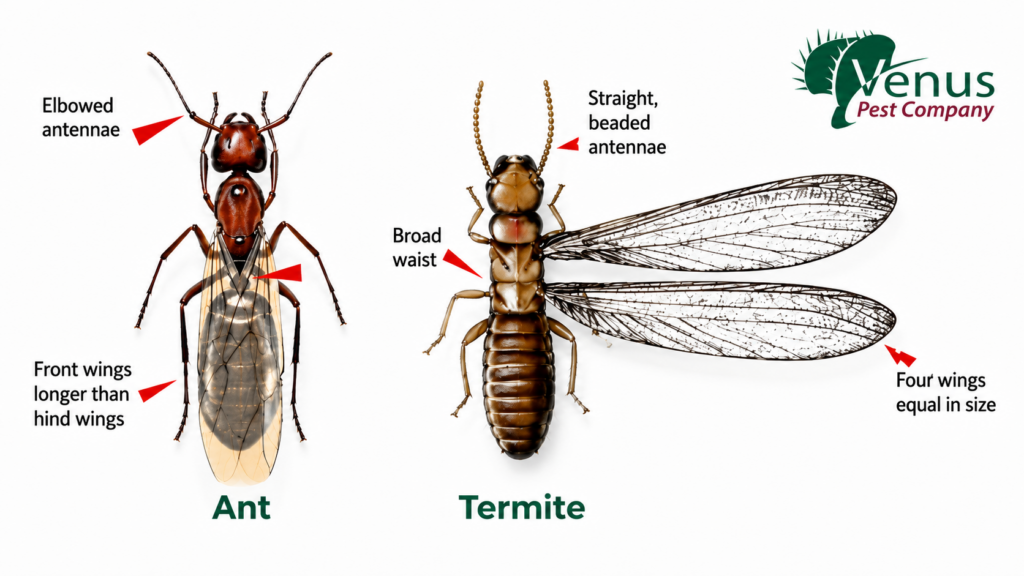
Ant swarmers have elbowed antennae, a narrow waist, and two pairs of unequal wings. Their front wings extend farther than the rear pair. Termite swarmers have straight antennae, a broad waist, and four wings of roughly equal size.
| Feature | Flying ant | Termite swarmer |
|---|---|---|
| Antennae | Elbowed | Straight |
| Waist | Narrow and pinched | Broad and nearly uniform |
| Wings | Front pair longer than rear pair | Four wings about equal in length |
| Body | Firm and clearly segmented | Softer with less narrowing between sections |
The Texas A&M guide to swarming insects uses these same features to separate ants from termites. Color and size can help, but they vary too much to settle the question alone.
Shed wings also require caution. Ant and termite reproductives can both lose their wings after a flight. Save a few complete insects when possible. A clear close photograph that shows the waist and antennae also helps.
Why a Colony Produces Wings
Most ants in a colony are wingless female workers. When the colony matures and conditions favor dispersal, it produces winged males and females. These reproductives leave the nest, mate, and attempt to establish new colonies.
The flight often follows a change in weather. Warmth, humidity, rain, wind, and barometric conditions can synchronize colonies across a neighborhood. That explains why people sometimes discover swarmers at many properties on the same day.
An outdoor flight does not prove that a colony occupies the building. Insects can land on a roof, enter through an open door, or gather near lights. A large emergence from a wall, ceiling, window frame, or other interior location carries much more weight.
The Calendar Is One of Our Best Identifiers
We use the calendar every day during swarming season. The timing patterns around Bryan and College Station are consistent enough to tell us what the problem probably is before we arrive.
During more than two decades of local service, we have documented carpenter ant swarms in January and February. Winged insects appearing during those months are almost certainly carpenter ants. Our common subterranean termites swarm primarily during March and April. A March or April swarm is usually termites, although an occasional late carpenter ant flight remains possible. It is not a typical fire ant flight.
By late summer, termites and carpenter ants have finished swarming in our area. Ants flying then belong to warm season species such as fire ants, rover ants, or other outdoor ants. We do not treat every month as if every swarming species remains equally possible.
The body still confirms the answer, especially before anyone makes a treatment decision. The calendar gives us a strong local diagnosis. The antennae, waist, wings, size, and emergence point verify it.
Rover ants and fire ants become more noticeable during warm weather. Rain can trigger fire ant flights across large areas. Tiny rover ant reproductives may collect around windows, pools, bathrooms, and other moisture-associated locations. Their small size can make photographs difficult to interpret.
The Large Winter Swarmers
Carpenter ants create some of the most dramatic termite scares we see. Their reproductive females can approach half an inch, and loose frass near wood makes the discovery look even more serious.
These ants have elbowed antennae, a pinched waist, and larger front wings. The workers we encounter locally are monomorphic rather than divided into obvious major and minor forms. The winged queens look much larger than the workers, which can make one colony appear to contain entirely different ants.
A large indoor emergence usually suggests that a mature colony occupies the building or a connected space. Carpenter ants often use damp wood, wall voids, insulation, hollow doors, roof spaces, and existing cavities. They excavate wood for nesting but do not eat it as termites do.
Frass can help locate an active opening. It may contain coarse wood shavings, dead ants, and insect fragments. Subterranean termites do not push piles of sawdust from their galleries. Our full carpenter-ant guide explains these differences and the moisture conditions that often support a nest.
Tiny Ants Around Water and Windows
Rover ants are only about one to two millimeters long. Their workers often appear around sinks, bathrooms, windows, patios, and pools. Moisture and honeydew-producing insects in the landscape can support large populations.
Winged rover ants may look like tiny dark specks until they collect in large numbers. Their narrow waist and elbowed antennae still identify them as ants, but a close specimen or magnified photograph may be necessary.
Rover ants do not sting and do not damage structural wood. A swarm can create a substantial nuisance, especially inside a home or commercial building, without indicating the kind of structural risk associated with termites.
Rover-ant management falls within Basic Pest Control, the HomeGard family of plans, and standard commercial ant coverage.
What Warm Rain Can Bring
Fire ant colonies often produce winged males and females after warm rain. Regional mating flights can send large numbers over yards, parking lots, athletic fields, and swimming pools.
A pool may collect both males and females. Finding winged fire ants in the water does not mean they intend to nest there. A mated queen needs suitable soil to begin a colony.
Fire ant workers show a conspicuous range of sizes and respond aggressively when someone disturbs the mound. Their swarmers may appear far from any visible mound because the adults can fly into the property from the surrounding area.
One brief flight does not mean a lawn program failed. No property treatment can prevent insects from flying overhead. Whole-lawn management focuses on colonies that establish in the protected area rather than every reproductive ant passing through the air.
Swarmers Indoors Deserve More Attention
Location changes the meaning of a discovery. A few winged insects on an exterior wall after rain may have arrived from elsewhere. Dozens emerging from an interior crack suggest a nearby colony.
Termite swarmers often collect at windows and doors because they move toward light. An indoor termite flight can indicate a colony beneath or within the structure. Carpenter ants behave similarly, especially when a satellite nest or mature colony occupies a wall, attic, or roof area.
Tiny ants can also enter through small gaps around plumbing, windows, and utility lines. An inspection should consider the insect, emergence point, moisture, frass, mud tubes, shed wings, and season together.
Do not clean away every specimen before taking photographs. Keep several insects in a small sealed container or zipper bag. Avoid crushing the waist and antennae, which provide the best identification features.
Why Correct Identification Comes First
Ants and termites require different responses. Even ant species vary greatly in nesting behavior, food preferences, colony structure, and service coverage. Treating every winged insect as a termite creates needless alarm. Treating a termite swarm as harmless flying ants can delay an important inspection.
We do not publish pesticide products, active ingredients, rates, mixing directions, or homeowner application recommendations. The useful first step is identification. Once we know the insect, we can evaluate whether it flew in from outdoors, occupies the structure, or points to moisture or another conducive condition.
Venus Pest Company has served the Brazos Valley since 2001. Founder Dr. Scott Lingren holds a PhD in entomology, and our technicians work from the species and evidence rather than the homeowner’s understandable first guess.
If you find swarmers, save a few and call or text 979-774-0486, email [email protected], or request an inspection. We can separate ants from termites and explain what the location, season, and species mean for the property.
Common Questions About Winged Insects
Does every flying ant mean there is a nest in my house?
No. One or two may enter from an outdoor flight. A large group emerging from an interior opening provides much stronger evidence of a colony in or connected to the structure.
What is the easiest way to distinguish ants from termites?
Look at the waist, antennae, and wings. Ants have a pinched waist, elbowed antennae, and longer front wings. Termites have a broad waist, straight antennae, and four similar wings.
When do carpenter ants swarm locally?
Venus has documented their local flights in January and February. That timing differs from our common subterranean termite swarms, which usually occur in March and April.
Why are winged insects gathering at a window?
Both ant and termite reproductives move toward light. A window often becomes the brightest apparent exit after insects emerge inside a building.
Are the large winged ants queens?
A swarm contains males and females. Reproductive females are larger and may become queens after mating, but not every winged ant is a queen.
Why are tiny swarmers appearing near my pool?
Pools collect insects during regional flights. Fire ant reproductives may land in the water after warm rain, while rover ants often occur around moisture and pool environments.
Should I save the insects?
Yes. Save several complete specimens and take close photographs before cleanup. The antennae, waist, and intact wings make identification much easier.
Can Venus identify swarmers for a business?
Yes. We identify and manage ants for homes and commercial properties. Termite evidence may require a separate wood-destroying-insect inspection or treatment proposal.