

Pest Expert Overview: Fire Ants in Bryan & College Station
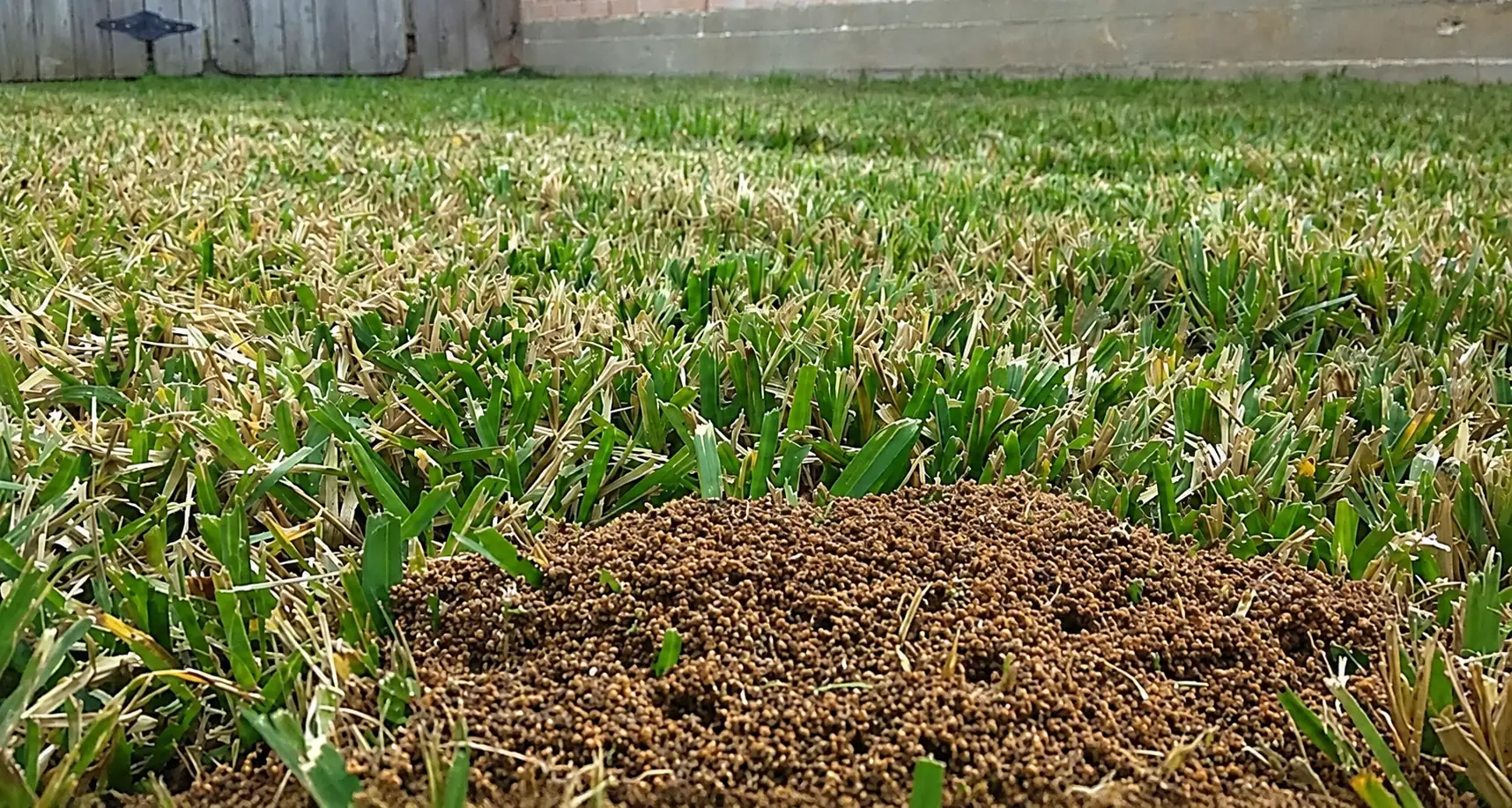
Fire Ants in Bryan and College Station, Texas
The red imported fire ant, Solenopsis invicta, dominates much of eastern Texas. It thrives in lawns, parks, pastures, athletic fields, roadsides, and landscaped commercial properties. Mounds may disappear for a while and then seem to return overnight after rain.
Around Bryan, College Station, and the rest of Brazos County, effective fire ant management has to account for the entire property and the constant arrival of new colonies. Killing the mound someone can see today doesn’t protect the yard from queens that fly in next month.
Recognizing the Red Imported Fire Ant
Workers range from reddish brown to dark brown or nearly black across the abdomen. One colony contains workers of noticeably different sizes, from about one sixteenth to nearly one quarter inch long. That size variation provides a useful clue because many other small lawn ants have workers that look more uniform.
Fire ant mounds consist of loose soil and usually lack a single obvious entrance in the center. Tunnels open away from the visible mound, allowing workers to forage without walking through a central hole. New colonies and mounds in hard or dry soil may remain low and easy to miss.
Identification becomes unmistakable when the colony is disturbed. Workers rush to the surface, climb vertical objects, bite to gain a grip, and then sting. Don’t kick or probe a suspected mound just to confirm the species.
Texas A&M’s fire ant identification guide compares imported fire ants with harvester ants, leafcutting ants, pyramid ants, and other soil nesting species. A photograph of the workers and mound often gives us enough information to decide whether closer examination is needed.
Why One Colony Has Several Worker Sizes
Fire ants have polymorphic workers. That means the sterile female workers occur in a range of sizes rather than one uniform form. Larger and smaller workers perform overlapping jobs that include caring for brood, maintaining tunnels, defending the colony, and collecting food.
The queen looks completely different. She has a large abdomen and remains deep within the colony after shedding her wings. Workers feed and protect her while she produces the eggs that maintain the population.
Winged males and females appear when mature colonies produce reproductives. These swarmers can cause temporary confusion with other ants, especially after they remove their wings.
Mounds Are Only the Visible Portion
A mature colony extends through an underground network much larger than the pile of soil at the surface. Workers move through tunnels to regulate temperature, care for developing ants, and reach foraging areas.
The mound changes with weather. Ants may build it higher when soil conditions allow, flatten it during hot or dry periods, or relocate after disturbance. Flooding can force an entire colony into a floating mass that travels until it reaches dry ground.
Texas A&M fire ant biology describes both single queen and multiple queen populations. Single queen colonies defend territories from neighboring colonies. Multiple queen populations tolerate connected mounds and can reach much higher mound densities.
That difference helps explain why two similar lawns can show very different pressure. One may have a few large, separated mounds. Another can develop many smaller colonies close together.
Why Fire Ant Mounds Appear After Rain
Moist soil makes excavation easier and brings mounding activity closer to the surface. The rain didn’t create a mature colony overnight. It made the colony easier to see.
Warm rain also favors mating flights. Winged males and females leave many colonies across a large area at roughly the same time. Mated queens land, shed their wings, and search for soil where they can begin a new colony.
Driveways, sidewalks, swimming pools, and transitions between surfaces often collect swarmers. The flight may last only a short time, and no property treatment can stop winged ants from passing overhead. The practical goal is to prevent successful colonies from taking over the yard.
Fire Ant Stings and the Familiar White Pustule
A worker first bites the skin to anchor itself, then curls its abdomen and stings. It can pivot and sting more than once. Several workers often attack together after a person or animal disturbs the colony.
The initial sting burns. An itchy white pustule commonly develops later. Avoid scratching or opening it because broken skin can become infected.
Most stings cause a local reaction, but some people develop serious allergic symptoms. Seek emergency medical care for breathing difficulty, swelling away from the sting area, dizziness, widespread hives, or another severe reaction. Young children, people with limited mobility, and anyone with a known insect venom allergy face greater risk because they may receive more stings or react more strongly.
Pets can disturb mounds with their feet or nose. Contact a veterinarian when numerous stings, facial swelling, weakness, breathing trouble, or unusual behavior follows an encounter.
Predator, Scavenger, and Invasive Pest
Fire ants eat insects, ticks, arthropod eggs, carrion, seeds, and many other foods. Their predation can reduce some pests, which gives them a limited beneficial role in agriculture and unmanaged areas.
That benefit doesn’t erase their effects. They sting people and animals, displace other ants, interfere with outdoor work, and can affect ground nesting wildlife. They also nest around electrical equipment, irrigation components, pavement, and structures.
Fire ants forage for different foods as colony needs change. Protein, oils, and sugars can all attract them. An indoor trail may reflect a colony beneath the slab or beside the building rather than a typical indoor nesting ant.
Why Treating Mounds One at a Time Falls Short
Individual mound control reacts to colonies after they become visible. It may reduce an immediate hazard, but untreated colonies remain and new queens continue arriving. Small founding colonies can develop for weeks before producing an obvious mound.
Whole property management addresses colonies that haven’t created a dramatic soil pile yet. Timing matters because workers must be actively foraging and weather affects colony behavior.
Ongoing management doesn’t mean eradication. Texas A&M explains that red imported fire ants can’t be permanently eradicated across the infested southeastern United States. A well managed property can still maintain very low pressure even though the surrounding region remains full of ants.
Why the Program Returns in Spring and Fall
Venus normally schedules whole yard service in April and October because those visits address two different parts of the annual cycle. Spring service reduces colonies as warmer weather brings workers back into active foraging. It also gives the property a lower starting population before the main season of mating flights and recolonization.
Fall service catches workers while they still forage but before winter activity slows. The Texas Imported Fire Ant Research and Management Project identifies late August through early October as an especially useful fall period because ants remain active and weather patterns often become more predictable. Our exact timing still responds to local temperature, rain, and what the technicians find on the property.
The two scheduled visits work together. Neither one places a permanent barrier around the yard, and queens can fly in from surrounding properties during the months between them. Qualifying spot service handles colonies that establish or become visible during that interval.
This seasonal approach also explains why we don’t wait for every colony to build a large mound. The program targets the property when colony behavior favors broad population reduction, including colonies that remain easy to miss from the surface.
Native Ants Can Help Hold the Ground
Removing imported fire ants creates space for other species to return. Pyramid ants and several other nonproblem lawn ants compete for resources and may prey on newly landed fire ant queens.
That gives us a reason not to eliminate every ant in the landscape. An ant colony that doesn’t sting, invade the building, or damage the property may help occupy habitat that imported fire ants would otherwise reclaim.
Correct identification supports that restraint. Bare circular craters, single entrance holes, uniform workers, and different foraging patterns may belong to native ants that don’t require control.
Practical Ways to Reduce Sting Risk
Teach children to recognize mounds and avoid standing on them. Check play areas, athletic fields, gardens, and pet spaces after rain when new soil becomes easier to see.
Wear closed shoes and gloves when working near suspected colonies. Watch where you kneel, place equipment, or set down bags. Don’t park a stroller, wheelchair, or pet crate on a mound.
Keep food waste and pet food managed outdoors. These steps won’t prevent queens from landing, but they reduce some foraging near patios and doors.
Professional Fire Ant Control
Venus Pest Company’s standalone Fire Ant Control Program includes two scheduled whole yard treatments each year, one in spring and one in fall, with qualifying spot treatments available between visits. HomeGard, HomeGard Plus, YardGard, and TotalGard also include lawn fire ant management.
Basic Pest Control covers fire ants only around the structure perimeter. It doesn’t provide whole lawn management. Standard commercial pest control can include perimeter fire ants, while turf and landscaped areas require added or separately quoted coverage.
Our program targets colonies while allowing harmless native ants to recolonize treated areas. We don’t publish pesticide products, active ingredients, rates, amounts, or homeowner application recommendations. Weather, timing, property use, and colony behavior all influence professional decisions.
Local Help Across Brazos County
Venus Pest Company has served local homes and businesses since 2001. Founder Dr. Scott Lingren holds a PhD in entomology, and our program treats fire ants as a landscape population rather than chasing one mound at a time.
If mounds keep returning or fire ants threaten a play area, pet space, or commercial property, call or text 979-774-0486, or email service@venuspest.com. We’ll explain which level of coverage matches the part of the property you want protected.
Common Questions
Why did a mound appear overnight?
The colony probably existed before the soil pile became visible. Rain and suitable soil conditions bring excavation closer to the surface and make the mound easier to see.
Why are the workers different sizes?
Fire ants have polymorphic workers. One colony naturally produces workers across a broad size range, and that variation helps distinguish them from many uniform sized lawn ants.
Do fire ants bite or sting?
They do both. A worker bites to anchor itself and then uses its stinger, sometimes more than once. The sting creates the burning sensation and typical pustule.
Are winged ants in my pool starting a colony there?
Usually not. Pools collect males and newly mated females during regional swarms. A queen needs suitable soil to establish a colony.
Can the entire Brazos Valley population be eradicated?
No. Imported fire ants occupy too much of the region and continually disperse. Management can greatly reduce them on a defined property without eliminating them from Texas.
Are all lawn ants harmful?
No. Many native ants don’t sting people or invade homes. Some compete with imported fire ants and may attack newly landed queens, so correct identification matters.
What does Basic Pest Control include?
Basic Pest Control covers fire ants around the structure perimeter. Whole lawn management comes through the standalone program or a Gard plan that includes it.
Which plans cover the entire lawn?
HomeGard, HomeGard Plus, YardGard, and TotalGard include lawn fire ant management. Commercial turf coverage must appear in the property’s customized proposal.