
Expert Overview: Geckos and Lizards in Bryan & College Station
Geckos and lizards are on our side.
Occasionally, someone asks Venus Pest Company to eliminate lizards or geckos from a property. We don’t offer that service. There is no sensible, selective residential treatment that removes free ranging reptiles while leaving people, pets, and other wildlife untouched. They also provide a real benefit by hunting insects around homes.
If one wanders indoors, the answer is usually identification, gentle removal, and exclusion. Killing every little lizard in the yard isn’t a realistic goal, and we wouldn’t want it to be.
The Dropping That Causes Most Calls
The call usually starts with some version of, “I think we have rats.” The homeowner found a small dark pellet and reasonably assumed that a mammal left it.
Gecko droppings can look surprisingly similar to rodent droppings at first glance. The best clue is the white or cream colored tip attached to one end. That pale section is urate, the solid form in which reptiles eliminate much of their nitrogen waste. The darker portion is fecal material.
Texas A&M’s house gecko guide describes the droppings as elongated, brownish, and frequently tipped with white. They may stain curtains, carpet, walls, and other surfaces, but finding them doesn’t mean the animal has caused structural damage.
Rat and mouse droppings don’t normally have that distinct white cap. Rodent droppings usually appear uniformly dark, although age, dust, mold, and lighting can change their appearance. If the white portion has broken away from an old gecko dropping, the identification becomes less obvious.
Location helps too. Gecko droppings often appear beneath porch lights, near windows, along exterior walls, or below an indoor hiding place. Rodent droppings tend to accumulate along travel routes, in attics, behind appliances, inside cabinets, or near food and nesting material. A single photograph doesn’t always settle the question, so we look at the surrounding evidence before recommending rodent control.
Gecko Poop Versus Rat Poop
A white tip strongly suggests a gecko or another small reptile. Size alone provides a weaker clue because a large gecko dropping can overlap with a small rodent dropping.
Rodent activity usually leaves more than feces. We may find gnawing, rub marks, tracks, nesting material, noises in walls or attics, damaged food packages, or a pattern of droppings along a runway. Our local roof rat guide explains the behavior and evidence we expect from an actual rat infestation.
Geckos don’t chew wiring, contaminate stored food as they forage through cabinets, or build nests from insulation. They may leave scattered droppings where they hunt insects, and a house gecko may hide in a wall gap or behind an object during the day.
If you find unfamiliar droppings, don’t jump straight to traps or treatment. Identification comes first. The wrong assumption can turn one harmless gecko into an expensive rodent scare.
Common Geckos and Lizards Around Brazos County
The Brazos Valley supports a good variety of lizards. Some belong here naturally, while others arrived from elsewhere and adapted to life around buildings.
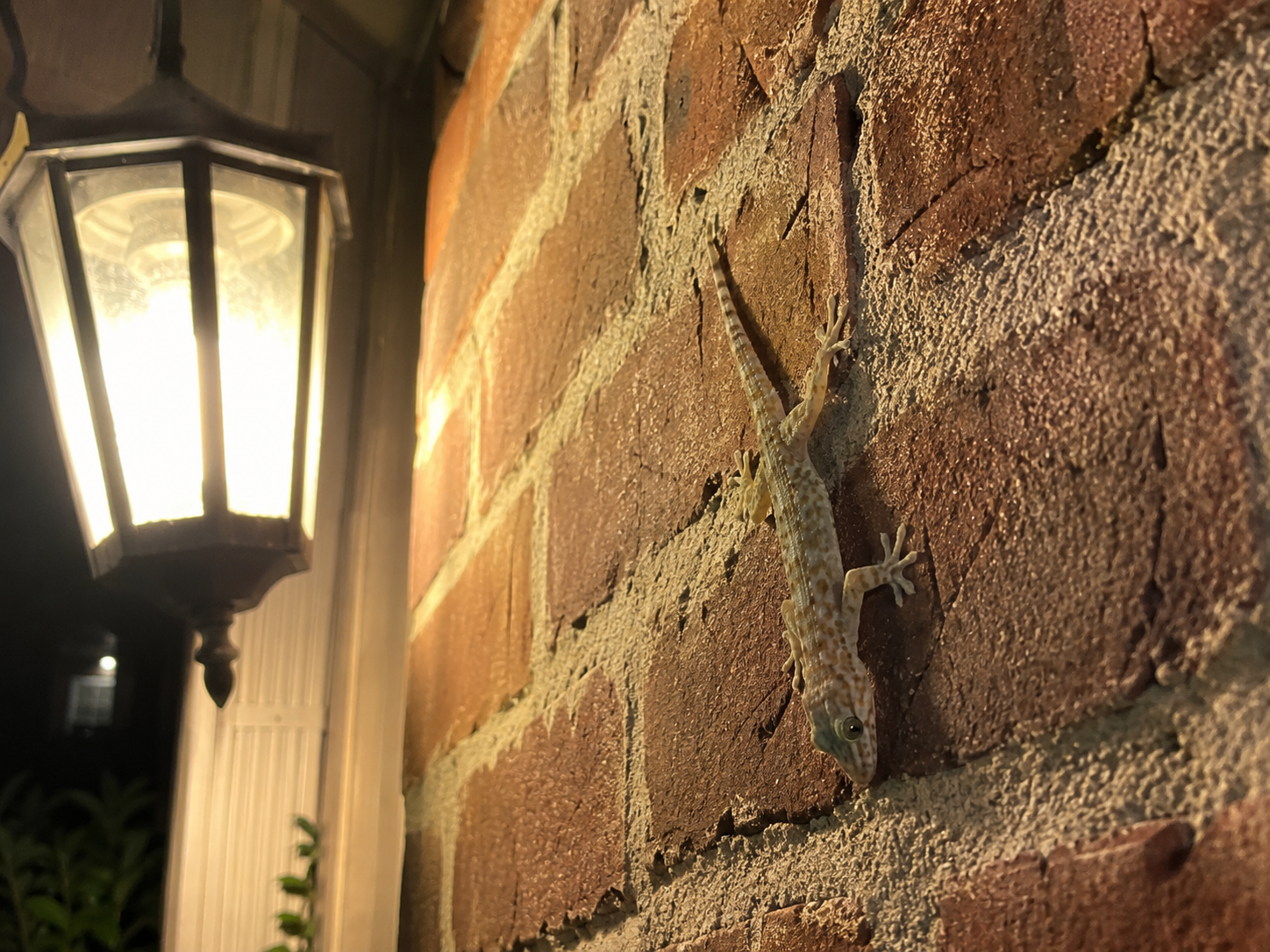
The Mediterranean house gecko (Hemidactylus turcicus) produces many of the calls we receive. It has pale, somewhat translucent skin, bumpy texture, wide toe pads, and large eyes. These nocturnal geckos gather near porch lights, windows, and lighted commercial buildings where insects concentrate. The species isn’t native, but it has established populations in cities across Texas. The Texas Invasives database documents strong urban populations throughout the state.
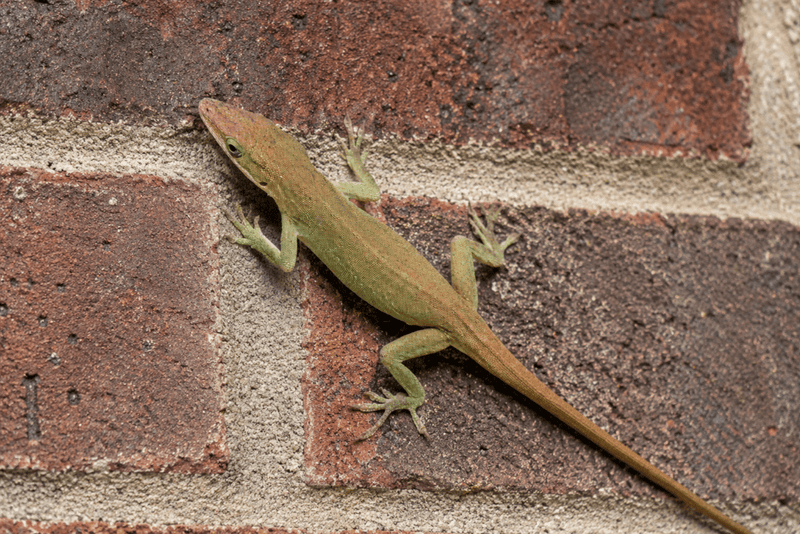
The green anole (Anolis carolinensis) is the little lizard many Texans grew up calling a chameleon. It can shift from green to brown, but it isn’t a true chameleon. Males display a pink or reddish throat fan called a dewlap. Texas Parks and Wildlife reports green anoles throughout the eastern third of Texas, where they use trees, shrubs, walls, and fences.
The Texas spiny lizard (Sceloporus olivaceus) is larger and rougher looking. It often races up tree trunks or fences when approached. Its mottled scales blend beautifully with bark.
We also see ground skinks, five lined skinks, and eastern fence lizards in appropriate habitat. Ground skinks slip through leaf litter like tiny bronze snakes with legs. Young five lined skinks often carry vivid blue tails. The exact mix changes with shade, soil moisture, vegetation, and how developed the surrounding property is.
Why They Gather Around Homes
Outdoor lighting creates a nightly buffet. Moths, midges, mosquitoes, beetles, and other insects gather around illuminated walls and windows. Geckos learn where that food appears and return to the same hunting areas.
Walls also hold warmth after sunset. Brick, stone, siding, fences, tree trunks, and patio structures give lizards places to bask, hide, and hunt. Narrow gaps provide daytime shelter and protected places for geckos to lay their small white eggs.
Native lizards usually remain outdoors, but they may dart through an open door or enter through a damaged screen. Mediterranean house geckos tolerate buildings better and may remain inside when warmth, shelter, and insect prey support them.
Seeing several geckos around a porch light doesn’t mean the house has a reptile infestation. It usually means the light attracts insects and the geckos have noticed.
Beneficial Predators Living Beside Us
Geckos and lizards spend much of their active time hunting. Depending on their size and species, they eat flies, moths, beetles, crickets, spiders, cockroaches, and other small arthropods.
They won’t replace professional pest control, and we shouldn’t pretend that one green anole patrols an entire yard. Still, every insect a lizard eats becomes one less insect in that tiny corner of the ecosystem. They form part of the normal predator community around a healthy landscape.
They also feed birds, snakes, and other wildlife. Removing them from a property affects more than the insects they consume.
This is why we don’t classify local lizards as pests simply because they live close to people. A gecko on a porch wall is doing exactly what its biology tells it to do.
Why We Don’t Eliminate Lizards or Geckos
Pesticides don’t offer a responsible lizard control program. A product or exposure severe enough to eliminate free ranging reptiles across a property could also harm pets, beneficial wildlife, and people. It would make no sense to create that risk for animals that rarely cause a meaningful problem.
Venus does not apply pesticides to kill lizards or geckos. Our treatments target the pests named in the service plan. Reducing insect prey may indirectly make a particular wall or porch less attractive to geckos, but killing the geckos isn’t the objective.
When someone wants fewer geckos near a doorway, we look at the setting. A bright light may concentrate insects beside the entrance. A worn door sweep may let both insects and geckos inside. Gaps around windows, siding, or utility penetrations may provide shelter.
Changing those conditions can reduce unwanted indoor encounters without trying to remove every lizard from the property.
Glue Boards Are a Cruel Answer
We hate seeing glue boards used for geckos and lizards. They don’t kill quickly. A trapped animal may struggle until it loses skin, damages a limb, becomes dehydrated, or dies from stress and exposure.
Glue boards also catch whatever happens to cross them. The Wildlife Center of Virginia regularly treats unintended victims, including lizards, snakes, birds, and small mammals.
Using one to catch a harmless gecko is cruel and unnecessary. If a glue board accidentally catches a lizard, don’t pull the animal loose by force. Contact a wildlife rehabilitator or veterinarian for guidance.
Exclusion solves the actual problem. A trap only injures the individual animal that found the opening.
What to Do When One Gets Inside
Most native lizards want to return outdoors as much as the homeowner wants them there. Close interior doors to limit where the animal can run. Give it a clear route toward an exterior door when practical.
For a small gecko, place a cup or lightweight container over it and slide a stiff piece of paper or thin cardboard beneath the opening. Carry the container outside and release the animal near cover. Move slowly because tails can break when someone grabs or corners a frightened lizard.
Afterward, inspect the nearby door sweep, screen, window frame, or wall gap. Seal ordinary entry points, but don’t block weep holes, required vents, or drainage openings with inappropriate materials.
Repeated indoor sightings may also point to an insect food source. Identification still matters. A gecko following moths near a door requires a different response from cockroaches supporting geckos inside a commercial kitchen.
Catching Lizards Is a Childhood Rite of Passage
For many kids, catching a lizard and keeping it as a temporary pet is part of growing up. You find a green anole or blue tailed skink, admire it for a while, learn that it moves much faster than expected, and eventually let it go. That kind of direct experience can create a lifelong interest in animals and the outdoors.
A brief look is different from keeping a wild reptile permanently. Handle it gently, provide air and shade, don’t leave the container in the sun, and release the animal where it was found. Never grab a lizard by the tail. Many species can drop the tail to escape, which costs the animal energy even though it may grow another one.
Reptiles can carry Salmonella while appearing perfectly healthy. Everyone should wash their hands after handling a lizard, its container, or its droppings. The Centers for Disease Control and Prevention advises that children under five shouldn’t handle reptiles because they face a greater risk of serious illness.
That small amount of common sense preserves the good part of the experience without treating a wild animal like a disposable toy.
Are Geckos Dangerous to People or Pets?
The small geckos, anoles, skinks, and fence lizards found around local homes aren’t venomous and don’t hunt or attack people. A handled lizard may bite defensively, but the species we commonly encounter are too small to create a serious injury.
Their droppings deserve normal sanitation. Avoid handling feces with bare hands, clean contaminated surfaces, and wash afterward. Keep reptile droppings away from food preparation areas.
Cats and dogs pose a greater threat to small lizards than the lizards pose to them. If a pet repeatedly catches wildlife, supervision may protect both the lizard and the pet.
Local Identification Help
Venus Pest Company serves Bryan, College Station, and the rest of Brazos County.
We don’t provide lizard or gecko elimination. We can help when droppings may indicate rats or mice, when indoor gecko activity points to an insect problem, or when a customer needs an experienced eye to identify what left the evidence.
Call or text 979-774-0486, or email [email protected].
Gecko and Lizard Questions
How can I tell gecko poop from rat poop?
Gecko droppings usually have a dark elongated portion with a distinct white or cream urate tip. Rat droppings normally look uniformly dark and appear with other rodent evidence such as gnawing, rub marks, nesting material, or repeated droppings along travel routes.
Why is part of the dropping white?
The white portion is urate. Reptiles conserve water by eliminating much of their nitrogen waste as a pale solid or paste rather than producing urine the way mammals do.
Do geckos damage houses?
They don’t chew wiring, eat wood, or damage the structure. Their droppings may stain surfaces, and repeated indoor sightings can become a nuisance. Most geckos simply hunt insects around lights and walls.
Will Venus Pest Company kill or remove them?
No. We don’t provide lizard or gecko elimination. There is no responsible selective pesticide treatment for free ranging reptiles, and these animals provide a benefit by eating insects. We focus on identification, exclusion, and any underlying insect or rodent problem.
Are glue traps humane?
They can catch lizards, which is exactly why we oppose using them for this purpose. Glue boards cause prolonged suffering and catch unintended wildlife. Gentle capture and structural exclusion provide a more humane response.
Why do they stay near my porch light?
The light attracts flying insects, and the geckos follow their food. The wall may also retain warmth and provide narrow daytime hiding places.
Can they live inside a house?
Mediterranean house geckos can survive in buildings when they find warmth, shelter, and insects. Many native lizards that enter accidentally don’t do well indoors and will benefit from gentle release outside.
Is it safe for children to catch lizards?
Older children can observe a lizard briefly if an adult teaches gentle handling and makes sure everyone washes their hands afterward. Children under five shouldn’t handle reptiles because of the risk from Salmonella. Release wild lizards where they were found rather than keeping them permanently.