
Pest Expert Overview: Sawtoothed Grain Beetles in Bryan & College Station
Most infestations begin when someone brings home a food or feed product that already contains eggs, larvae, or adults. The insects may have entered during processing, storage, shipping, or retail display. Once inside a pantry, their flat bodies help them crawl through loose package seams and into nearby foods.
In Brazos County homes, the source may sit outside the kitchen. Large bags of pet food or bird seed in a garage can support an infestation, as can forgotten dog treats or baking ingredients. Finding that source matters far more than killing the beetles crawling across a counter.
What Does a Sawtoothed Grain Beetle Look Like?
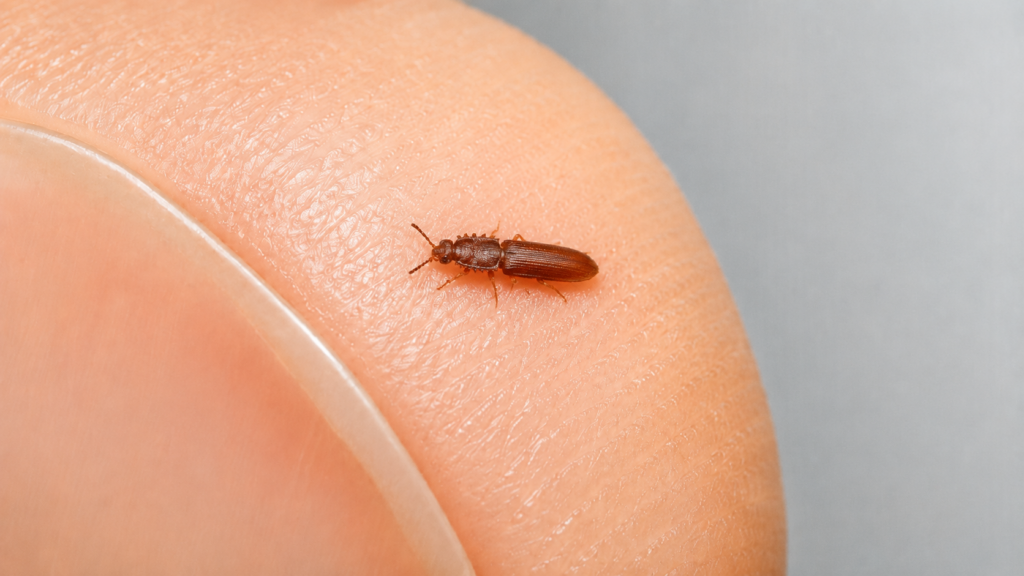
Adult sawtoothed grain beetles measure about 1/10 inch long. Their narrow, reddish brown to nearly black bodies look noticeably flat when viewed from the side. The head remains visible from above, and each antenna ends in a small club.
The beetle gets its name from six toothlike projections along each side of the thorax, the body section directly behind the head. Those twelve teeth provide the best identifying feature, but you’ll usually need magnification to see them clearly. To the naked eye, the insect may look like nothing more than a tiny brown dash moving through food.
The larvae look slender and cream colored with brown heads. They crawl freely through food, so a close inspection may reveal both larvae and adults.
Sawtoothed Grain Beetle or Another Pantry Pest?
Several common stored product beetles share the same small size and reddish brown color. A photograph taken through a phone magnifier can help, but body shape and food associations often provide the first useful clues.
| Pest | Useful identification feature | Foods that often reveal the source | Flight |
|---|---|---|---|
| Sawtoothed grain beetle | Flat, narrow body with six teeth on each side of the thorax | Processed grains, cereal, nuts, dried fruit, spices, and pet food | Cannot fly |
| Merchant grain beetle | Nearly identical; larger eyes and subtle differences near the head | Similar foods, with a strong association with oil rich products such as nuts | Can fly |
| Red flour beetle | Larger, smoother body without sawlike teeth | Flour, cornmeal, baking mixes, and damaged grain | Can fly |
| Granary, rice, or maize weevil | Distinct snout extending from the head | Whole kernels and seeds | Depends on species |
Sawtoothed and merchant grain beetles can be difficult to separate without a microscope or strong magnification. Fortunately, that distinction rarely changes the first steps in a residential inspection. Both point toward dry stored foods, and both require someone to find every infested source.
Why Are They Called Secondary Grain Pests?
Sawtoothed grain beetles usually cannot penetrate and develop in hard, undamaged grain kernels. They feed more successfully on flour, processed foods, cracked grain, and kernels that handling or other insects have already damaged. Entomologists call insects with this feeding pattern secondary stored product pests.
Grain weevils behave differently. Their larvae develop inside intact kernels, which makes them primary pests. If you find a true weevil with a long snout, whole rice, corn, wheat, and seeds deserve the closest inspection. If you find a sawtoothed grain beetle, the search should include a much wider range of processed food.
A grain weevil can damage whole kernels, creating food that sawtoothed grain beetles can use. Spilled flour or grain dust can also support beetles after someone removes the package that started the infestation.
What Foods Do Sawtoothed Grain Beetles Infest?
Their menu covers much of a typical pantry. They commonly infest breakfast cereal, oatmeal, flour, cornmeal, pasta, crackers, baking mixes, rice, nuts, seeds, chocolate, candy, spices, dried fruit, and dried meat. Pet food, pet treats, bird seed, and rodent food can also support them.
The common thread is dry food that offers broken grain, food dust, or processed plant material. Despite that preference, don’t assume the most obvious package holds the source. An adult crawling through a box of pasta may have left a bag of nuts nearby. A beetle on a windowsill may have walked from bird seed stored in the next room.
Old products deserve special attention. A rarely used spice, half empty bag of baking ingredients, forgotten holiday nuts, or food based craft can sit undisturbed long enough for several generations to develop.
How Their Life Cycle Hides the Problem
Female sawtoothed grain beetles place tiny eggs loosely in food or within cracks near a food source. The eggs hatch into active larvae that feed as they move through the product. A mature larva gathers small food particles around itself and forms a crude protective cell before pupating.
Warm conditions can shorten the life cycle to roughly one month. Cooler temperatures and less suitable food slow development. Because adults live for months, a small infestation can continue quietly in a product that nobody uses often.
Unlike grain weevil larvae, sawtoothed grain beetle larvae don’t remain sealed inside kernels. You may see them moving through food, but their pale color and small size make them easy to miss. Package folds, cabinet joints, and loose debris also give larvae protected places to pupate.
How Did Beetles Get Into a Closed Package?
Ordinary food packaging often looks more secure than it really is. A folded seam, thin plastic bag, or loose lid may leave an opening wide enough for this flat insect. Adults can move between products without chewing an obvious hole.
An unopened package may also contain an infestation that began before purchase. Finding beetles in a clean pantry doesn’t mean poor housekeeping created the problem. Sanitation affects how easily the insects spread and how long they persist, but any home can receive an infested product.
Food stored in genuinely airtight glass or sturdy plastic containers usually contains the insects if they emerge. That containment makes clear containers especially useful. You can see activity before beetles reach everything else on the shelf.
How to Find the Source of an Infestation
Begin near the greatest beetle activity, but inspect by food type rather than distance alone. Open dry products over a light colored tray and look for adult beetles, pale larvae, shed skins, clumped food, or insects caught along package seams. Check the shelf beneath each product for fine debris and dead insects.
Then widen the search to nearby cabinets, the garage, utility room, pet feeding area, and storage closets. Check the bottoms of large bags, where food dust accumulates. A few beetles on top may represent more activity deeper inside.
Place infested food in a sealed bag and remove it from the home. Vacuum shelf corners, cabinet joints, peg holes, and the floor beneath storage areas. Pull out removable shelves when possible because crumbs and larvae can hide along the edges. Empty the vacuum outside afterward.
Don’t stop after finding one infested item. These beetles crawl well and may have reached several products. Inspect everything nearby before restocking the area. Store replacement food in tightly closed containers, wash containers before refilling them, and avoid pouring new food over an older batch.
A few adults may continue wandering after you remove the source. Their numbers should decline. Continued or increasing activity usually means another food source or accumulation of debris remains somewhere in the building.
Are Sawtoothed Grain Beetles Harmful?
Sawtoothed grain beetles don’t bite or sting, and they don’t damage wood, clothing, or the structure of a home. Their damage involves food contamination.
Larvae and adults feed in stored products and leave insect fragments, shed skins, waste, and dead beetles behind. Heavy activity can change a food’s odor or flavor. The insects also waste food by spreading from one package into others.
Most people should discard inexpensive infested food rather than try to save it. Killing the insects wouldn’t remove the contamination or restore the food’s quality. If a product has unusual value, professional identification can help confirm what happened before you decide how to handle it.
Preventing Future Pantry Beetle Problems
Buy dry foods in amounts your household will use within a reasonable time. Long storage gives an unnoticed infestation room to grow. Check packages for damage, loose seams, leaking food dust, or visible insects before purchase.
At home, clean spills promptly and keep susceptible foods in tight glass or sturdy plastic containers. Wash and dry containers before adding fresh food. Give pet food, treats, and bird seed the same attention as food in the kitchen, especially when you store large bags in a warm garage.
These habits won’t stop beetles that already live inside a newly purchased product, but they can contain the problem. One infested bag is much easier to handle than a pantry full of affected packages.
Professional Sawtoothed Grain Beetle Control
Sawtoothed grain beetles feed in so many products that finding the source can take more patience than people expect. They also resemble merchant grain beetles, flour beetles, and other pantry pests. A wrong identification can send the search toward the wrong foods.
Venus Pest Company identifies the insect, follows the pattern of activity, and searches for overlooked sources. We consider the pantry, but we also look at garages, utility rooms, pet areas, storage closets, and places where food debris can collect. The goal is to find where the beetles develop and why they continue appearing.
Venus Pest Company serves Bryan, College Station, and the rest of Brazos County. Owner Scott Lingren holds a PhD in entomology and has worked with insects since childhood. If tiny brown beetles keep turning up in your pantry, we can determine what they are and where the inspection should focus.
Call or text 979-774-0486 or request service online.
Frequently Asked Questions
Can sawtoothed grain beetles fly?
No. Sawtoothed grain beetles have wings but cannot fly. They spread by crawling or by traveling inside infested products. Their close relative, the merchant grain beetle, can fly.
Why do I keep finding them near a window?
Adults wander away from infested food and may end up near light, even though they cannot fly. A windowsill sighting usually points to a source somewhere inside the building rather than beetles coming through the window.
Do sawtoothed grain beetles only eat grain?
No. They infest a wide range of processed dry foods, including cereal, flour, pasta, nuts, dried fruit, spices, candy, and pet food. Their name understates how broad their diet can be.
Can they get into unopened food?
Yes. They can pass through small gaps in ordinary paper, cardboard, and thin plastic packaging. An infestation may also begin before the product reaches your home.
How long will I see beetles after removing the source?
A few wandering adults may appear for a short time after cleanup. Activity should steadily decline. If it continues or grows, another infested product or food spill probably remains.
Are sawtoothed grain beetles weevils?
No. Both infest stored food, but true weevils have a noticeable snout. Sawtoothed grain beetles have a flat body and toothlike projections along the thorax.