Pest Expert Overview: Indianmeal Moths in Bryan & College Station
Most infestations arrive with food or feed brought into the home. Adult moths can fly, but they don’t normally enter from the yard and then establish themselves in a pantry.
Warm conditions speed their development, so Indianmeal moths can remain active throughout the year in Bryan, College Station, and the rest of Brazos County. A bag of bird seed or pet food stored in a hot garage may produce moths surprisingly quickly.
What Does an Indianmeal Moth Look Like?
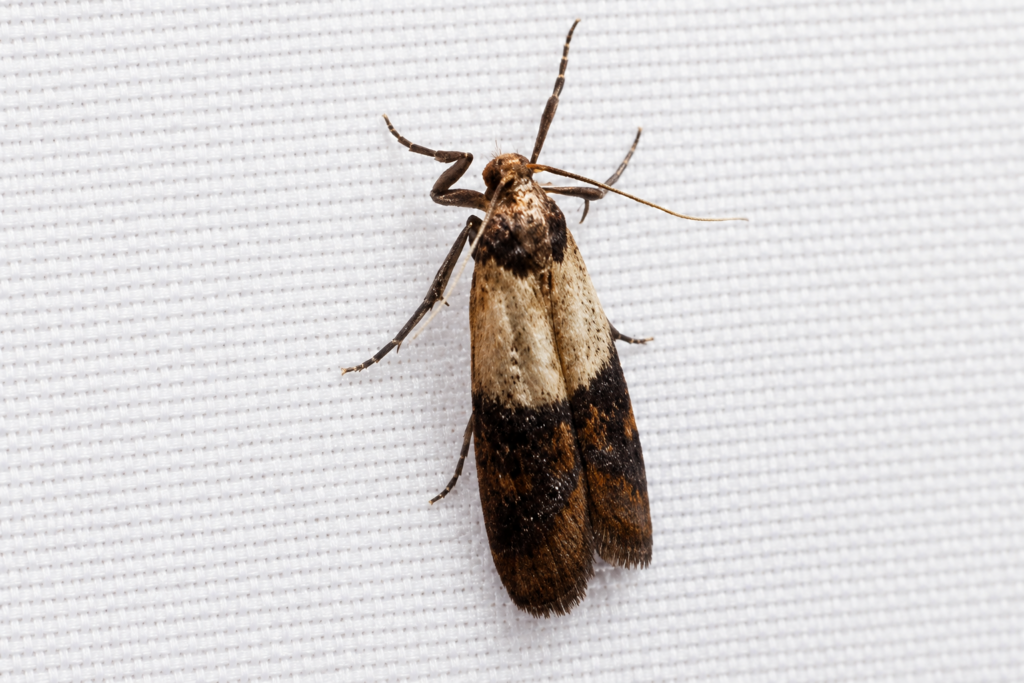
Adult Indianmeal moths have a wingspan of roughly 1/2 to 5/8 inch. When the moth rests, it folds its wings close to the body. The portion nearest the head looks pale gray or tan, while the outer portion has a reddish brown or coppery color. That sharp two toned pattern provides the easiest field mark.
The larvae look like small caterpillars with brown heads. Their bodies may appear cream, pinkish, pale green, or slightly yellow depending on age and food. A mature larva reaches about 1/2 inch long. Unlike the adult moth, the larva causes all the feeding damage.
Indianmeal Moth or Another Indoor Moth?
Not every moth near a kitchen comes from stored food, and not every small moth damages clothing. Color, location, and larval evidence help narrow the identification.
| Moth | Adult appearance | Larval food | Useful clue |
|---|---|---|---|
| Indianmeal moth | Pale inner wings with coppery reddish outer sections | Dry food, pet food, bird seed, nuts, and dried fruit | Silk webbing and clumped food inside packages |
| Webbing clothes moth | Fairly uniform pale gold or buff wings | Wool, fur, feathers, and other animal fibers | Fabric damage, cases, or webbing in dark storage areas |
| Meal moth | Larger moth with contrasting dark and lighter bands | Flour, grain, and stored food | Less common in homes and has a broader patterned wing |
| Outdoor moth | Appearance varies widely | Living plants or outdoor material | An isolated visitor without food webbing or pantry activity |
Indianmeal moths don’t eat clothing. Clothes moth larvae don’t normally infest cereal or bird seed. If the moths repeatedly appear around a pantry and food contains webbing, Indianmeal moths move to the top of the list.
Why Is It Called an Indianmeal Moth?
The name doesn’t refer to the country of India. “Indian meal” once served as a common term for cornmeal, one of the foods associated with the moth. The scientific name is Plodia interpunctella.
People now use “pantry moth” more often, but that phrase can include several stored food moths. The copper colored outer wings make the Indianmeal moth one of the easier pantry species to recognize.
What Foods Do Indianmeal Moths Infest?
Indianmeal moth larvae prefer dry stored food, especially products with coarse particles, broken grain, seeds, or nuts. Common sources include cereal, oatmeal, cornmeal, whole wheat flour, rice, pasta, crackers, baking ingredients, nuts, chocolate, dried fruit, powdered milk, spices, and dried peppers.
Pet products deserve equal attention. Dry dog or cat food, pet treats, fish food, bird seed, grass seed, and wildlife feed can support large infestations. Decorative corn, seed filled crafts, and dried plant arrangements sometimes provide the source when every package in the pantry looks clean.
Older products cause many persistent problems because nobody disturbs them. A half used bag of nuts or bird seed can support several generations, even when adult moths fly elsewhere.
Why Is There Webbing in the Food?
Indianmeal moth larvae produce silk as they feed. The silk catches crumbs, grain dust, waste, and shed material, creating clumps or mats near the food surface and along package seams. In nuts or coarse grain, the webbing may tie pieces together. In flour or meal, it can create an unusual crust or stringy layer.
This webbing provides one of the strongest signs of an active infestation. Grain beetles and weevils may leave dust and damaged food, but they don’t produce the same silk. A package with caterpillars and webbing strongly points toward a stored food moth.
Larvae can contaminate much more food than they consume. Even a moderate infestation may fill a package with silk, waste, shed skins, and insect fragments. Removing the visible caterpillars doesn’t restore the product’s quality.
Why Are Caterpillars Crawling on the Walls or Ceiling?
Mature Indianmeal moth larvae usually leave the food before they pupate. They may crawl up cabinet walls, travel across a ceiling, or move into a neighboring room. Eventually they choose a protected edge, crack, shelf pin hole, or wall and ceiling junction and spin a small cocoon.
This behavior often sends the inspection in the wrong direction. A caterpillar near the ceiling doesn’t mean the infestation began in the attic. It may have climbed from a bag of food several yards away. Likewise, an adult moth in a bedroom may have developed in pet food stored near the kitchen.
Because the larvae wander, removing one infested package may not end adult sightings immediately. Caterpillars that already left the food can finish developing in hidden pupation sites and emerge later.
The Indianmeal Moth Life Cycle
Adult females place tiny eggs on or near suitable food. After hatching, the larvae begin feeding and producing silk. They pass through several growth stages before wandering away to pupate. The adult moth emerges, mates, and starts the cycle again.
Warm conditions may allow the moth to complete a generation in roughly six to eight weeks. Cooler temperatures or poor food can slow the process. Several generations may overlap in a product that remains stored for a long time.
Adult Indianmeal moths don’t feed. Removing adults in flight doesn’t affect larvae already inside packages, so source removal remains essential.
Can Indianmeal Moths Get Into Unopened Packages?
Yes. Ordinary cardboard, paper, and thin plastic packages often include folded seams or tiny gaps. Newly hatched larvae need very little space and can crawl into packaging that looks closed. Some larvae can also chew through lightweight material.
An unopened package may already contain eggs or larvae when someone buys it. A clean pantry cannot prevent that. Airtight glass or sturdy plastic containers help by containing any insects that emerge and keeping them from spreading into neighboring food.
Don’t assume every unopened product has an infestation just because moths occur nearby. Inspect each package for webbing, larvae, holes, clumping, or insects caught beneath clear wrapping. The goal is to find evidence, not empty the pantry blindly.
How to Find the Source
Begin with foods near the greatest moth activity, then work through every dry product the larvae can use. Open suspect packages over a light colored tray and inspect the top surface, corners, and seams. Webbing, clumps, caterpillars, cocoons, and loose skins provide better evidence than the package date alone.
Expand the search beyond kitchen food. Check pet feeding areas, the garage, utility rooms, storage closets, and places that hold bird seed or dried decorations. In many homes, the overlooked source turns out to be something purchased in a large bag and used slowly.
Place infested products in a sealed bag and remove them from the home. Vacuum pantry corners, shelf joints, peg holes, and the edges beneath removable shelves. Remove spilled food and visible cocoons, then empty the vacuum outside.
Inspect nearby products before returning them to storage. Wash and dry reusable containers before refilling them, and don’t combine new food with an older batch. One remaining source can restart the whole problem.
Why Do Moths Remain After the Source Is Gone?
Seeing a few moths after cleanup doesn’t automatically mean the inspection failed. Larvae may have left the food days earlier and formed cocoons elsewhere. Those insects can continue emerging for several weeks.
The pattern should move in the right direction. Moth numbers should decline, and new webbing or larvae shouldn’t appear in stored food. Steady or increasing activity points toward another source.
Pheromone traps can help monitor adult male moths and show whether activity continues. A trap doesn’t attract larvae or remove infested food, so it cannot replace a thorough inspection. Its value comes from tracking the problem, not solving it by itself.
Are Indianmeal Moths Harmful?
Indianmeal moths don’t bite or sting people, and they don’t damage the structure of a home. Their importance comes from food contamination and waste.
Larvae leave silk, waste, shed skins, and insect fragments throughout food. Discard most inexpensive affected products because removing the caterpillars won’t remove that contamination. The moths can also spread into several packages, multiplying the loss.
Preventing Future Pantry Moth Problems
Buy dry food and pet products in amounts you’ll use within a reasonable time. Check packages for damage, webbing, clumping, or insects before purchase. Rotate older products forward and clean spills before they collect beneath shelves.
Store susceptible products in airtight glass or sturdy plastic containers. Apply the same habit to pet food, treats, bird seed, and specialty baking ingredients. Inspect dried decorations and seed crafts before storing them indoors for long periods.
These habits cannot prevent eggs already present in a purchased product from hatching. They can keep the insects contained and make the source much easier to identify.
Professional Indianmeal Moth Control
Indianmeal moth infestations become frustrating when larvae wander and adults appear far from the food. The source may sit in an obvious cereal box, but it may also hide in bird seed, nuts, spices, pet food, dried peppers, or a decorative item.
Venus Pest Company identifies the moth, studies the pattern of adult and larval activity, and searches for products that support development. We inspect the pantry but also consider garages, closets, pet areas, utility rooms, commercial storage, and likely pupation sites. The goal is to find what keeps the life cycle going.
Venus Pest Company serves Bryan, College Station, and the rest of Brazos County. Owner Scott Lingren holds a PhD in entomology and has worked with insects since childhood. If pantry moths keep appearing after you’ve cleaned the obvious areas, we can identify the insect and determine where the inspection should focus.
Call or text 979-774-0486 or request service online.
Frequently Asked Questions
Do Indianmeal moths eat clothing?
No. Their larvae feed on dry food, seeds, nuts, pet products, and similar materials. Clothes moth larvae feed on animal fibers such as wool, fur, and feathers.
Why are Indianmeal moth larvae on my ceiling?
Mature larvae leave the food and crawl to protected places before pupating. A ceiling caterpillar may have traveled several yards from the actual food source.
How long will pantry moths remain after cleanup?
Adults may continue emerging for several weeks from cocoons that larvae formed before you removed the food. Their numbers should steadily decline if no other source remains.
Can Indianmeal moths infest unopened food?
Yes. Larvae can enter small package seams, and an infestation may begin before purchase. Airtight containers keep emerging insects from spreading.
What causes webbing in cereal or bird seed?
Indianmeal moth larvae produce silk while feeding. The silk collects food particles and waste, creating clumps, mats, or strands inside the package.
Will a pheromone trap eliminate Indianmeal moths?
No. A trap captures adult males and helps monitor activity, but it doesn’t affect larvae in food or females laying eggs. Finding every infested source remains essential.