

 Pest Expert Overview: Grubs in Bryan & College Station
The white grubs that damage Texas lawns are the larvae of scarab beetles. Around Bryan and College Station, May and June beetles and southern masked chafers account for many turf problems. Their larvae feed below ground, while the adult beetles fly above it and often gather around outdoor lights.
Not every grub damages a lawn, and not every brown patch comes from grubs. Drought stress, irrigation problems, disease, chinch bugs, and several other conditions can create similar symptoms. Good grub management starts with understanding the life cycle and recognizing when the insects can actually cause damage.
Venus Pest Company provides lawn insect services throughout Bryan, College Station, and the rest of Brazos County. We time residential grub protection around Texas guidance and local seasonal biology rather than waiting for widespread root damage to appear.
What Is a White Grub?
A white grub is the immature stage of a scarab beetle. The typical lawn grub has a cream colored body, a brown head, six small legs near the front, and a swollen abdomen. When disturbed, it usually curls into a C shape.
Size depends on species and age. Newly hatched grubs are small and difficult to notice. Mature larvae can reach an inch or more. The largest grub in a flower bed is not automatically the most important lawn pest because scarab beetles use many habitats and food sources.
Entomologists often identify white grubs by the raster, a pattern of hairs and spines on the underside of the final abdominal segment. That sounds like a tiny detail, but it can separate species with different habits. A photograph of a curled grub from several feet away usually cannot provide that level of identification.
Which Beetles Produce Lawn Grubs in Texas?
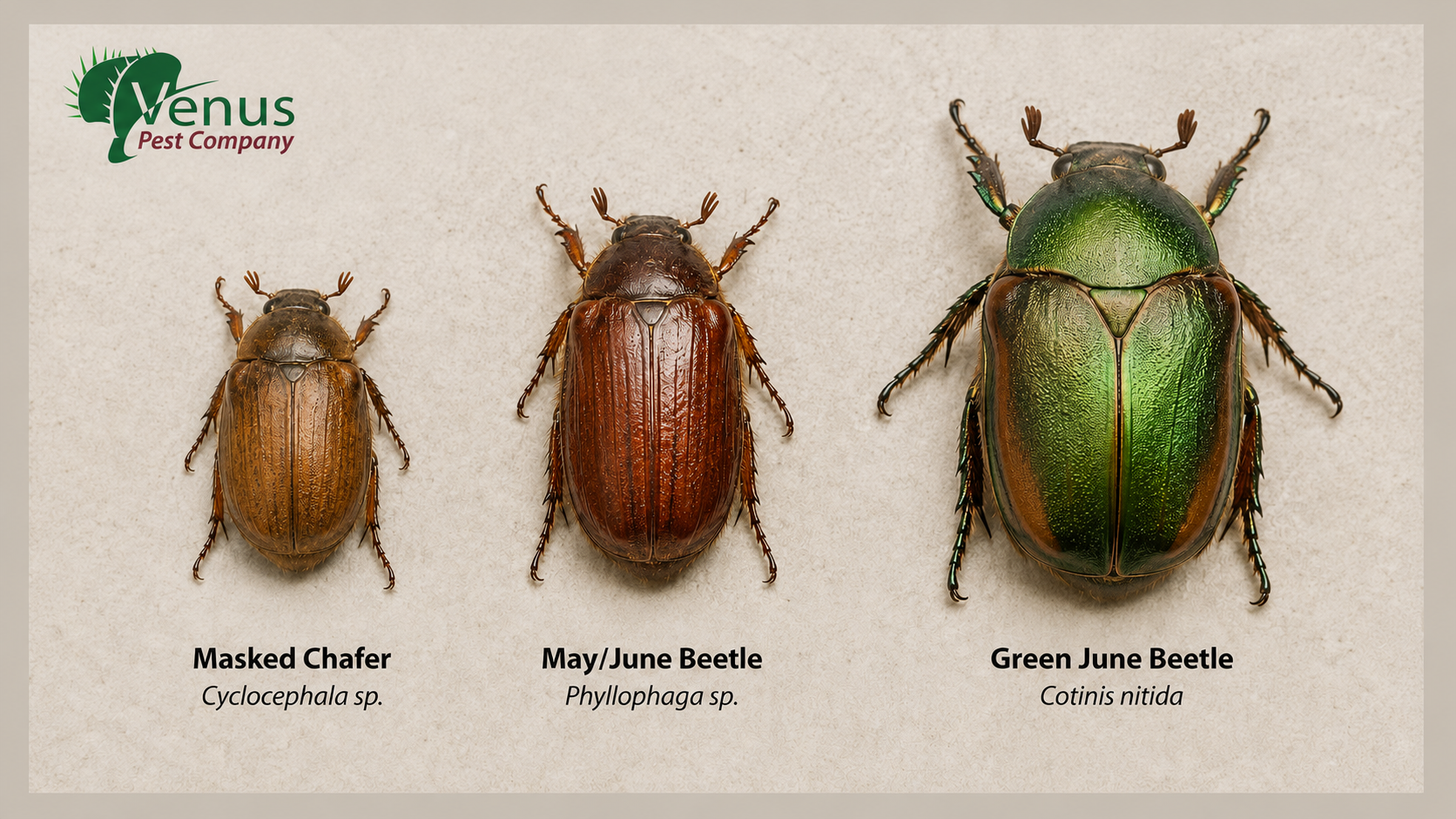
The name “June beetle” covers many species in the genus Phyllophaga. Adults tend to have heavy, oval bodies with reddish brown, tan, or dark coloring. They emerge during spring or early summer, fly at night, and often bump against windows and porch lights.
Southern masked chafers, Cyclocephala lurida, also produce important turf feeding grubs in Texas. The adults have tan bodies and a darker mask across the face. They may appear around lights during warm weather even when nobody notices the larvae below ground.
Other scarab larvae live in compost, decaying wood, manure, or rich organic soil. Some feed on decaying material rather than healthy grass roots. Dung beetles and predatory scarabs also belong to the same broad beetle family. Finding a white C shaped larva somewhere on the property does not automatically prove that it caused a lawn problem.
The White Grub Life Cycle
The lawn damaging species that matter most in Texas generally follow a one year cycle. Adult beetles emerge from the soil, mate, and place eggs below the turf during late spring or early summer. Moist soil often favors egg survival.
The eggs hatch into small first stage grubs. These young larvae begin feeding on grass roots and grow through three larval stages. They cause the greatest concern from summer into early fall as they consume roots and gain size.
When soil temperatures cool, mature grubs move deeper into the ground. They return toward the root zone as conditions warm, but spring feeding usually causes much less turf damage than late summer feeding. Texas A&M AgriLife makes this point clearly: large grubs uncovered during spring gardening look alarming, but treating those mature larvae rarely provides the same value as targeting the next generation when it is young.
The mature grub eventually pupates in the soil. An adult beetle develops inside the pupal chamber, emerges, and begins the cycle again.
Why Timing Matters More Than Seeing Adult Beetles
Young grubs sit near the root zone and remain easier to manage than large late season larvae. Once they grow, move deeper, and cause visible root loss, the lawn has already absorbed much of the damage. Texas A&M guidance recommends targeting the period around egg hatch and the first weeks of larval development. For our part of Texas, that generally places the important window in June.
Adult flights provide biological context, but porch light activity does not tell you how many eggs landed in a particular lawn. Beetles can fly from surrounding fields, pastures, and neighboring properties. Several harmless scarab species also emerge during spring and respond to lights without producing damaging turf grubs.
Venus does not set traps at each residential property and wait for a beetle count before scheduling routine grub protection. We follow Texas timing guidance for the region. That approach targets the vulnerable stage without pretending that a single light trap can predict the exact grub population beneath every yard.
What I Learned Working on Scarab Beetle Traps
Earlier in my career, I worked at Trécé, Inc. and spent time working with Dr. Michael Klein of The Ohio State University on traps and attractants for scarab beetle monitoring. The goal was to track adult activity well enough to improve the timing of management in settings where precise population information mattered.
The research surrounding that work became much larger than one trap or one field. A published study on Phyllophaga sex attractants deployed different lure blends at 59 locations across the United States and Canada. Cooperators captured more than 57,000 male beetles representing 61 species. During the early years, the project used Trécé Japanese beetle vane traps along with another commercial trap design.
The study also showed why scarab monitoring poses a complicated challenge. Different species responded to different blends, and some populations of the same species showed geographic differences in their response. A lure that performs well for one beetle in one place may not tell the same story somewhere else.
That work gave researchers and pest managers a better way to study beetle flights and match management timing to adult activity. Our residential program uses the same basic biological principle, but not the same research protocol. We rely on Texas recommendations for seasonal timing rather than placing pheromone traps at every home.
What Does Grub Damage Look Like?
White grubs feed on roots, so the first visible symptom often resembles drought stress. Grass may wilt, lose color, thin out, or form irregular brown patches even when the surrounding lawn looks healthy. Damaged turf cannot pull water and nutrients from the soil effectively.
As root loss increases, the sod may feel spongy underfoot or lift easily from the soil. Healthy turf resists when you tug it because the roots anchor it. Grub damaged turf may peel back with little effort.
Armadillos, skunks, raccoons, and birds can make the problem more obvious. They dig or pull at turf while hunting the larvae. Those animals may cause additional damage, but their activity does not prove that grubs caused the original decline. They also search for earthworms and other soil organisms.
Damage often appears in patches because eggs, soil moisture, turf condition, and larval survival vary across a property. One area can support a damaging population while another section of the same yard has very few grubs.
How to Confirm a White Grub Problem
Brown grass alone does not diagnose grubs. Start near the edge of an active patch, where weakened grass meets healthier turf. Cut and lift a section of sod, then inspect the root zone and the upper few inches of soil. Check several locations because grubs rarely spread evenly across the lawn.
Texas A&M uses roughly five to ten grubs per square foot as a general damage threshold, although turf condition changes how many a lawn can tolerate. A healthy lawn with a strong root system may support more grubs without visible injury. A drought stressed or poorly rooted lawn may show damage at a lower number.
Grub size and season matter too. A few large mature grubs found during spring do not create the same concern as a group of small actively feeding larvae during summer. Identification, density, grass condition, and timing should all inform the diagnosis.
Grubs or Another Lawn Problem?
Several common Brazos County lawn problems can mimic root feeding. Looking at the pattern and the plant parts under attack helps separate them.
| Possible cause | What you may notice | Useful clue |
|---|---|---|
| White grubs | Irregular thinning, wilting, and brown turf | Roots are damaged and sod lifts easily; C shaped larvae appear in the soil |
| Chinch bugs | Expanding yellow or brown patches, often during hot weather | Small bugs occur in the thatch near the edge of the damaged area |
| Irrigation problem | Repeating dry areas or a pattern that matches sprinkler coverage | Soil moisture differs noticeably between healthy and damaged turf |
| Lawn disease | Discolored leaves, spots, rotting tissue, or patches tied to wet conditions | Roots may remain anchored while leaf symptoms provide stronger clues |
| Armyworms | Rapid loss of green leaf tissue | Caterpillars feed above ground and may move across the turf quickly |
Treating the wrong cause wastes time while the lawn continues to decline. A grub service cannot repair poor sprinkler coverage, and disease management will not stop larvae from eating roots.
Are Adult June Beetles Damaging the Lawn?
Adult June beetles usually do not cause the root damage associated with white grubs. The adults may feed on foliage or flowers, depending on the species, but the underground larvae create the familiar turf problem.
Large numbers of adults around a porch light can look serious without predicting lawn damage. The beetles may come from a broad surrounding area, and some spring scarabs do not feed on turf as larvae. Venus does not offer a separate service aimed at eliminating adult June beetles simply because they gather around lights.
Reducing unnecessary exterior lighting, choosing warm colored lamps, and keeping doors closed can limit indoor nuisance activity. Those changes address beetles at the building without claiming to control the next generation beneath the entire landscape.
Does Good Lawn Care Prevent Grubs?
A healthy lawn tolerates root loss better than stressed turf, but good maintenance cannot guarantee that beetles will avoid it. Proper mowing, irrigation, and fertilization support root growth and help grass recover. Excessive irrigation during adult egg laying and egg hatch can sometimes create favorable soil moisture, while severe drought weakens the turf and reduces its ability to withstand feeding.
Thatch does not cause white grubs, and routine aeration does not end their life cycle. Those practices may improve general turf health when the lawn actually needs them, but they should not replace identification and correct seasonal timing.
Professional Grub Protection in Brazos County
White grub management works best before root damage becomes obvious. Venus Pest Company offers lawn protection for grubs, chinch bugs, and aphids in Bryan, College Station, and communities throughout Brazos County. We plan grub service around the young larval stage identified in Texas guidance.
We do not provide homeowners with a shopping list of products or suggest that every grub requires treatment. The property’s history, turf value, current symptoms, and season all matter. Lawns with recurring grub damage present a different risk from a yard where someone found one mature larva while planting flowers.
Our owner, Dr. Scott Lingren, earned his PhD in entomology and graduated from Texas A&M with the Class of 1999. His experience includes scarab trapping and attractant research from his time at Trécé, Inc., along with decades of practical pest management. To ask about lawn insect protection, call or text 979-774-0486 or use our contact form to request service.
White Grub FAQs
What do white grubs turn into?
White grubs become scarab beetles. Common Texas turf species develop into May or June beetles and southern masked chafers.
What month do grubs damage lawns in Brazos County?
Young grubs begin feeding after eggs hatch in early summer, and damage may develop through summer and early fall. Texas guidance places the most useful preventive timing around the early larval period, generally during June in our region.
Do grubs bite people or pets?
No. White grubs live in soil and feed on roots, organic material, or other small organisms depending on the species. They do not attack people or pets.
Does finding one grub mean my lawn needs treatment?
No. Soil naturally supports many insects. Grub density, species, season, turf health, and evidence of root damage determine whether the population matters.
Why does grub damaged sod lift so easily?
The larvae chew through the roots that anchor grass to the soil. When enough roots disappear, the turf can peel back like loose carpet.
Do armadillo holes prove that I have grubs?
No. Armadillos eat grubs, but they also hunt earthworms and other soil animals. Inspect the root zone before blaming white grubs for the digging or lawn decline.