
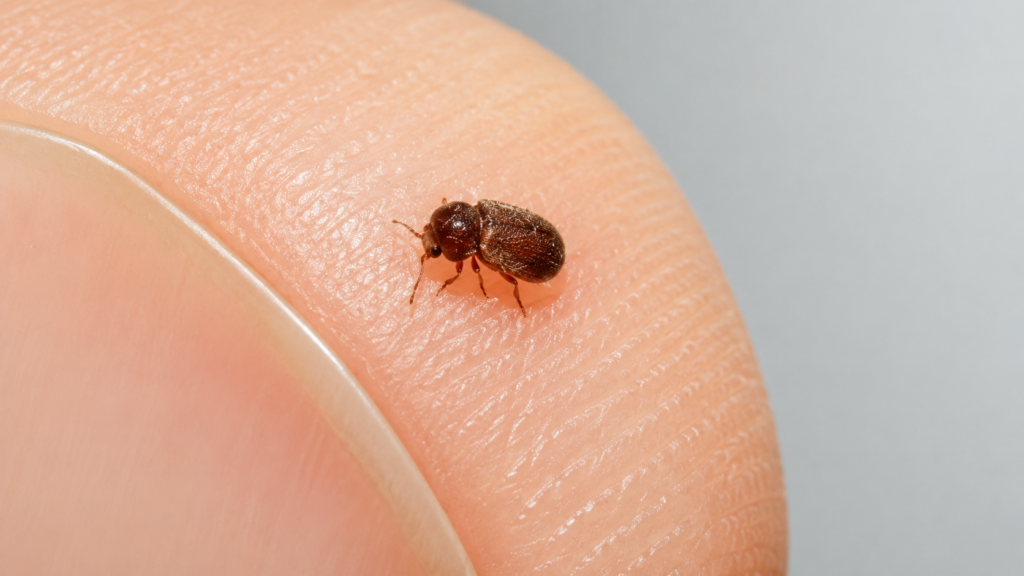
Drugstore beetles are tiny brown insects that infest dry food, spices, pet food, dried plants, and an unusually broad range of other stored materials. Most homeowners first see the adults flying near a window or crawling across a counter. The source may sit in the pantry, but it could just as easily be an old spice container, forgotten dog treats, bird seed in the garage, or a dried flower arrangement in another room.
These beetles usually arrive inside an infested product. They don’t commonly fly in from the yard and then go searching for a box of crackers. Once adults emerge, however, they can fly toward lights and appear far from the material where their larvae developed.
Drugstore beetles thrive in warm buildings, which makes them well suited to homes and businesses in Bryan, College Station, and the rest of Brazos County. Their broad diet and small size can make the source harder to find than people expect.
What Does a Drugstore Beetle Look Like?
Adult drugstore beetles measure about 1/10 inch long. Their cylindrical bodies range from light brown to reddish brown. The head bends downward beneath the thorax, so it may disappear from view when you look at the beetle from above. That posture gives the insect a rounded, humped appearance.
Under magnification, the wing covers show neat rows of tiny pits that create a lined or striated pattern. The antennae end in a distinct club formed by the final three segments. Those two features help separate a drugstore beetle from its close relative, the cigarette beetle.
Drugstore beetle larvae look like small white or cream colored grubs with brown heads. Older larvae curl slightly and resemble miniature scarab beetle grubs. The larval stage causes most of the feeding damage and usually remains hidden inside the affected material.
Drugstore Beetle or Cigarette Beetle?
Drugstore and cigarette beetles look nearly identical without magnification. They have similar habits, infest many of the same products, and often appear near windows because both species fly. A close view of the antennae and wing covers provides the most dependable separation.
| Feature | Drugstore beetle | Cigarette beetle |
|---|---|---|
| Scientific name | Stegobium paniceum | Lasioderma serricorne |
| Antennae | End in a three segment club | Have a sawlike or serrated shape |
| Wing covers | Rows of pits create visible lines | Look smooth and carry fine hairs |
| Body shape | Cylindrical and slightly less rounded | More rounded and oval |
| Familiar association | Dry food, spices, medicinal herbs, and many other materials | Tobacco, spices, dry food, and plant products |
The common names describe famous associations, not the limits of either insect’s diet. Drugstore beetles don’t live only in pharmacies, and cigarette beetles don’t require tobacco. Both can infest common pantry foods.
For most residential problems, separating the species doesn’t change the first priority. The inspection still needs to locate every product where larvae feed. Identification matters because similar looking beetles outside this pair may point toward a very different source.
Why Are They Called Drugstore Beetles?
Old pharmacies stored dried medicinal herbs, plant products, and other materials that these beetles could eat. Drugstore beetles also gained a reputation for damaging packaged medicines. Their scientific name, Stegobium paniceum, refers to their long association with bread and other stored foods.
The species has an odd ability to survive on dry materials with limited nutritional value. That flexibility helps explain reports from books, dried specimens, leather, hair, and products that contain starch based glues. In homes, though, food, spices, pet products, and dried decorations provide more likely starting points.
What Do Drugstore Beetles Eat?
Drugstore beetle larvae feed in flour, cereal, baking mixes, crackers, cookies, pasta, rice, chocolate, nuts, seeds, dried fruit, coffee, tea, and many herbs or spices. Pet food, dog treats, bird seed, fish food, and wildlife feed can support them too.
Spices deserve special attention. Paprika, chili powder, red pepper, and other rarely used seasonings may sit undisturbed for years. A small container can produce enough adults to make the kitchen look as though beetles are coming from several places.
The insects also use dried flowers, potpourri, decorative seed arrangements, tobacco, dried botanical material, and some animal based products. This range creates the main challenge. Someone may throw away every bag of flour and still miss the old wreath or pet treats that started the infestation.
How the Life Cycle Hides an Infestation
Female drugstore beetles place eggs directly in or near suitable material. The eggs hatch into small larvae that burrow through the food or other product as they feed. Their activity may produce powdery debris, small tunnels, or tiny holes, but a closed package can hide those signs.
When mature, a larva creates a protected cell in the material and pupates. The new adult chews its way out, sometimes leaving a clean round hole through the product or its package. Adults then fly toward light, which explains why people often find them on windowsills instead of beside the source.
Temperature and food quality strongly influence development. The life cycle may take less than two months under favorable conditions or stretch across several months. Because different stages overlap, one old product can continue producing adults for a long time.
How Did Beetles Get Into an Unopened Package?
Paper, cardboard, foil liners, and thin plastic look sealed to us but may include folded seams or small imperfections. Larvae can also chew through some packaging. An adult emerging from a package may leave a round hole that looks as though someone pierced it with a fine pin.
An infestation may begin before the product reaches your home. Finding drugstore beetles doesn’t prove that the pantry is dirty. Good sanitation limits food debris and secondary sources, but any household can bring home an affected item.
Airtight glass or sturdy plastic containers offer better containment. They won’t prevent larvae already inside a product from developing, but they can stop emerging adults from reaching everything around them. Clear containers also make a hidden problem easier to notice.
Signs of a Drugstore Beetle Infestation
Flying adults near windows provide the most common clue. You may also find small reddish brown beetles on counters, inside cabinets, or around light fixtures. Because adults can fly, their location may not identify the room that holds the source.
Inside a product, look for cream colored larvae, powdery debris, damaged material, or round emergence holes. Package seams may hold shed skins, dead beetles, or pupal material. A spice jar or bag of dry food may look normal on top while larvae remain active deeper inside.
One adult doesn’t always mean a widespread infestation. Repeated sightings, several beetles at one window, or larvae inside a product deserve a broader inspection. The pattern over time tells more than one isolated beetle.
How to Find the Source
Start with dry foods and spices near the room where adults appear. Open suspect products over a light colored tray and inspect the contents under good light. Pay attention to old seasonings, baking supplies, crackers, tea, pet treats, and foods that nobody has used recently.
Then search beyond the kitchen. Check the garage, laundry room, utility spaces, storage closets, and pet feeding areas. Bird seed, fish food, dried flowers, potpourri, seed crafts, and forgotten decorative materials can keep producing beetles after a pantry cleanout.
Place affected products in a sealed bag and remove them from the home. Vacuum shelf corners, cabinet joints, peg holes, and any place where crumbs or powder have collected. Check beneath shelf liners and removable shelves, then empty the vacuum outside.
Don’t stop after finding the first source. Flying adults may have reached another suitable product. Inspect nearby items before returning them to storage, and wash reusable containers before refilling them.
A few adults may still emerge after cleanup because some larvae or pupae had already developed away from the main product. Activity should decline. Continued or increasing sightings usually mean that another source remains.
Are Drugstore Beetles Harmful?
Drugstore beetles don’t bite or sting people, and they don’t infest the structure of a home. Their damage involves contamination and loss of stored products.
Larvae leave waste, shed skins, insect fragments, and feeding debris inside whatever they infest. They may also damage packaging as adults emerge. Discard most inexpensive affected food because removing or killing the insects wouldn’t remove the contamination.
Commercial kitchens, food warehouses, grocery stores, and pet related businesses face a larger risk. One overlooked source can spread through inventory, and adults may travel well beyond the original package. A good inspection needs to follow the insect’s biology rather than stop at the first shelf where someone sees it.
Preventing Future Drugstore Beetle Problems
Buy dry foods, spices, and pet products in quantities you’ll use within a reasonable time. Check packaging for holes, food dust, or insects before purchase. At home, rotate older products forward and remove items that have sat unused for years.
Store susceptible products in airtight glass or sturdy plastic containers. Clean spills promptly and wash containers before adding new food. Give items in garages and pet areas the same attention as food in the pantry.
Dried decorations need their own inspection. A wreath, potpourri bowl, or seed filled craft can become an overlooked food source. If beetles keep appearing after the pantry looks clean, those less obvious materials deserve another look.
Professional Drugstore Beetle Control
Drugstore beetles feed in more materials than most pantry pests, so the source can hide where nobody expects it. They also resemble cigarette beetles and other small brown beetles. An incorrect identification can send the inspection toward the wrong foods or even the wrong part of the building.
Venus Pest Company identifies the insect, studies where adults appear, and searches for products that support the larvae. We consider the pantry along with garages, closets, pet areas, dried decorations, and commercial storage spaces. The goal is to find why beetles continue emerging, not simply remove the adults at a window.
Venus Pest Company serves Bryan, College Station, and the rest of Brazos County. Owner Scott Lingren holds a PhD in entomology and has worked with insects since childhood. If small brown beetles keep flying around your kitchen or windows, we can determine what they are and where the inspection should focus.
Call or text 979-774-0486 or request service online.
Frequently Asked Questions
Can drugstore beetles fly?
Yes. Adults fly well and often move toward windows or lights. Their appearance near a window usually points toward an indoor product rather than an invasion from outdoors.
Are drugstore beetles the same as cigarette beetles?
No. They’re closely related and look similar. Drugstore beetles have lined wing covers and clubbed antennae, while cigarette beetles have smooth wing covers and sawlike antennae.
Why are drugstore beetles in my spices?
Their larvae can develop in many dried plant products, including paprika, chili powder, herbs, and other seasonings. Old spices often remain undisturbed long enough for an infestation to grow.
Can drugstore beetles infest unopened food?
Yes. An infestation may begin before purchase, and larvae can penetrate some packaging. Small gaps in ordinary package seams also allow insects to move between products.
Do drugstore beetles eat books?
They can damage paper products and materials that contain starch based glues, but stored food, spices, pet products, and dried plant material provide more common household sources.
Why do beetles remain after I cleaned the pantry?
The source may sit outside the pantry, or adults may still emerge from larvae and pupae that had already developed. Continued or increasing activity usually means another affected product remains.