
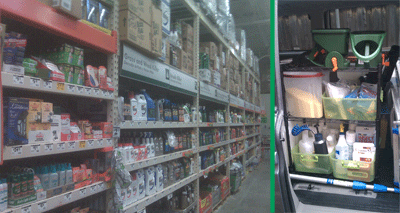
Back at the office, everything I carried in my service vehicle at that time fit on a shelf about 13 inches deep with three tiers.
The difference was not a collection of secret chemicals. Many consumer and professional products rely on similar principles. The real difference was knowing what pest I was dealing with, where it lived and which part of the problem needed attention.
A store sells a product. A professional service should provide a diagnosis, a plan and responsibility for the result.
My Mother’s Carpenter Ant Problem
Before I moved back to College Station, my mother developed a serious carpenter ant problem. She waited for me to return, but the activity became bad enough that she bought a large bag of ant control material from a hardware store.
She followed the directions and placed it across the ants’ trail near the garage. The ants were moving along the bottom of the garage door and entering a weep hole. Unfortunately, the material created a strong odor and visible piles around the area. The ants continued walking through it and into the house.
When I arrived, I removed the mess and inspected the activity. These were carpenter ants, not a generic category called household ants. Their size, nesting behavior and seasonal activity gave me a different set of questions to answer.
Where were they nesting? Were they only foraging through the garage area? Did moisture or damaged wood make part of the structure more suitable? Was the visible trail connected to the main colony?
Once I identified the ants and treated the problem according to their biology, the activity stopped. The lesson was not that everything sold to consumers fails. Some products work well when they match the pest and situation. The lesson was that a label cannot inspect a house or reconsider the plan when the first attempt does not work.
Identification Comes Before Control
People often shop for “ant killer,” “roach spray” or “bug control.” Those categories sound useful in an aisle, but they hide important biological differences.
A carpenter ant does not behave like a fire ant, rover ant or ghost ant. A German cockroach infestation inside a kitchen requires a different investigation from an outdoor cockroach that wandered through a doorway. A springtail near a bathtub points toward moisture, while a flea jumping near a pet has a completely different life cycle.
Misidentification wastes time and can make the original evidence harder to interpret. Accurate identification narrows the search for food, moisture, nesting sites and entry points.
The EPA’s Integrated Pest Management principles place monitoring and identification before control decisions. That order matters because not every organism needs control and no single method fits every infestation.
The Product Is Only One Part of the Work
A pesticide label explains where and how the product may legally be used. It does not evaluate the construction, find hidden moisture or determine whether the insect in front of you represents the main infestation.
Professional pest control also includes decisions about where not to treat. Children, pets, food areas, pollinators, aquariums and sensitive surfaces all affect the plan. Using more material does not make a poor diagnosis better.
The inspection may reveal that exclusion, sanitation, moisture correction or removal of a food source matters more than a pesticide. It may also reveal that the pest came from an item brought into the building rather than through the foundation.
That is why the shelf comparison stayed with me. The smaller professional inventory did not prove that I owned better bottles. It showed that pest control depends more on choosing and using a limited set of tools with purpose.
Follow Up Changes the Outcome
A consumer purchase ends at the register. The store does not return to see whether the pest disappeared, whether the identification was correct or whether a hidden source remains.
A professional service should include a way to evaluate the result. Some infestations need time because the insects remain hidden or continue emerging from protected stages. Others require another inspection when activity moves or new evidence appears.
Venus Pest Company’s regular plans include return visits for covered pests when needed. That does not mean every pest belongs to every plan. Termites, active rodents, fleas, bed bugs, mosquitoes and wildlife may require separate programs or estimates.
Clear coverage matters more than a vague promise that one visit solves everything.
When Simple Prevention Is Enough
Not every sighting requires professional treatment. A single outdoor insect may have wandered inside. Correcting a leaking pipe, removing spoiled food or closing an obvious entry point may solve the condition that attracted a nuisance pest.
Homeowners can also help by saving a specimen, taking a clear photograph and noting exactly where and when activity occurs. That information often matters more than a photograph of a product someone already tried.
The decision to call a professional should consider the pest, location and consequences of getting it wrong. Hidden wood damage, repeated indoor activity, contamination, stinging risk and animals inside a structure deserve more caution than one harmless insect near a door.
Some Problems Become Harder After Repeated Attempts
We regularly treat German cockroach, flea and bed bug infestations after consumer foggers or other broad attempts failed. One German cockroach job in a mobile home showed how dangerous that can become. The residents had placed a fogger beneath the sink beside a stove. The pilot light ignited it, and they said the entire trailer expanded and shrank back. Fortunately, they got out before the explosion.
The physical damage remained visible when I arrived to handle the cockroach infestation.
That experience goes far beyond an ineffective bag of ant material. It is one reason we do not publish pesticide products, ingredients, quantities or homeowner application instructions. A recommendation that ignores the building, ignition sources, pets, occupants and pest biology is not responsible advice.
What Professional Pest Service Should Include
A professional should identify the pest, inspect the property and explain what evidence supports the conclusion. The plan should address the organism’s biology and the conditions allowing it to persist.
The customer should also understand which pests the service covers, what cooperation is needed and what happens if activity continues. Treatment without communication leaves the customer guessing even when the technician made a sound decision.
For businesses, the plan must account for operating hours, customers, food areas, records and the facility itself. Our commercial pest control programs are customized for the property and define included and optional pests in the proposal.
The Venus Difference
Dr. Scott Lingren founded Venus Pest Company in 2001 after a career in entomology. He holds a PhD in entomology from Texas A&M University and has studied insects since childhood.
Venus serves Bryan, College Station and the rest of Brazos County. Our programs use identification, inspection and Integrated Pest Management rather than treating every building and pest the same way.
Basic Pest Control covers many common household pests through scheduled visits and return service for covered activity. The HomeGard, HomeGard Plus and TotalGard plans combine additional protections. Active infestations or pests outside regular coverage receive the appropriate separate service or estimate.
If you are unsure what you found or whether professional help makes sense, call or text 979.774.0486, or email [email protected]. A photograph and a short description of where the activity occurs can help us start with the right questions.
Common Questions About DIY and Professional Pest Control
Do professional companies use stronger pesticides?
That is not the most useful distinction. Product availability and licensing vary, but identification, inspection, placement, risk management and follow up often create the larger difference in results.
Can I identify a pest with an online photograph?
Sometimes. A clear image can narrow the possibilities, but scale, behavior, location and an intact specimen may reveal details that a photograph misses.
Why did an ant product fail even though I followed the label?
Several explanations are possible. The ants may have been misidentified, the material may not have matched their behavior, or the visible trail may have represented only one part of a larger colony. An inspection replaces guessing with evidence.
Does seeing one insect mean I need pest control?
No. One harmless outdoor insect near a door may need nothing more than removal. Repeated activity, structural damage, contamination or a pest capable of establishing indoors deserves closer attention.
What does a pest control guarantee cover?
Coverage depends on the company and service agreement. Venus provides return service for pests covered by the selected plan. Separate programs and excluded pests should appear clearly in the estimate or agreement.
Is professional service safer than doing it myself?
A trained professional should consider the pest, building, occupants, pets, environment and label requirements before choosing a method. No pesticide use is free of responsibility, whether the product comes from a store or a professional supplier.