
Pest Expert Overview: Armadillos in Bryan & College Station
The animal usually is not trying to destroy the landscaping. It is searching for food. That distinction matters because many popular armadillo remedies focus on the wrong target. Killing a few lawn grubs, installing a noisy device, or putting out a strong smelling product will not necessarily make the property less attractive. Armadillos eat many kinds of insects and other invertebrates, and research based wildlife guidance has not found a dependable repellent that drives them away.
When the damage becomes unacceptable, trapping usually provides the most practical answer. Armadillos do not respond to bait the way raccoons, opossums, or many other nuisance animals do, so success depends heavily on reading their travel routes and placing equipment where the animal already wants to go.
The Nine Banded Armadillo in Texas
Brazos County has one armadillo species, the nine banded armadillo, Dasypus novemcinctus. Texas Parks and Wildlife recognizes it as the official small mammal of Texas. Despite the name, the flexible section of its shell may have seven to eleven bands.
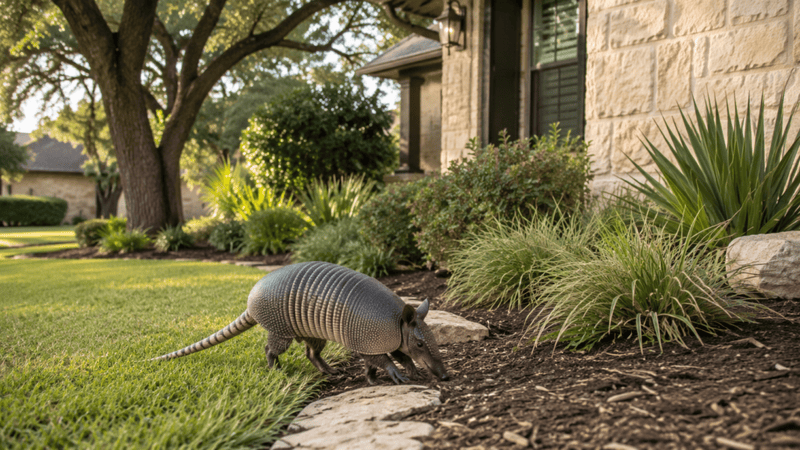
An adult usually grows about as large as a small dog, with a long tapered tail, pointed snout, short legs, and powerful front claws. Bony plates cover the head, back, sides, tail, and outer legs. Tough skin and sparse hair cover the underside.
Armadillos rely much more on smell than eyesight. They move through leaf litter and turf with their nose close to the ground, pausing to dig when they detect insects, larvae, earthworms, spiders, or other small animals beneath the surface. More than 90 percent of their diet may consist of insects and other invertebrates, although they sometimes eat fruit, roots, seeds, and small vertebrates.
Armadillos can provide benefits where their digging causes no conflict, but the same feeding behavior can tear through lawns, planted beds, and landscaping beside buildings.
What Armadillo Damage Looks Like
Most armadillo lawn damage comes from shallow feeding holes rather than a permanent burrow. Typical holes measure roughly 3 to 5 inches across and 1 to 3 inches deep. The animal may leave one isolated divot or dozens of holes spread across the yard.
In flower beds, an armadillo can flip mulch, disturb edging, expose roots, and uproot small plants while searching the loose soil. Freshly watered ground often attracts more attention because soft soil makes digging easier and brings some invertebrates closer to the surface.
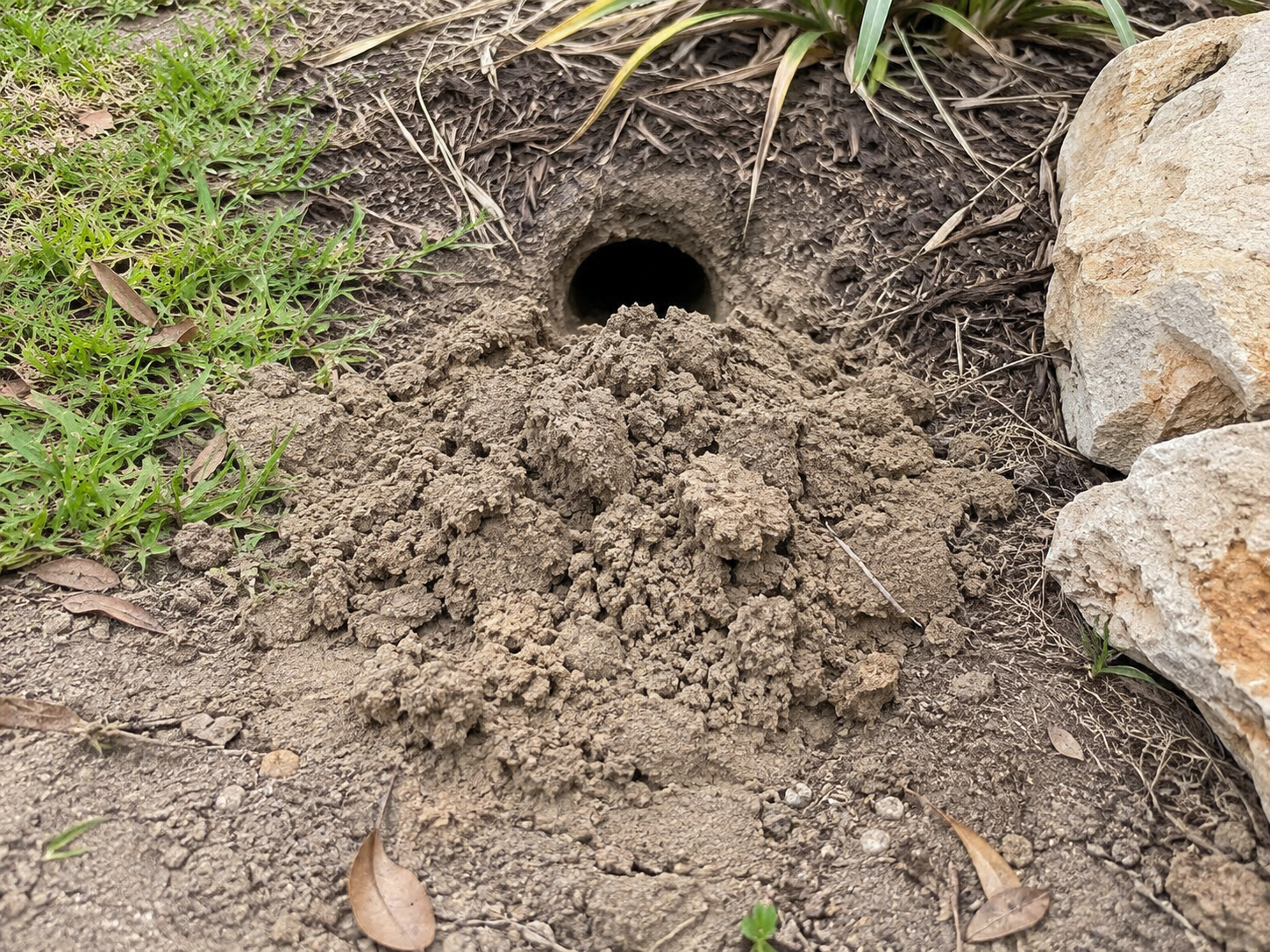
A den entrance looks different. Armadillo burrows often measure 7 or 8 inches in diameter and may extend 15 feet underground. The entrance usually sits beneath brush, beside a stump, under a deck, along a fence, or near another form of cover. One armadillo may use several burrows within its home range, so an empty looking hole does not necessarily mean the animal has abandoned the property.
Burrows beside a slab, driveway, pool deck, retaining wall, or other structure deserve closer attention. Armadillos do not eat concrete or intentionally attack foundations. Their excavation can remove supporting soil or contribute to erosion, however. Serious structural damage is far less common than torn turf, but location makes the difference. A shallow feeding hole in the middle of the lawn does not carry the same concern as an active burrow disappearing beneath a slab.
Armadillo Damage or Another Animal?
Several Brazos County animals dig for food, and the damaged lawn does not always reveal the culprit. A trail camera can settle the question when tracks and holes remain unclear.
| Animal | Common damage pattern | Helpful clue |
|---|---|---|
| Armadillo | Numerous conical holes scattered through turf or mulch | Narrow snout marks, small digging holes, and nighttime activity along fences or beds |
| Raccoon | Sod pulled, peeled, or rolled back while searching for food | Hand shaped tracks with five long toes |
| Skunk | Small cone shaped holes, often grouped in a feeding area | Five toed tracks, occasional odor, and holes that may resemble armadillo feeding |
| Feral hog | Large areas of soil overturned or rooted deeply | Much heavier disturbance, hoofprints, and damage that looks plowed rather than poked |
| Squirrel | Small holes where it buried or recovered food | Daytime activity and shallow holes near trees |
Timing also helps. Armadillos usually forage at night during hot weather but may appear during the warmest part of a winter day.
Why Treating Lawn Grubs Does Not Solve the Problem
People often assume an armadillo digging in turf proves that the lawn has a grub infestation. Sometimes grubs contribute to the food supply, but that does not make them the only reason the animal visits.
Armadillos also eat ants, beetles, caterpillars, earthworms, spiders, centipedes, millipedes, and many other small animals in or near the soil. They may consume roots, fruit, or other plant material too. Removing one food item leaves plenty of alternatives.
Timing creates another problem with the grub theory. The large white grubs people find in spring developed from eggs laid during the previous summer. By late spring, many have moved deeper or begun preparing to pupate. A lawn treatment at that point may do little to those mature insects and even less to discourage an armadillo willing to eat everything else it finds.
Venus Pest Company does not recommend treating a lawn for grubs merely because an armadillo dug holes in it. Grub control should address a confirmed turf pest problem, not serve as an indirect wildlife repellent. Selling an unrelated lawn treatment would add cost without solving the armadillo problem.
Armadillo Reproduction and Activity
Nine banded armadillos have one of the strangest reproductive systems among mammals. Mating usually occurs during summer. After fertilization, the embryo delays implantation for several months. Active gestation then lasts about four months, with births usually occurring in March or April.
One fertilized egg normally splits into four genetically identical embryos. The mother produces identical quadruplets of the same sex. The young arrive with their eyes open and can walk within hours, although they remain in the burrow while their armor hardens and they grow. After a few weeks, they begin following their mother, and she continues nursing them for several months.
Armadillos do not form large social groups. Except for a mother with young, the animal damaging a lawn often travels alone. Multiple sets of tracks or damage in several places do not automatically prove that several armadillos occupy the property. One individual may cover a surprisingly large area and rotate among several dens.
They also handle water better than their heavy shell suggests. An armadillo may walk along the bottom of a narrow stream while holding its breath. In deeper water, it can swallow air, increase its buoyancy, and swim. A drainage ditch or creek does not necessarily block its movement into a neighborhood.
Can Armadillos Carry Leprosy?
Some nine banded armadillos in the southern United States naturally carry Mycobacterium leprae, the bacterium that causes Hansen’s disease, also called leprosy. That fact deserves respect without turning every armadillo sighting into a health scare.
The Centers for Disease Control and Prevention says transmission from armadillos to people may occur, but the risk remains very low. Most people who encounter an armadillo will not develop the disease, and about 95 percent of people have natural immune protection against it.
Avoid handling armadillos with bare hands or contacting their blood and body fluids. Keep pets away from trapped, injured, or dead wildlife. Anyone with a specific exposure or health concern should contact a medical professional rather than relying on pest control advice for a diagnosis.
Why Armadillos Are Difficult to Trap
Many wildlife traps depend on food or scent bait. Armadillos spend their nights probing soil for scattered prey, and no standard bait reliably draws them into a cage. A trap can sit only a few feet from fresh damage while the animal walks around it.
Placement makes the difference. Armadillos tend to follow edges, fences, buildings, landscape borders, and established paths. A trap positioned directly on an active route has a much better chance than one placed wherever it happens to fit. Guide boards can direct the animal toward the opening without depending on bait.
Double door cage traps work well in travel corridors because an armadillo can see an apparent path through the equipment. A single door trap may fit better at a confined burrow entrance or along a solid barrier. No setup works everywhere. Pets, children, drainage, sun exposure, non target wildlife, and access for daily inspection all affect the decision.
Patience matters too. An armadillo may alternate among several burrows and routes. Rain, irrigation, temperature, pets, and other disturbances can change its movement, so even a well placed trap may need adjustment.
Trained Wildlife Control From Venus Pest Company
Ken and I both completed the National Wildlife Control Operators Association’s two day Wildlife Control Operator Training Course. The course covers animal biology, property inspection, handling, safety, and management of wildlife commonly encountered around homes and commercial buildings.
That training does not make armadillos predictable. Nothing does. It does give us a better framework for evaluating the property, selecting equipment, reducing risks to non target animals, and planning what happens after a capture.
Our inspection looks for active feeding holes, burrows, tracks, fence crossings, travel edges, and places where the animal has squeezed beneath a structure. We also consider whether the damage actually came from an armadillo. Catching the wrong animal does not solve the problem and creates an unnecessary handling issue.
We follow current wildlife requirements and account for the setting before beginning removal. Texas Parks and Wildlife classifies armadillos as nongame animals, and regulations can change. The legal and practical options may depend on the property, trapping method, and planned disposition.
Removal stops damage from the captured animal, but it cannot make the neighborhood permanently armadillo free. Another animal may eventually discover the same food, cover, or access route. After activity ends, closing a specific gap, reducing dense ground cover, or repairing a burrow entrance may lower the chance of an immediate repeat. Full property exclusion often proves impractical because armadillos dig and travel over a much wider area than a typical residential yard.
Venus Pest Company provides armadillo inspection and trapping throughout Brazos County, including Bryan and College Station. If something is digging up your lawn or flower beds, call or text 979-774-0486, or email [email protected].
Armadillo Questions
Why is an armadillo digging holes in my lawn?
It is probably searching for insects, larvae, earthworms, or other food beneath the surface. Soft irrigated soil makes that search easier. The digging does not automatically prove that the lawn has damaging numbers of white grubs.
Will grub control make an armadillo leave?
Usually not. Armadillos eat many kinds of invertebrates and some plant material. Removing one possible food source leaves many others, so a grub treatment does not function as a dependable armadillo deterrent.
Do mothballs or repellents keep armadillos away?
Research based wildlife guidance has not identified a successful armadillo repellent. Products used outside their labeled purpose may also create risks for people, pets, and other wildlife. Trapping or a carefully designed physical barrier offers a more realistic response.
How can I tell a burrow from a feeding hole?
A feeding hole usually measures only a few inches wide and deep. A den entrance commonly measures 7 or 8 inches across and leads into a longer underground tunnel, often beneath brush, a stump, a deck, or another protected edge.
Do armadillos damage foundations?
Most armadillo complaints involve shallow lawn and flower bed damage. A burrow beside or beneath a slab, driveway, pool deck, or retaining wall can remove soil and deserves inspection. That does not mean every armadillo hole threatens a structure.
Are armadillos dangerous to people or pets?
Armadillos usually avoid confrontation, but any wild animal may scratch or bite when cornered or handled. Some can carry the bacterium that causes Hansen’s disease, although the CDC describes the risk to people as very low. Avoid direct contact and keep pets away.
Why has the trap not caught the armadillo yet?
Armadillos do not respond reliably to food bait, and they may alternate among several burrows and travel paths. Successful trapping depends on intercepting an active route. Changes in weather, soil moisture, pets, or other activity can shift that route.
Will removing one armadillo solve the problem permanently?
It stops damage from that animal. It cannot prevent every future armadillo from entering the property. Correcting a specific access point or removing dense cover may help, but complete exclusion from a residential yard often costs more and requires more construction than the damage justifies.