
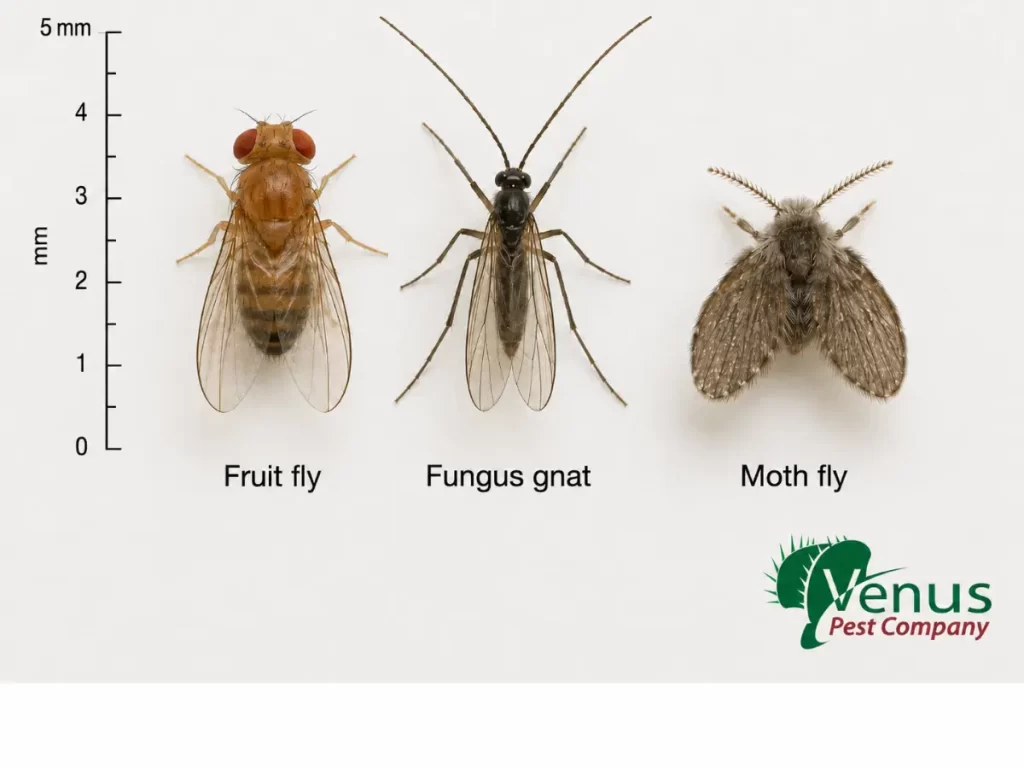
“Drain fly” is one of the most misused names in pest control. People tend to call any tiny fly near a kitchen or bathroom sink a drain fly. Unfortunately, plenty of pest control people do it too.
The fly may be breeding in the drain, but its choice of parking spot proves very little. It could be a fruit fly coming from a forgotten potato, a fungus gnat in wet potting soil, or a moth fly emerging from drain buildup. All three may collect around sinks for moisture, food odors, and light.
Getting rid of these flies starts with identifying which one you have. Killing the adults may make the room more pleasant for a day or two, but the problem continues until the material feeding the larvae is found and removed.
Which Small Fly Do You Have?
Most of the tiny flies we find indoors around Bryan and College Station fall into one of three unrelated groups.
| Type of fly | What it looks like | Most likely breeding material |
|---|---|---|
| Fruit fly | Compact, tan or brown body; many have red eyes | Fermenting fruit, vegetables, sugary drinks, beer, food residue, and other moist organic material |
| Fungus gnat | Slender, dark, long legged, and shaped like a tiny mosquito | Wet potting soil, fungi, decaying roots, and other damp organic material |
| Moth fly | Fuzzy body with broad, hairy wings; looks like a tiny moth | Organic film inside drains, sewer lines, grease traps, and persistently wet plumbing areas |
Catch one gently on clear tape without crushing it. A close photo through the tape often shows enough detail for identification. Where the adults gather helps narrow the search, but it does not prove the breeding site.
Fruit Flies Are the Usual Culprit in Restaurants and Bars
Fruit flies, also called vinegar flies, are the most common of these small flies in restaurants and bars. They are attracted to fermenting material and sugary liquids, and they really like spilled beer.
A small amount of beer beneath a cooler, bar mat, keg connection, floor edge, or piece of equipment can support continuous development. The same is true for residue around soda dispensers, recycling, trash, mop heads, and drains receiving beverage waste. Wiping the surface may not reach liquid inside a crack or beneath heavy equipment.
In homes, fruit flies commonly develop in overripe produce, potatoes or onions stored in a dark cabinet, recycling, old beverage containers, garbage disposals, lunch boxes, and small amounts of food that have rolled or leaked out of sight. The source can be tiny. That is why a spotless kitchen can still have hundreds of flies.
Fruit fly traps made with vinegar or wine can catch adults and help confirm the identification. They rarely solve the infestation. If new adults keep emerging, the trap is just keeping score.
Fungus Gnats Usually Point to Moisture
Fungus gnats look more like miniature mosquitoes than fruit flies. They have slender bodies, long legs, and long antennae. Adults are weak fliers and often make short flights or run across a surface.
Houseplants are the most common source. Fungus gnat larvae live in moist soil and feed mostly on fungi and decaying organic material. Constant watering keeps the soil wet and produces exactly the conditions they need. Letting the upper layer of soil dry between waterings often makes a major difference, provided the plant can tolerate it.
Plants are not the only possibility. Fungus gnats can also develop in wet potting soil stored in a bag, decaying roots, damp organic debris, water damaged building material, or soil and roots exposed by a plumbing problem. If the flies are not concentrated near a plant, the search has to expand.
Moth Flies Are the True Drain Flies
Moth flies are the insects most accurately called drain flies. Their broad, hairy wings give them a fuzzy, mothlike appearance. They are weak fliers and often rest on walls near showers, sinks, floor drains, and other damp areas.
Their larvae do not live in clean water. They develop in the wet organic film that builds up on a surface. That may be inside a sink or shower drain, but it can also be in a grease trap, condensate line, sewage ejector pit, damaged sewer line, or soil contaminated by a plumbing leak.
A few moth flies may come from buildup in an accessible drain. A heavy problem that continues after the drains have been thoroughly cleaned deserves more attention. I have found that persistent moth fly activity often points to a concealed plumbing or sewage problem. Pesticide cannot repair a failed sewer connection. The defect has to be located, repaired, and any contaminated material may need to be removed.
To test a suspected drain, place a clear cup or container upside down over it at night without creating a perfect airtight seal. Flies trapped beneath the cup the next morning probably emerged from that drain. Test drains separately and repeat the test for several nights if necessary. Simply placing sticky tape across the opening can be misleading because flies from elsewhere may land on it.
Why the Source Is Often Hard to Find
I have been called many times to find the source of fruit flies, fungus gnats, and moth flies after the obvious possibilities were eliminated. Usually, the house is pristine. That is part of what makes these cases so frustrating. Everyone has already checked the fruit bowl, emptied the trash, cleaned the sink, and poured something down every drain. The flies keep coming because the real source is hidden.
Twice in homes in Traditions, I found fungus gnats and fruit flies occurring together. In both cases, the source was a forgotten potato hidden behind something in the pantry. The decaying potato created enough moist organic material to support both types of flies.
At a home in Pebble Creek, the source was a toddler’s secret collection of opened GoGurt tubes tucked behind canned goods in the pantry. The kitchen itself was immaculate. The child had simply created a tiny fruit fly restaurant where no adult thought to look.
The most stubborn case was in a beautiful Indian Lakes home. After two thorough searches, I finally discovered a banana peel stuffed into a tiny side pocket of a soft sided lunch box. That overlooked pocket kept the infestation going.
These are not stories about dirty homes. They show how little material these flies need and how specific the search can become. When the obvious source is missing, think like a toddler and look inside every pocket. Tiny flies are excellent at making sensible adults feel slightly ridiculous.
How to Get Rid of Small Flies Indoors
Start with the adult fly. Identification tells you where to spend your time. A fuzzy moth fly justifies testing drains and plumbing. A mosquito shaped fungus gnat sends the investigation toward plants and damp organic material. A compact fruit fly shifts attention to produce, beverages, recycling, and hidden food.
Once the breeding material is found, remove it or clean it thoroughly. For fruit flies, that might mean discarding spoiled produce, cleaning beneath equipment, washing recycling containers, or finding a hidden food item. In a restaurant or bar, beer and sugary residue may need to be removed from cracks, equipment voids, drain edges, and areas beneath fixtures.
For fungus gnats, correct the moisture problem. Reduce watering, empty plant saucers, remove decaying roots, and allow the soil surface to dry when the plant permits. A plumbing leak or water damaged material needs to be repaired rather than repeatedly sprayed.
For moth flies, the organic film must be physically removed or digested with a drain product designed for that purpose. Pouring bleach or insecticide down a drain may kill some exposed insects, but it often passes through too quickly to remove the film where larvae are developing. If accessible drains are clean and the flies continue, a plumber may be needed to inspect for a damaged line or concealed leak.
Traps and targeted adult treatments can reduce the flies you see while the source is being corrected. They are support tools, not substitutes for finding the larval habitat.
Professional Small Fly Identification in Brazos County
Venus Pest Company approaches these problems as an investigation. We identify the adult fly first, then concentrate on the breeding materials that fit its biology. That is much more productive than treating every drain and hoping for the best.
Our pest management programs were developed by Dr. Scott Lingren, a Texas A&M trained entomologist with more than 40 years of hands on experience studying and managing pests. We serve homes and businesses throughout Bryan, College Station, and Brazos County.
If tiny flies keep appearing and you cannot find the source, capture one on clear tape and send us a close photograph. You can also call Venus Pest Company at 979-774-0486 or request service online. We’ll identify what you have and help determine where the next generation is coming from.
Frequently Asked Questions
Are fruit flies and drain flies the same thing?
No. Fruit flies are compact flies that develop in fermenting fruit, vegetables, beverages, and other moist food residue. True drain flies are moth flies with fuzzy bodies and hairy wings. They usually develop in organic film associated with drains or plumbing.
Why do I still have flies after pouring bleach down the drain?
The drain may not be the source. Even when moth flies are breeding there, bleach may pass through without removing the organic film attached to the pipe. The drain needs to be cleaned properly, and persistent activity may indicate another drain or a concealed plumbing problem.
Can fruit flies come from beer?
Yes. Fruit flies are strongly attracted to fermenting liquids, including beer, wine, syrup, and sugary drink residue. Spilled beer is one of the most common sources in bars and restaurants, especially when it collects beneath or behind equipment.
Can a clean house have fruit flies or fungus gnats?
Certainly. A single potato, banana peel, leaking drink container, overwatered plant, or hidden piece of food can support many flies. The condition of the rest of the house has little to do with that one concealed breeding site.
How long will the flies continue after I remove the source?
Adult activity should begin declining once the breeding material is removed, but flies already in the pupal stage may continue emerging for several days. If the numbers do not steadily decrease, another source may still be active.