
Pest Expert Overview: Flour Beetles in Bryan & College Station
Most flour beetle infestations begin inside a product brought into the home. The package may have picked up insects during processing, storage, shipping, or retail display. Once beetles emerge, they can crawl through loose package seams and spread to nearby foods. Red flour beetles can also fly when conditions suit them.
Our warm climate gives the red flour beetle an advantage in Bryan, College Station, and the rest of Brazos County. It occurs commonly in southern homes and businesses. Confused flour beetles favor somewhat cooler conditions and often cause trouble in flour mills and commercial food facilities, though either species can turn up locally.
What Do Flour Beetles Look Like?
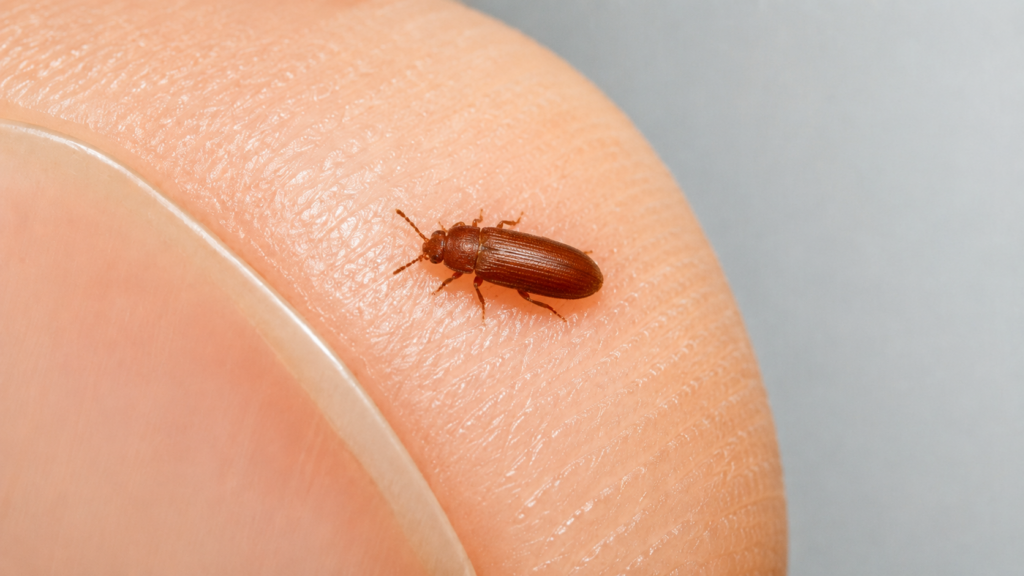
Adult red and confused flour beetles measure about 1/8 inch long. Their bodies look narrow, flat, and reddish brown, with sides that run almost parallel. They don’t have the long snout of a grain weevil or the sawlike teeth found on a sawtoothed grain beetle.
The larvae look cream to light brown with darker heads. Two small dark projections extend from the rear of the body. Larvae move freely through food rather than developing inside individual grain kernels.
To the naked eye, both adult species look nearly identical. The antennae provide the best difference under magnification. A red flour beetle has a distinct club formed by the final three antennal segments. A confused flour beetle’s antenna gradually thickens toward the tip across four segments. The sides of the red flour beetle’s thorax also curve slightly, while the confused flour beetle’s thorax looks more parallel sided.
The word “confused” doesn’t describe the insect’s state of mind. The name reflects the difficulty early entomologists had separating it from the red flour beetle.
Red Flour Beetle or Confused Flour Beetle?
| Feature | Red flour beetle | Confused flour beetle |
|---|---|---|
| Scientific name | Tribolium castaneum | Tribolium confusum |
| Antennae | Distinct three segment club at the tip | Gradual four segment club |
| Thorax | Sides curve slightly | Sides look more nearly parallel |
| Flight | Can fly in warm conditions | Cannot fly |
| Typical U.S. pattern | More common in warmer southern areas and homes | More common in cooler areas and flour mills |
Flight can provide a useful clue, but it doesn’t always settle the question. A red flour beetle may walk most of the time, so finding one crawling doesn’t make it a confused flour beetle. Likewise, seeing tiny brown beetles near a window suggests a flying species but doesn’t prove which pantry pest you have.
Fortunately, both flour beetles eat similar foods and require the same source focused inspection. If you don’t need a species level record, confirming the genus and finding the infested product usually provides enough information to solve a residential problem.
What Foods Do Red and Confused Flour Beetles Infest?
Their common name points toward flour, but their diet extends across much of a pantry. They feed in cornmeal, cereal, oatmeal, pasta, crackers, baking mixes, rice, damaged grain, nuts, seeds, chocolate, spices, dried fruit, and dried plant material. Dry pet food, pet treats, bird seed, fish food, and rodent food can also support them.
Flour beetles prefer finely milled food, grain dust, processed foods, and broken kernels. Entomologists classify them as secondary stored product pests because they usually cannot penetrate and develop in sound, undamaged grain. Grain weevils work differently. Their larvae can live inside intact kernels.
That distinction changes the search. A long snouted grain weevil directs attention toward whole rice, corn, wheat, or seeds. A flour beetle calls for a much broader look at processed food, damaged grain, crumbs, and dust. If flour beetles occur in whole grain, handling damage or another insect may have opened the kernels first.
How Flour Beetle Infestations Develop
Female flour beetles scatter tiny white eggs through food. The eggs have a sticky surface, so flour and dust quickly cover them. That camouflage makes them almost impossible to find during a normal pantry inspection.
The eggs hatch into slender larvae that feed while moving through the product. When mature, the larvae pupate loosely in food or nearby debris. Adults emerge and continue feeding, mating, and laying eggs. Under warm conditions, the full cycle can take roughly one to three months. Temperature and food quality can change that timing considerably.
Adults may live for many months, and a neglected package can contain eggs, larvae, pupae, and adults at the same time. This overlap explains why a small problem can grow quietly in something nobody uses often. By the time beetles appear across a counter, several generations may occupy the source.
Why Does Infested Flour Smell Strange?
Heavy flour beetle infestations can produce a sharp or unpleasant odor. The beetles release defensive chemicals called quinones, and those compounds can affect a food’s smell and taste. A heavily infested product may also develop a pinkish cast.
The amount of food the beetles consume tells only part of the story. Eggs, shed skins, waste, dead insects, and defensive secretions contaminate the product. Even when much of the flour remains, its quality may have declined enough to make it unusable.
An odd odor in flour, cereal, or another dry product doesn’t prove that flour beetles caused it. Moisture, mold, and rancid fats can create different smells. However, a sharp odor combined with small reddish beetles, pale larvae, or discolored flour makes a flour beetle infestation much more likely.
How Did Beetles Get Into a Closed Package?
Ordinary paper, cardboard, and thin plastic packages often include folded seams or tiny openings. Flour beetles have flat bodies and can pass through gaps that don’t look large enough to admit an insect. They may spread from one affected package into several others without leaving an obvious hole.
An unopened product may also contain insects that entered before purchase. Finding flour beetles in a clean home doesn’t mean poor housekeeping created them. Cleaning matters because spills and old food help an infestation persist, but any household can bring home an affected product.
Genuinely airtight glass or sturdy plastic containers work differently. If insects emerge from a product already inside, the container holds them there. Clear containers also make activity easier to notice before the beetles reach neighboring food.
How to Find the Source
Begin with flour, cornmeal, cereal, baking mixes, crackers, pasta, spices, nuts, dried fruit, and other dry foods near the sightings. Open suspect products over a light colored tray. Look for reddish adult beetles, cream colored larvae, shed skins, clumping, discoloration, or an unusual odor.
Then expand the inspection beyond the main pantry. In Brazos County homes, large bags of pet food, bird seed, or fish food may sit in a garage, laundry room, utility space, or closet. Warm storage speeds development, and food dust tends to collect near the bottom of a large bag. A forgotten box of baking supplies or old container of pet treats can cause the same problem.
Place affected products in a sealed bag and remove them from the home. Vacuum food dust and debris from shelf corners, cabinet joints, peg holes, and the floor beneath storage areas. Check beneath shelf liners and removable shelves. Empty the vacuum outside when you finish.
Don’t stop after finding the first source. Flour beetles crawl between packages, and red flour beetles may fly. Inspect nearby foods before returning them to storage. Wash and dry reusable containers before refilling them, and don’t pour new food on top of an older batch.
You may continue seeing a few adults after removing the source because some had already wandered away. Their numbers should fall steadily. Continued or increasing activity usually means another affected product or food spill remains.
Are Flour Beetles Harmful?
Red and confused flour beetles don’t bite or sting people. They don’t eat clothing, furniture, or structural wood. Their importance comes from food contamination and waste.
Most people should discard inexpensive infested food rather than try to save it. Removing or killing the insects wouldn’t take out their eggs, waste, shed skins, or chemical secretions. A product may no longer offer acceptable quality even if it still looks mostly full.
Commercial kitchens, grocery stores, food warehouses, and processing facilities face an added concern. A small source can spread into inventory, and flour dust around equipment can sustain activity. Accurate identification and a thorough inspection protect much more than the package where someone first noticed a beetle.
Preventing Future Flour Beetle Problems
Buy dry foods in amounts you’ll use within a reasonable time. Check packages for torn seams, food dust, or visible insects before purchase. At home, rotate older products forward and clean spills before they collect beneath shelves or appliances.
Store susceptible foods in tight glass or sturdy plastic containers. Apply the same habits to pet food, treats, bird seed, and baking supplies stored outside the kitchen. Wash containers between batches so a small amount of old food doesn’t carry an infestation into a fresh purchase.
These steps cannot prevent beetles that already live inside a newly purchased product from emerging. They can contain those beetles and keep one affected package from becoming a cabinet wide problem.
Professional Flour Beetle Control
Flour beetles resemble several other stored product pests, and each identification points toward a different group of foods. Confusing a flour beetle with a grain weevil can lead someone to inspect whole kernels while overlooking the flour, spices, or pet food that actually supports the insects.
Venus Pest Company identifies the beetle, studies where activity occurs, and searches for sources that a basic pantry cleanout missed. We consider food inside the kitchen as well as stored products in garages, utility rooms, closets, pet areas, and commercial storage spaces. The goal is to find where the beetles develop and why they keep appearing.
Venus Pest Company serves Bryan, College Station, and the rest of Brazos County. Owner Scott Lingren holds a PhD in entomology and has worked with insects since childhood. If reddish brown beetles keep showing up in your pantry or around your windows, we can identify them and determine where the inspection should focus.
Call or text 979-774-0486 or request service online.
Frequently Asked Questions
Can red flour beetles fly?
Yes. Red flour beetles can fly in warm conditions, although they also crawl readily. Confused flour beetles cannot fly.
Why are flour beetles near my windows?
Red flour beetles may fly toward light, while either species can wander away from infested food. Beetles near a window often came from a product somewhere inside the building.
Do flour beetles only infest flour?
No. They use many processed dry foods, including cereal, baking mixes, pasta, crackers, spices, nuts, dried fruit, chocolate, and pet food.
Can flour beetles infest whole grain?
They may feed on cracked or damaged kernels, but they usually cannot develop in sound grain. Grain weevils can attack intact kernels and may create damage that flour beetles later use.
Why is it called a confused flour beetle?
The name reflects how easily people confuse it with the nearly identical red flour beetle. It doesn’t describe the beetle’s behavior.
Will cleaning the pantry get rid of flour beetles?
Cleaning removes spills and wandering insects, but you must also find every affected product. Continued activity usually means a source remains in the pantry or another storage area.