
Pest Expert Overview: House Flies in Bryan & College Station
The most important first step is confirming that the insects really are house flies. Several common flies look similar from across a room, but they breed in different materials. A gray fly that gathers around garbage calls for a different inspection than a metallic green blow fly, a fuzzy drain fly, or a stable fly that bites your ankles.
Venus Pest Company identifies fly problems and helps homes and businesses in Bryan, College Station, and the rest of Brazos County find the conditions that keep them going. Our approach starts with the fly’s biology and the source, not a generic treatment.
What Does a House Fly Look Like?
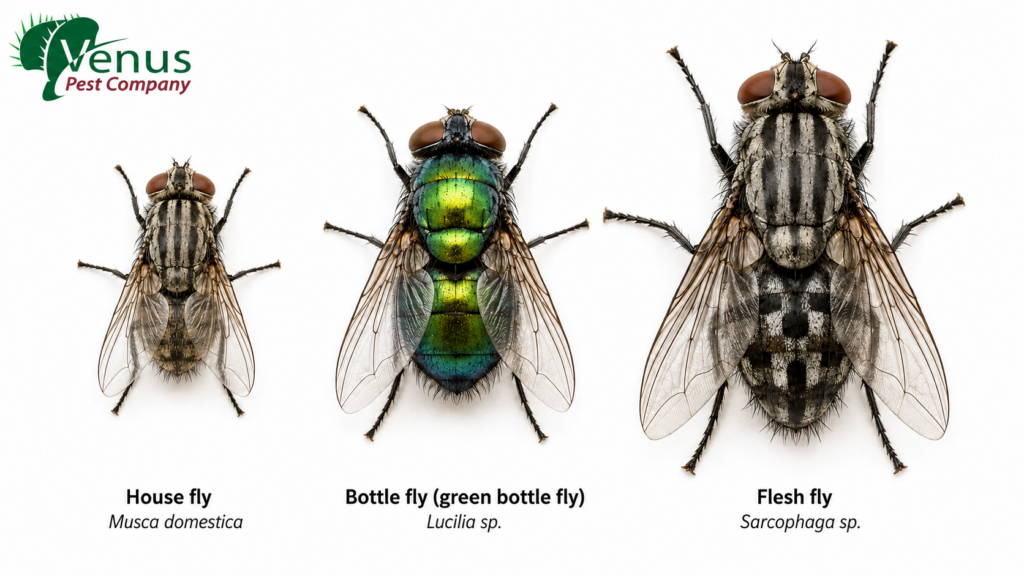
The common house fly, Musca domestica, measures about 1/6 to 1/4 inch long. It has a dull gray body, four narrow dark stripes running lengthwise across the thorax, and large compound eyes. The sides of the abdomen often look pale or yellowish. Like other true flies, it has one functional pair of wings. A second pair of tiny structures called halteres helps the fly balance in the air.
House flies have sponging mouthparts rather than jaws or a piercing beak. They can consume only liquid food. When they land on solid material, they release saliva and digestive fluid to dissolve part of it, then sponge up the liquid. They also have taste receptors on their feet, which lets them sample a surface as soon as they land.
That habit explains why house flies repeatedly touch food, counters, trash, manure, and other organic material. It also explains why people should take house flies seriously around kitchens and food service areas.
Do House Flies Bite?
No. House flies cannot bite people or animals. If a fly that resembles a house fly gives you a sharp bite, especially around the ankles or lower legs, you may have stable flies instead.
Stable flies look similar in size and color, but a close view reveals a rigid, forward pointing mouthpart. Both male and female stable flies feed on blood, and their bites can hurt. This distinction matters because stable fly larvae often develop in wet, decaying vegetation, soiled animal bedding, or mixtures of manure and feed. House flies favor moist garbage, manure, animal waste, and other decaying organic matter.
House Fly or Another Common Fly?
People use “house fly” as a general name for almost any fly that gets indoors. A careful identification narrows the source and prevents wasted effort.
| Fly | What you may notice | Typical source |
|---|---|---|
| House fly | Dull gray body, four dark thorax stripes, no bite | Moist garbage, manure, pet waste, spilled feed, and decaying organic material |
| Stable fly | House fly shape with a forward pointing mouthpart; painful bites often target lower legs | Wet hay, grass clippings, soiled bedding, and manure mixed with plant material or feed |
| Blow fly | Stout body with a metallic blue, green, bronze, or dark sheen | Dead animals, meat, afterbirth, and other animal material |
| Drain fly | Very small, dark, fuzzy, and mothlike | Organic film inside drains, sewer problems, or other wet buildup |
Fruit flies also enter the conversation, but they look much smaller and often have tan bodies and red eyes. They develop around fermenting produce, beer, wine, syrup, and residue in bottles or trash. The insect’s size, shape, behavior, and location all help point toward the correct source.
The House Fly Life Cycle
House flies pass through four stages: egg, larva, pupa, and adult. The pale, legless larvae are the maggots people sometimes find in a trash container or crawling across a floor.
A female places her eggs in moist, decaying organic material that can feed the larvae after they hatch. The maggots eat and grow in that material. Mature larvae then crawl toward a drier location and form brown, seedlike pupae. Adult flies emerge from the pupae and begin the cycle again.
Warm conditions speed the process. Texas A&M AgriLife reports that a generation can take as little as six days under ideal conditions and that two or three generations may develop each month during warm Texas weather. Real world timing varies with temperature, moisture, and food quality. Even so, the biology explains why a neglected bag of garbage, wet feed spill, or accumulation of animal waste can create an apparent overnight problem.
Adult flies may travel from a nearby source, so the breeding material does not always sit inside the affected room or even on the same property. Dumpsters, livestock areas, pet waste, compost, and neighboring sanitation problems can all contribute to outdoor pressure.
Why House Flies Matter
House flies visit feces, garbage, spoiled food, animal waste, and other contaminated material. Microorganisms can cling to their bodies or pass through their digestive systems. The flies can then transfer contamination when they walk, feed, regurgitate, or defecate on another surface.
That behavior creates a food safety concern in homes, restaurants, bars, commercial kitchens, schools, health care settings, and animal facilities. A fly’s presence does not prove that it has spread an illness, but allowing house flies to move between waste and food preparation areas creates an avoidable risk.
Fly specks offer another clue. Dark spots on walls, windows, light fixtures, ceiling areas, or equipment may come from fly feces or regurgitation. A pattern of specks can reveal where adult flies rest and help guide an inspection.
Where House Flies Come From
House flies need moisture and decaying organic matter. In a residential setting, a common source is residue trapped between a trash bag and the container. A leaking bag or liquid in the bottom of the can can support larvae even after someone removes the visible garbage.
Pet waste in the yard, food left in an outdoor bin, dirty recycling, spoiled produce, compost, and wet organic debris can also support development. On properties with animals, manure, wet bedding, and spilled feed deserve close attention. Commercial sites should inspect dumpster pads, trash rooms, floor areas beneath equipment, loading zones, and places where food residue collects.
House flies do not normally develop in clean standing water. They also do not point automatically to a drain. If tiny fuzzy flies rest near a sink or floor drain, drain flies make more sense. If small tan flies hover around beer taps, fruit, or bottles, fruit flies may fit better. Treating every fly problem as a drain problem can leave the true source untouched.
Why Are Maggots Crawling Across the Floor?
Maggots near a kitchen trash can often cause alarm, but the explanation can be simple. A house fly may have laid eggs in wet residue between the liner and the container. When someone lifts the bag, larvae can drop onto the floor. Mature larvae may also leave wet material on their own because they need a drier place to pupate.
Remove the affected waste, clean the container, and collect the visible larvae. Then inspect beneath and behind the can for spilled liquid or pupae. A small, isolated event should end after the material and developing flies are gone. Continuing activity suggests that another source remains nearby.
Why Did Many Flies Suddenly Appear in One Room?
A sudden group of adult flies often means that larvae finished developing somewhere close by. Look for forgotten food, a leaking trash bag, pet accidents, or organic material under an appliance. The flies may emerge over a short period as the pupae mature.
Large metallic blow flies change the likely explanation. They often develop in a dead rodent, bird, or other animal. When they appear around one wall, fireplace, window, attic access, or light fixture, a hidden carcass may sit in a wall void, chimney, attic, crawlspace, or vent. Finding the exact carcass is not always practical, but correct identification can explain why the flies arrived and whether the problem should fade after emergence ends.
A sustained house fly problem has a different pattern. New adults continue to appear because breeding material remains available or more flies keep entering from outdoors. That situation calls for a wider inspection.
Why Are There So Many Flies Outside?
Warm weather can support rapid house fly development across Brazos County. Outdoor numbers often rise around trash, pet waste, livestock, compost, decaying vegetation, or spilled animal feed. Flies may also travel from a source beyond your property, which can make an otherwise tidy patio feel impossible to protect.
Pay attention to where the flies gather and when the pressure changes. Activity around a trash enclosure points toward a different source than activity near a dog run or animal area. At restaurants, frequently opened service doors can let outdoor flies move directly toward indoor light, odors, and food.
How to Prevent House Flies
Source reduction provides the foundation for long term fly prevention. Remove household garbage regularly and clean residue from the can rather than replacing only the liner. Keep outdoor containers closed, wash recyclables when practical, and clean spills before they dry into hard to reach seams. Pick up pet waste often, manage compost carefully, and avoid leaving wet animal feed or organic debris in place.
Exclusion limits the number of adults that get indoors. Repair window screens, close gaps around doors, and make sure exterior doors shut fully. Busy commercial kitchens may need to review employee traffic, delivery procedures, door timing, and the placement and maintenance of air curtains. A clean facility can still struggle when a service door stands open near a fly source.
Light traps and other monitoring devices can help reveal where flies move, but placement matters. A device should not draw outdoor flies through an entrance or hang where insects could fall near exposed food. Monitoring also cannot make up for active breeding material. If the source continues producing flies, collecting adults addresses only the visible part of the problem.
Professional House Fly Control in Brazos County
Persistent fly problems require more than swatting the adults. A useful inspection asks four questions: Which fly is present? Where are the larvae developing? How are adults entering? What conditions keep supporting them?
Venus Pest Company uses those answers to build a practical plan for the property. We inspect likely breeding areas, resting sites, sanitation concerns, and entry points. We also consider how the building operates because a home, restaurant, veterinary facility, and livestock property do not create the same fly pressures.
Our owner, Dr. Scott Lingren, earned his PhD in entomology and graduated from Texas A&M with the Class of 1999. Venus serves Bryan, College Station, and communities throughout Brazos County. If house flies keep returning or you cannot find the source, call or text 979-774-0486 or use our contact form to request service.
House Fly FAQs
Can house flies bite people?
No. House flies have sponging mouthparts and cannot bite. A painful bite from a similar gray fly may come from a stable fly.
How quickly can house flies reproduce?
Under ideal warm conditions, the life cycle can take as little as six days. Temperature, moisture, and the quality of the breeding material affect the actual timing.
Do house flies come from drains?
House flies usually develop in moist garbage, manure, animal waste, spilled feed, and similar decaying material. Tiny fuzzy flies near drains are more likely drain flies, although damaged sewer lines or heavily contaminated areas can support several kinds of flies.
Does a clean house rule out house flies?
No. Adult flies can enter through doors or screens and travel from outdoor sources. A small amount of hidden residue can also support larvae. The fly’s identity and distribution help separate an indoor source from outdoor pressure.
Will house flies go away after the trash leaves?
They may, but larvae or pupae can remain beneath the liner, around the container, or in nearby cracks. Clean the can and surrounding area. If new flies continue to appear, inspect for another source.
Why do house flies rub their legs together?
Flies groom their legs and other body parts to remove particles that can interfere with their sensory structures. Because their feet help them taste and sense surfaces, grooming helps keep those structures functional.