Pest Expert Overview: Flesh Flies in Bryan & College Station
Flesh flies play a useful role outdoors by helping break down dead animals and other organic material. They become a problem when they gather around food, enter a building, or emerge indoors after developing in a dead rodent, bird, or other hidden source.
A sudden roomful of large flies can feel like an infestation, but the building itself usually isn’t the breeding material. Something nearby supported the larvae, and the new adults moved toward windows or indoor lights after they emerged. Correct identification helps determine whether that source is a carcass, garbage, animal waste, or something else entirely.
Venus Pest Company identifies fly problems for homes and businesses in Bryan, College Station, and the rest of Brazos County. We start with the species and the source because swatting visible adults won’t explain why they appeared.
What Does a Flesh Fly Look Like?
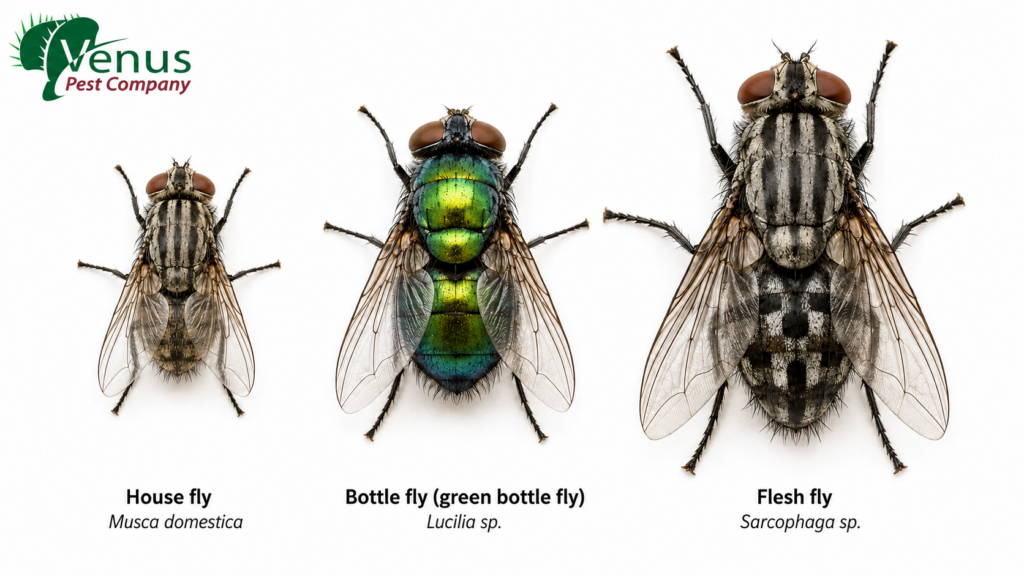
Flesh flies belong to the family Sarcophagidae. Most species that people notice around buildings look larger and heavier than a common house fly. Adults often measure roughly 3/8 to 1/2 inch long, although size varies among species.
Look for a gray body with three bold black stripes running lengthwise across the thorax, the section directly behind the head. The abdomen usually carries a black and gray checkerboard pattern. Many species have reddish eyes, a reddish tip on the abdomen, and stiff body bristles.
Those markings separate flesh flies from several common lookalikes. House flies generally have four narrow thorax stripes and a less distinct abdominal pattern. Blow flies often show a metallic blue, green, bronze, or black sheen. Stable flies resemble house flies but carry a rigid, forward pointing mouthpart that they use to bite.
Photographs can often confirm the family, but many flesh fly species look almost identical from above. Entomologists may need microscopic features, and sometimes the male reproductive structures, to determine the exact species. Fortunately, property inspections rarely require a species level name. Recognizing a flesh fly usually narrows the likely source enough to guide the search.
Flesh Fly, House Fly, or Blow Fly?
People often group every large indoor fly under the name “house fly.” The differences matter because each fly points toward a somewhat different set of sources.
| Fly | Appearance | Common source clues |
|---|---|---|
| Flesh fly | Large gray fly with three dark thorax stripes and a checkerboard abdomen | Dead animals, animal waste, garbage, and decaying animal material |
| House fly | Smaller gray fly with four narrow thorax stripes | Moist garbage, manure, pet waste, spilled feed, and other decaying organic matter |
| Blow fly | Stout fly with metallic blue, green, bronze, or dark coloring | Carrion, meat scraps, fish waste, and other animal material |
| Stable fly | Gray house fly shape with a visible forward pointing mouthpart | Wet hay, grass clippings, soiled bedding, and manure mixed with plant material |
Flesh flies and blow flies may visit the same carcass, so an indoor outbreak can contain more than one kind of fly. Color and thorax markings provide a good starting point, but a close view gives a more reliable answer than judging the insects while they circle a window.
Do Flesh Flies Bite?
Flesh flies do not bite or sting people. Their bristly bodies and large size can make them look threatening, but adults lack the piercing mouthparts of stable flies, horse flies, and deer flies.
They may land on people, food, outdoor tables, or surfaces near an odor. That behavior makes them annoying and raises sanitation concerns, especially around restaurants, food preparation areas, cookouts, and outdoor events. A painful bite means the insect is something other than a typical flesh fly.
The Flesh Fly Life Cycle
Flesh flies pass through larval, pupal, and adult stages, but they handle the egg stage differently from most familiar flies. A female generally retains her eggs until they hatch and deposits live first stage larvae directly onto suitable material. People sometimes describe this as giving birth to maggots.
That strategy gives the larvae an immediate start. They begin feeding as soon as the female places them on carrion, animal waste, or another suitable source. After growing through several larval stages, mature maggots leave the wet feeding material and seek a drier, protected spot. There they form dark, capsule shaped pupae. Adults later emerge and fly toward light or outdoor odors.
Development speed depends heavily on temperature and species. Warm Brazos County weather can shorten the cycle, while cool conditions slow it. Food quality and larval crowding also affect growth. A fixed promise that adults will emerge on one exact day ignores those variables.
This close relationship between insect development and temperature gives some flesh flies forensic value. Forensic entomologists identify the insects, determine their developmental stage, and compare local temperature records to estimate how long colonization may have occurred. The insects contribute evidence, but they don’t act as a perfect clock that pinpoints the moment of death by themselves.
What Do Flesh Fly Larvae Eat?
The family name suggests that every flesh fly develops in a vertebrate carcass. Many do, but the family has broader habits. Species may use dead mammals, birds, reptiles, fish, and other decaying animal material. Others develop in feces, garbage, or wounds, while some attack or parasitize insects and other invertebrates.
Around a home, the most relevant sources include a dead mouse in a wall, a rat in the attic, a bird in a chimney or vent, spoiled meat, fish remains, crawfish shells, pet waste, and animal material left in a trash container. Rural properties may also have livestock waste or wildlife carcasses nearby.
The source does not need to sit in the middle of the affected room. Larvae may crawl away before pupating, and adults can move through wall gaps, light fixtures, vents, attic openings, and doorways. That movement can make a problem appear several feet from the material that started it.
Why Did Flesh Flies Suddenly Appear Indoors?
When dozens of flesh flies gather at one window, they probably emerged close by. A rodent may have died in a wall, attic, fireplace, crawlspace, or duct chase. A bird or squirrel could have entered a vent or chimney. Forgotten food, a leaking trash bag, or animal material in a garage can create a similar pattern.
The adults usually head toward the brightest window because light offers an apparent route outdoors. That concentration makes it possible to remove many of them quickly with a vacuum. You may continue seeing stragglers as other pupae finish developing.
An isolated emergence often tapers after the source can no longer support larvae and the remaining pupae produce adults. The timing may range from a few days to longer, depending on the source and conditions. Continued waves of flies suggest that breeding material remains available, new animals keep gaining access, or the insects belong to another species with a different source.
If you smell a dead animal, inspect accessible areas before assuming that the carcass sits inside a sealed wall. Check the attic, chimney, fireplace, garage, crawlspace, and reachable voids. Remove a carcass when you can do so safely, then clean the affected area. If the source lies inside an inaccessible wall, opening the structure may cause more damage than the short lived fly event justifies. The odor, fly activity, source location, and building materials all factor into that decision.
Flesh Flies Around Trash, Fish, and Crawfish Remains
Flesh flies detect animal odors quickly. Fish scraps, bait, meat packaging, crawfish shells, and outdoor cooking waste can draw them before the gathering ends. A loosely tied bag left beside the house gives females access and may support larvae in warm weather.
Place animal remains in a tightly closed bag and move them to a covered outdoor container. Clean liquid residue from coolers, trash cans, prep tables, and concrete. Waiting until pickup day to deal with a leaking bag can turn a one night cookout into several days of fly activity.
Restaurants, seafood businesses, veterinary facilities, and properties with outdoor food service need the same principle on a larger scale. Trash storage, dumpster lids, container residue, pickup schedules, and delivery doors all affect pressure. An adult fly problem inside may begin at a waste area outside.
Are Flesh Flies Dangerous?
Most flesh flies around Brazos County create a nuisance and sanitation concern rather than a direct physical threat. They visit carrion, feces, garbage, and other contaminated material, then may land on food or food contact surfaces. That movement can transfer microorganisms mechanically.
A fly landing on a counter does not prove that it spread disease, but food businesses should not ignore insects that move between waste and preparation areas. Remove exposed food, clean affected surfaces, and correct the source or entry route.
Some flesh fly species elsewhere can cause myiasis when larvae develop in wounds or body tissues. That uncommon medical issue is different from finding adult flies at a window. Anyone who discovers larvae in a human or animal wound should contact a physician or veterinarian rather than treating it as a routine structural pest problem.
How to Prevent Flesh Fly Problems
Good waste handling prevents the most predictable problems. Remove spoiled meat and animal remains promptly. Keep trash bags closed, clean residue from containers, and store fish or crawfish waste where flies cannot reach it. Pick up pet waste regularly and inspect outdoor containers for leaks.
Exclusion helps when wildlife or rodents create the source. Repair gaps that allow rodents into attics and crawlspaces, screen vents appropriately, cap chimneys, and address damaged soffits or roof returns. Removing one carcass provides short term relief, but closing the entry point lowers the chance of another animal dying in the same void.
Screens and tight doors keep adult flies outside. Repair torn mesh, replace worn door sweeps, and avoid propping doors open near trash areas. These steps matter most for kitchens and commercial buildings, where frequent traffic can create a direct path from outdoor waste to indoor food.
Professional Flesh Fly Control in Brazos County
Flesh fly service begins with identification and source assessment. We look at the fly’s markings, where adults collect, how long activity has continued, and whether odors or building conditions point toward a hidden animal. We also check sanitation and entry routes when the pattern suggests an outdoor source.
Venus Pest Company does not need to make a broad treatment recommendation for every short lived emergence. Sometimes the practical answer is source removal, exclusion, and collecting the adults as they appear. A persistent problem deserves a deeper inspection because something continues to support it.
Our owner, Dr. Scott Lingren, earned his PhD in entomology and graduated from Texas A&M with the Class of 1999. Venus serves Bryan, College Station, and communities throughout Brazos County. If large flies suddenly appear indoors or you need a reliable identification, call or text 979-774-0486 or use our contact form to request service.
Flesh Fly FAQs
Why are flesh flies called flesh flies?
Many species develop in carrion or other animal material. The name describes that common association, although some species use feces, garbage, or living invertebrate hosts instead.
Do flesh flies lay eggs?
Females generally retain their eggs until they hatch and deposit live larvae on suitable material. This lets the maggots begin feeding immediately.
Do flesh flies mean there is a dead animal in the house?
They can. A group emerging in one room often points toward a rodent, bird, or other animal nearby. Flesh flies also use garbage, animal waste, and outdoor carcasses, so identification and inspection should come before that conclusion.
How long will flesh flies keep emerging?
An isolated group often fades after the existing pupae produce adults. You may see stragglers for several days. Repeated waves or ongoing activity suggest that a source remains or that new flies continue entering.
Can flesh flies reproduce inside a house?
Only if they can reach suitable animal material, waste, or another appropriate larval food source. They cannot develop in clean walls, dry wood, carpet, or ordinary household dust.
What is the difference between a flesh fly and a blow fly?
Flesh flies usually have gray bodies, three black thorax stripes, and checkerboard abdomens. Blow flies often look metallic blue, green, bronze, or black. Both groups may develop in dead animals.