
Pest Expert Overview: Dung Beetles in Bryan & College Station
They can still become a nuisance when dozens of adults fly toward porch lights or slip indoors. That doesn’t make them destructive, dangerous, or a sign that they’re breeding inside the house. It usually means fresh animal waste sits somewhere nearby and outdoor lighting has pulled the adult beetles toward the building.
Venus Pest Company helps homeowners and businesses in Bryan, College Station, and the rest of Brazos County identify nuisance beetles and determine why they’re gathering around a structure. With dung beetles, the goal is usually to keep them outside without disrupting the useful job they perform.
What Is a Dung Beetle?
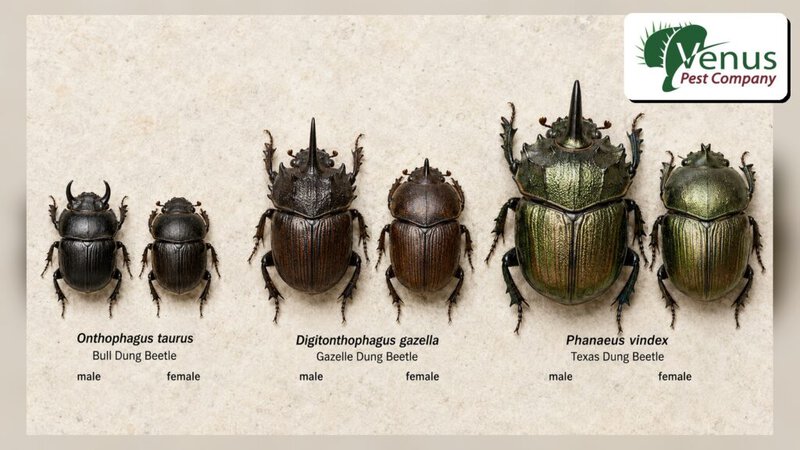
“Dung beetle” describes several groups of scarab related beetles that use animal feces for food or reproduction. They don’t all look alike. Depending on the species, an adult may measure only a few millimeters or approach an inch in length. Many look black or dark brown, while others shine with green, blue, copper, or reddish colors.
Their bodies tend to look stout, rounded, and well suited for digging. Strong legs help them move through soil and manure. Some males have noticeable horns or projections on the head or thorax. Those features can make a harmless dung beetle look more intimidating than it is.
One of the most striking species found across much of Texas and the eastern United States is the rainbow scarab, Phanaeus vindex. It may show metallic green wing covers and a copper colored thorax. Large males carry an obvious horn, while females and smaller males have much shorter projections. Texas has many other dung beetles, so color alone cannot confirm the species.
Are Dung Beetles Harmful?
Dung beetles don’t bite or sting people. They don’t eat wood, damage foundations, infest stored food, or reproduce in normal building materials. A beetle that accidentally enters a house usually wants to get back outdoors.
They also don’t create the animal waste that attracts them. Their presence points toward a resource that already exists, such as cattle manure, horse manure, wildlife droppings, or dog waste. On rural properties, the source may be obvious. In a neighborhood, it could sit in a yard, greenbelt, pasture, drainage area, or nearby property.
The beetles become a practical problem only when adults gather around lights, enter through open doors, fall into pools, or appear in numbers that concern the occupants. Even then, killing every beetle outside would remove a beneficial part of the local ecosystem without solving the attraction that brought them to the building.
Why Dung Beetles Are Good for Brazos County
Animal manure contains nutrients, but a pat left on the surface can smother grass and provide moist habitat for flies. Dung beetles break it apart, consume it, or carry portions below ground. Their activity speeds decomposition and places organic matter where soil organisms and plant roots can use it.
Tunneling also loosens and aerates the soil. Water can move into the ground more readily through the channels, and buried manure adds nutrients below the surface. On pastures, that process helps return grazing nutrients to the soil rather than leaving them concentrated in drying pats.
Dung beetles also compete with manure breeding flies. Texas A&M AgriLife explains that removing manure causes pats to dry faster and makes them less suitable for fly development. The beetles won’t eliminate every horn fly, house fly, or stable fly, but they reduce one of the resources those pests need.
I saw just how effective they could be during the summer after my sophomore year, when I worked for Dr. Truman Fincher at the USDA/ARS facility in College Station. We placed cow patties in a pasture and put horn fly eggs beneath them to simulate natural horn fly reproduction. At different intervals, we collected the patties to find out which natural enemies had arrived and how many horn flies survived. We repeated the test every week throughout the summer.
Sometimes dung beetles buried an entire cow pat within four hours. Once they moved the manure underground, none of the horn flies beneath that pat survived. Watching that happen made the relationship pretty hard to forget. The beetles weren’t simply cleaning up manure. They removed the habitat before the horn flies had a chance to develop.
That makes dung beetles particularly useful around cattle, horses, and other grazing animals. They also help in ordinary neighborhoods by working on wildlife droppings and pet waste, although picking up dog waste remains the sensible sanitation practice around a home.
Rollers, Tunnelers, and Dwellers
The famous beetle pushing a perfectly round ball represents only one dung beetle strategy. Scientists generally group their behavior into three broad categories.
Rollers shape a piece of dung into a ball, move it away from the original pile, and bury it. The beetle may use the ball for food or prepare it as a brood ball for developing young. Rolling helps the beetle escape competition at a crowded dung pat.
Tunnelers work closer to the source. They dig into the soil beneath or beside the manure and carry dung into underground chambers. Rainbow scarabs follow this general pattern. They form dung portions below the original mass rather than rolling a ball across open ground.
Dwellers remain in or immediately beneath the manure. Adults place eggs in the pat, and the larvae feed where they hatch. These species may not bury as much material, but they still help break apart the pat and accelerate decomposition.
All three strategies benefit the environment. They also explain why one person may see beetles rolling balls across a trail while another finds small beetles inside a cow pat and never sees a ball at all.
The Dung Beetle Life Cycle
Dung beetles undergo complete metamorphosis through egg, larva, pupa, and adult stages. The female selects or prepares a supply of dung for each developing larva. Depending on the species, she may place an egg in a rolled brood ball, in an underground chamber filled with dung, or directly within the manure pat.
After the egg hatches, the pale, curved larva feeds on the stored material. It grows through several larval stages and then pupates in the protected nesting area. The adult eventually emerges, digs to the surface, and searches for fresh dung.
Development time varies widely among species and changes with temperature, soil moisture, and food conditions. Warm, wet weather can increase insect activity in Brazos County, but a burst of adults at a light doesn’t mean they completed their life cycle inside the wall. The building usually serves as the attraction point, not the breeding source.
How Dung Beetles Find Manure
Fresh dung releases odors that quickly move downwind. Dung beetles detect those chemicals with sensitive antennae and fly toward the source. A fresh cattle pat can attract a busy community of beetles and other insects within a short time.
Competition begins once they arrive. Rollers try to remove a portion before another beetle steals it. Tunnelers dig beneath the resource, while dwellers stay in it. The rush explains why dung beetle behavior can look frantic even though the beetles pose no threat to people.
Some African rolling species use celestial cues to travel in a straight line, and experiments have shown that one nocturnal species can orient by the Milky Way. That unusual ability makes a great dung beetle fact, but it doesn’t describe every species. Local beetles use behavior suited to their own habitat and nesting strategy.
Why Dung Beetles Gather Around Outdoor Lights
Many adult scarab beetles fly at night and respond to artificial light. A bright fixture can overwhelm the darker natural surroundings and pull beetles toward a porch, garage, shop, restaurant, or apartment breezeway. Once they reach the structure, they may circle the fixture, hit walls, land near doors, or crawl through gaps.
Activity may increase after warm rain because moisture improves soil conditions and can trigger insect movement. Nearby livestock, wildlife, or dog waste supplies the food source. The light simply concentrates the adults where people notice them.
Changing the lighting often helps more than focusing on the beetles. Keep unnecessary exterior lights off, use motion controls where practical, and choose fixtures that direct light downward rather than outward. Warm colored lamps generally draw fewer night flying insects than bright lamps rich in blue or ultraviolet wavelengths. Closing blinds can also reduce light spilling through windows.
Door management matters too. Repair screens, replace worn weather stripping, and avoid leaving doors open beside active lights. Moving a fixture away from an entrance can draw insects toward a less troublesome part of the property. These changes won’t remove dung beetles from the surrounding environment, which is good, but they can reduce how many arrive at the door.
Is It Really a Dung Beetle?
Several stout beetles fly to lights during the same warm months. June beetles, masked chafers, rhinoceros beetles, and other scarabs may resemble dung beetles at a glance. Some feed on plant roots as larvae, while others develop in decaying vegetation or wood. A shiny or horned beetle near a porch light does not automatically use manure.
Location provides a clue, but it doesn’t settle the identification. A true dung beetle may appear near a pasture, dog park, horse property, or wildlife corridor. A June beetle may gather at the same fixture because both insects respond to light. Clear photos of the top, underside, antennae, and front legs can help an entomologist separate them.
What to Do When Dung Beetles Get Indoors
An occasional indoor beetle usually needs no more than physical removal. Capture it in a container and release it outdoors, or vacuum it if that makes more sense. Then look for the entry point. A torn screen, loose door sweep, or gap around a frequently opened door often explains the visit.
Repeated activity calls for a broader look at lighting, access points, and nearby animal waste. Pick up pet waste regularly and keep doors closed during periods of heavy flight. On livestock property, manure management has to account for animal health, pasture conditions, and the beneficial insects already doing part of the cleanup.
Indoor dung beetles should not establish a lasting infestation unless suitable animal waste remains inside the structure. If beetles keep appearing in a home with no clear source, identification becomes especially important. The insects may belong to another beetle group with very different habits.
Professional Dung Beetle Management in Brazos County
Venus Pest Company starts by determining whether the insect is actually a dung beetle. We then look at where adults gather, how they enter, what lighting attracts them, and whether nearby conditions explain the activity. The right answer may involve exclusion and lighting changes rather than treating a beneficial outdoor insect as a conventional pest.
Our owner, Dr. Scott Lingren, earned his PhD in entomology and graduated from Texas A&M with the Class of 1999. Venus serves Bryan, College Station, and communities throughout Brazos County. If beetles keep getting indoors or you need a reliable identification, call or text 979-774-0486 or use our contact form to request service.
Dung Beetle FAQs
Do dung beetles bite or sting?
No. Dung beetles don’t bite or sting people. Their horns and strong digging legs may look formidable, but they serve the beetle during digging, competition, or mating.
Do dung beetles carry dung into houses?
They normally use dung outdoors and do not carry it into a home. Adults found indoors usually followed light or entered accidentally through an open door or gap.
Why are dung beetles in my yard?
Animal waste attracted them. The source may come from pets, livestock, deer, raccoons, or other wildlife. Their presence often means they’re helping remove that material.
Should I get rid of dung beetles?
Usually not. They recycle nutrients, improve soil, and reduce manure habitat available to pest flies. Focus on keeping adults out of the building and reducing excessive light attraction.
Do all dung beetles roll balls?
No. Rollers make and move balls, tunnelers bury dung beneath the source, and dwellers develop within the manure. Many dung beetles never roll a visible ball.
Are rainbow scarabs dung beetles?
Yes. The rainbow scarab is a colorful dung beetle found across a broad part of the United States, including Texas. Its metallic colors and the horn on large males make it easy to remember, although related species can look similar.