

Pest Expert Overview: Subterranean Termites in Bryan & College Station
Homes in Bryan, College Station, and throughout Brazos County sit in prime termite country. Texas A&M AgriLife Extension identifies Texas as one of the states at greatest risk for termite infestations. Termites occur naturally in our soil, so finding a colony somewhere on a property isn’t unusual. The important question is whether termites have found a concealed route into the house.
Subterranean termites rarely announce themselves early. They stay inside soil, mud tubes, or wood, where light and dry air can’t reach them. A homeowner may see no obvious activity until termites swarm indoors or remodeling exposes damaged wood. That hidden behavior makes a careful inspection far more valuable than a quick glance around the foundation.
The Termite School That Prepared Me to Start Venus
My formal entomology education and much of my early career focused on agricultural entomology. When I started Venus Pest Company, I was honestly afraid of dealing with termites. I understood insects, research, and pest management, but structural termite work carried a different kind of responsibility. A mistake could leave someone’s largest investment unprotected.
Luckily, Texas A&M offered the Philip J. Hamman Termite Control Training School. I enrolled in the very next class. The school combined termite biology with inspections, field laboratories, treatment equipment, damage evaluation, and the practical details of protecting real structures. Its stated mission was to produce expert termite control specialists, and the hands on format gave me the foundation I needed.
Two of the best people in the industry taught me there: Dr. Harry Howell and Dr. Grady Glenn. Both have since passed away, but their influence still shapes the way we inspect and treat homes today. Texas A&M also credits Harry and Grady with helping prepare revisions to its subterranean termite publication.
Grady helped me in another way that had nothing to do with treatment equipment. I was still on the fence about starting my own pest control company when I ran into him at a national Entomological Society of America meeting. He was the first and only person who enthusiastically told me to go for it. I did, and I’ll always be grateful that he gave me that push.
Grady’s widow, Laura Tankersley-Glenn, is also a fine entomologist. Before Grady moved into academia, the two of them ran their own pest control company, so Laura understands both the science and the practical side of the work. She later served as executive director of Keep Brazos Beautiful, and I believe she was the person who first got me involved with the organization. I eventually served on its board.
That connection continues in a small but meaningful way. Last year, Laura and I worked together to help a family in need eliminate a serious flea infestation. She later gave me some of Grady’s old sprayer parts. We still use some of those parts today. Pest control equipment usually isn’t sentimental, but this is an exception.
What Makes a Termite Subterranean?
The name describes how these termites live. Their colonies usually occupy the soil, where they can maintain the moisture their soft bodies require. Workers travel through underground tunnels to reach buried wood, tree roots, stumps, fences, landscape timbers, and structures.
When workers need to cross an exposed surface, they build shelter tubes from soil, saliva, and other material. These mud tubes protect them from dry air, light, and predators. A tube may run up a slab foundation, across a pier, through an expansion joint, behind siding, or into a crack that leads to wood.
The eastern subterranean termite, Reticulitermes flavipes, ranks among the most common structural termite species in Texas. Formosan subterranean termites, Coptotermes formosanus, also occur in the state. Workers cause the wood damage, soldiers defend the colony, and reproductives produce offspring. Mature colonies also produce winged reproductives called swarmers or alates.
Termite Swarmers Are Often the First Warning
In much of Texas, native subterranean termites commonly swarm during spring when temperature, moisture, and other conditions line up. A swarm may last only a short time. The insects often gather near windows, doors, or other light sources, then drop their wings and die.
The swarmers themselves don’t cause structural damage. Their job is to leave a mature colony, find a mate, and attempt to start a new one. The location of the swarm matters more than the number of insects.
Subterranean termites swarming from a stump or somewhere out in the yard don’t automatically prove that the house has an infestation. Termites belong in the local environment, and colonies can exist near homes without entering them. Swarmers coming from an interior wall, baseboard, plumbing opening, attached garage, porch, or another part of the structure tell a different story. Texas A&M’s School Integrated Pest Management program describes indoor swarmers as a clear sign of an active infestation that warrants a professional inspection.
Don’t assume the problem left when the swarm disappeared. The winged termites may die quickly indoors, but the workers remain hidden in the wood, soil, or shelter tubes. Save a few insects or clear photos if possible. They help us distinguish termites from ants after the swarm ends.
Flying Termites Versus Flying Ants
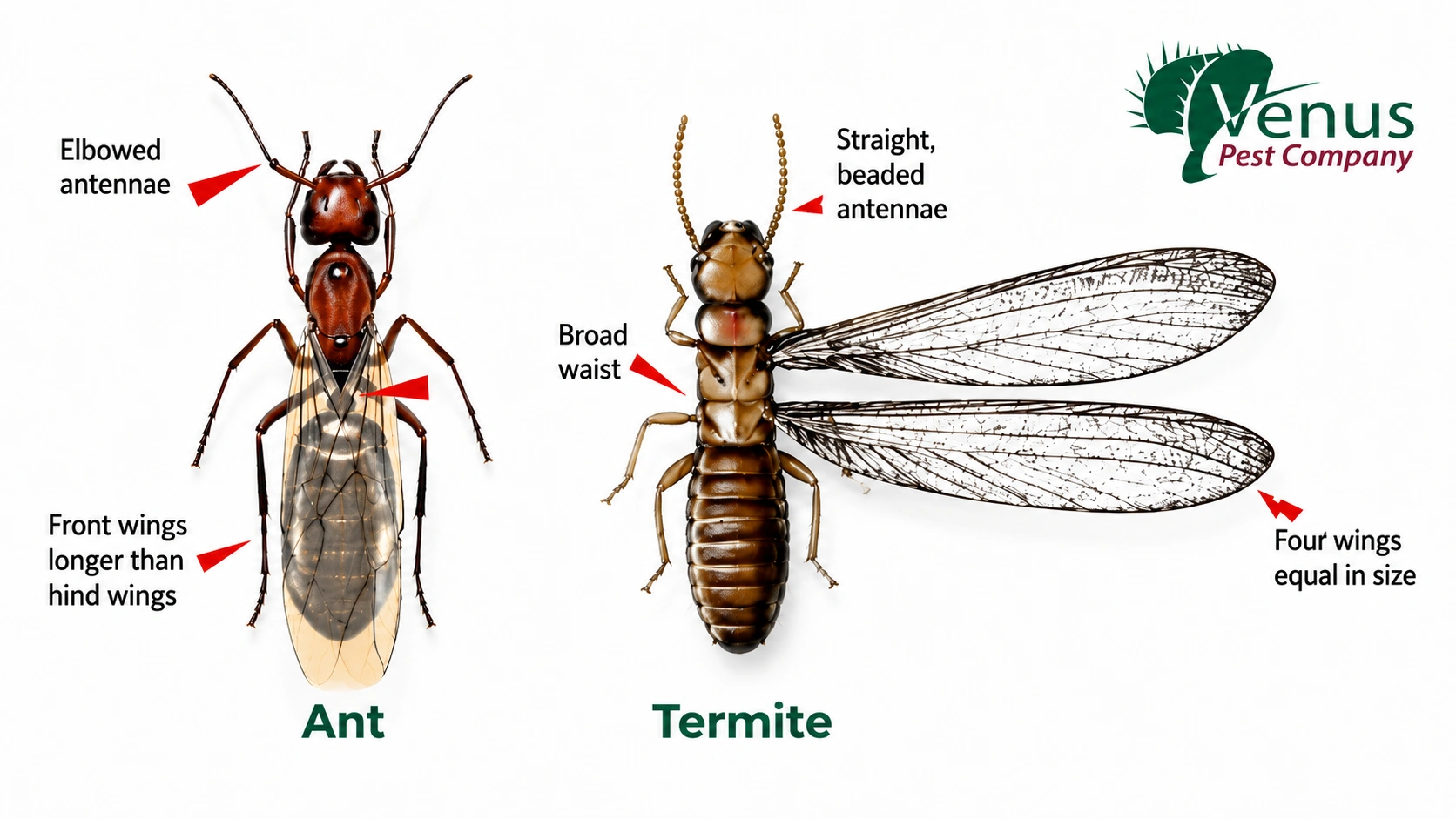
Ants and termites often swarm during similar weather, and both may appear suddenly around windows. A close look usually separates them.
| Feature | Termite swarmer | Winged ant |
|---|---|---|
| Antennae | Fairly straight and beadlike | Elbowed |
| Waist | Broad, without a narrow pinch | Clearly narrowed between body sections |
| Wings | Front and rear wings roughly equal in size | Front wings larger than rear wings |
| Shed wings | Often leaves many similar wings near the emergence area | Usually doesn’t create the same pile of equal sized wings |
Color alone doesn’t provide a reliable answer. Subterranean termite swarmers often look dark brown or black, while the concealed workers and soldiers remain pale.
Signs of a Subterranean Termite Infestation
Mud shelter tubes provide the classic sign, but termites don’t always build those tubes where a homeowner can see them. They may travel through a foundation crack, plumbing penetration, expansion joint, enclosed porch, bath trap, or hidden area where soil sits close to the structure.
Indoor swarmers or piles of shed wings deserve immediate attention. Other clues include soil packed into cracks, soft or hollow wood, damaged trim, blistered surfaces, or wood that breaks open to reveal galleries containing soil. Subterranean termite galleries tend to follow softer portions of the wood and usually contain some mud or soil. Carpenter ant galleries generally look cleaner and smoother because carpenter ants excavate wood rather than eat it.
Some termite damage remains visible long after a colony becomes inactive, so damage alone doesn’t establish current activity. Conversely, a home can contain active termites before anyone finds damage. We look for live termites, fresh tubes, current moisture conditions, access routes, construction details, and the pattern of evidence rather than relying on one clue.
How They Find a Way Inside
People sometimes ask what attracted termites to their house, as though a neighboring home sent them over. Usually, the termites were already foraging in the surrounding soil. A structure becomes vulnerable when workers encounter accessible wood or find a protected path inside.
Wood touching soil creates an easy route. So can siding that extends below the soil line, form boards left after construction, buried wood scraps, landscape timbers, or a porch built against the original foundation. Termites can also pass through extremely small gaps around pipes, cracks, joints, and other penetrations. They don’t eat concrete, but concrete rarely forms a perfectly solid, uninterrupted barrier.
Moisture increases the risk around many homes. Plumbing leaks, poor drainage, clogged gutters, air conditioning condensate, irrigation problems, and inadequate ventilation can keep soil or wood damp. Termites still infest sound wood, so a dry house isn’t immune, but correcting excess moisture removes conditions that make inspection and control more difficult.
What a Professional Inspection Looks For
A good termite inspection does more than confirm that the insects in a photograph are termites. We examine the foundation, accessible framing, plumbing areas, exterior wall transitions, porches, attached structures, crawlspaces when present, and other likely access points. We also look for moisture, wood to soil contact, construction gaps, old treatment evidence, and conditions that could interfere with a new treatment.
The visible swarm location doesn’t always identify the point where workers entered. Termites can travel through concealed spaces before swarmers emerge around a window or light. We use the building layout and evidence to separate active infestation from old damage and determine which areas need the most attention. If damage appears significant, a qualified contractor or engineer may need to evaluate the wood. A pest inspection doesn’t replace a structural assessment.
Professional Subterranean Termite Treatment
Subterranean termite control requires a plan built around the structure. Common professional approaches include soil treatments, termite baiting systems, and targeted treatments to accessible woodor termite activity. Each method has strengths and limitations. Slab construction, pier and beam construction, wells, drainage, additions, patios, plumbing routes, accessibility, and the location of activity all influence the decision.
A soil treatment aims to establish a treated zone where termites travel between the soil and structure. A baiting system uses termite foraging and food sharing to affect the colony over time. Targeted work may supplement either approach when termites appear in a specific accessible area. Some homes need one primary method, while others benefit from a combination.
This isn’t a good project for guesswork. The U.S. Environmental Protection Agency explains that termite products must demonstrate structural protection and that professional application requires training, proper equipment, and close attention to the building and label. An incomplete treatment can leave concealed entry routes open while giving the homeowner false confidence.
Venus Pest Company doesn’t recommend pesticide products, application rates, or do it yourself termite treatment instructions on this page. A product name can’t tell you where termites entered, how a slab was built, or whether a treatment can reach the necessary areas. The inspection and treatment design matter as much as the material used.
Reducing Risk Around Your Home
Homeowners can reduce favorable conditions without attempting a termite treatment. Keep the visible foundation edge exposed where practical so mud tubes don’t disappear behind soil, mulch, or dense plants. Correct leaks and drainage problems. Avoid direct contact between soil and wooden siding, posts, trim, or framing. Store firewood and lumber away from the house, and remove buried wood or construction debris when you find it.
These changes help, but they don’t create a termite proof house. Subterranean termites can find hidden openings that no homeowner could reasonably detect. Periodic professional inspections remain important, especially after remodeling, plumbing repairs, foundation work, or previous termite activity.
Protecting Homes Across Brazos County
Venus Pest Company has served Brazos County since 2001. The confidence I gained at the Philip J. Hamman Termite Control Training School helped turn termites from the service I feared into one we approach carefully and systematically. Harry Howell and Grady Glenn taught me that good termite work begins with biology, but it succeeds through attention to the building.
If you’ve found termite swarmers, shed wings, mud tubes, or suspicious wood damage, call or text 979-774-0486, or email service@venuspest.com. We’ll inspect the evidence, explain what it means, and recommend a treatment plan that fits the structure.
Subterranean Termite Questions
Do termites in my yard mean they are inside my house?
No. Subterranean termites naturally live throughout Brazos County, and colonies commonly feed on stumps, buried roots, and dead wood. Termites in the yard justify awareness, but indoor swarmers, shelter tubes on the structure, or active termites in the house provide much stronger evidence of an infestation.
What should I do if they swarm inside?
Save a few insects or take close photos, note where they emerged, and arrange a professional inspection. You can clean up the dead swarmers, but don’t assume the infestation disappeared with them. The workers usually remain concealed.
How can I tell a termite from an ant?
Termite swarmers have a broad waist, relatively straight antennae, and two pairs of wings that look about equal in size. Winged ants have a narrow waist, elbowed antennae, and larger front wings.
Do subterranean termites eat concrete?
No. They may travel through cracks, joints, utility openings, and gaps in or around concrete to reach wood. A slab can hide their route without serving as food.
Can a very clean home get them?
Yes. Cleanliness has little to do with subterranean termite activity. The colony lives in soil and looks for cellulose, moisture, and protected access. New, clean, and well maintained homes can still develop infestations.
How quickly can they damage a house?
The rate varies with colony size, species, temperature, moisture, available wood, and access. No honest inspector can determine the age of an infestation from one mud tube or damaged board. The practical response is to inspect promptly, then choose a sound treatment instead of panicking.
Will homeowner insurance cover the damage?
Most standard homeowner policies exclude damage from termites and other insects, but policies differ. Ask your insurer to explain your coverage. This common exclusion makes inspection and early intervention especially important.
Does treatment require leaving the house?
That depends on the treatment method, product label, structure, and work area. Many subterranean termite treatments don’t require a long absence, but your pest professional should explain preparation and reentry requirements before work begins.