
Pest Expert Overview: Ghost Ants in Bryan & College Station
When I started Venus Pest Company in 2001, we didn’t see ghost ants around the Brazos Valley at all. That has changed. Some years they become a common service call across Bryan and College Station. Other years, we barely encounter them.
That uneven pattern may tell us something about competition among the tiny ants living around our homes. It also explains why identification matters. A treatment plan based only on “little ants in the kitchen” can miss the biology that makes this species difficult.
The Ant That Wasn’t Here Before
Ghost ants, Tapinoma melanocephalum, are tropical ants carried around the world through human commerce. Their original home remains uncertain because people moved them so widely before entomologists could reconstruct their range.
The University of Florida’s ghost ant profile reports that the species reached Texas in 1994 or 1995, probably through Galveston in a shipment of plants from Florida. That statewide arrival came only a few years before I founded Venus, but an introduced species doesn’t become equally common everywhere at once.
It takes time for colonies to move through nursery stock, landscaping, commercial buildings, and neighborhoods. Local weather and competition also affect whether a newly introduced ant merely survives or becomes noticeable. Our service history provides a small window into that process. Ghost ants went from something we didn’t encounter to a recurring pest whose abundance changes dramatically from one year to the next.
Why Their Numbers Change So Much
Insects rarely follow a neat annual calendar. Heat, winter cold, rainfall, soil moisture, irrigation, plant growth, and honeydew producing insects can all change which ant species thrive in a particular season.
Competition matters too. Several tiny, sweet feeding ants use similar resources around Brazos County homes. They forage around foundations, trees, mulch, kitchens, bathrooms, and other places where they can find moisture or sugar. When one species becomes dominant, another may lose access to food or nesting space.
A Local Hypothesis About an Open Niche
My working hypothesis comes from years of watching local ant calls change. Dark rover ants became much more common after Venus opened, and they appeared to displace many of the ants that customers and technicians loosely called “sugar ants.” During years that don’t favor those dominant species, ghost ants may find an opening in that same ecological niche.
I want to be precise about what that means. We have a strong field observation, not a controlled experiment proving that rover ants caused the change. Ant populations respond to several forces at once, and “sugar ant” is a common name that people apply to more than one small ant species. Still, the pattern is biologically reasonable. When competition weakens and the weather suits a tropical ant, ghost ants can take advantage of food and nesting sites that become available.
That may explain why they seem plentiful one year and almost absent the next. It also gives us a better question than “Why did these ants suddenly appear?” The more useful question is, “What changed around this property or in the local ant community that allowed them to succeed?”
How to Identify Ghost Ants
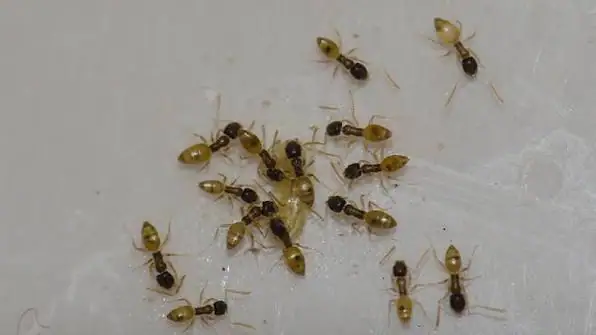
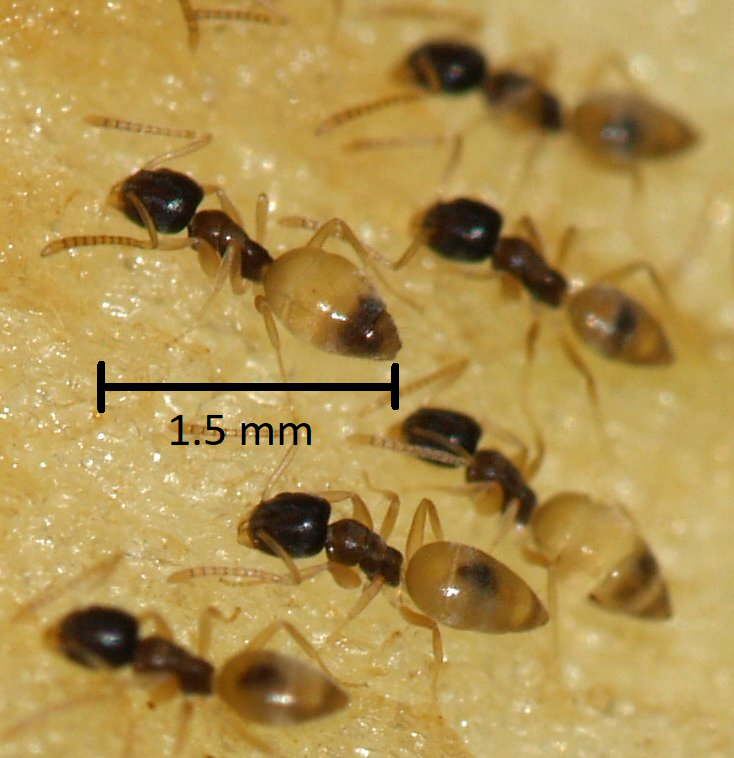
Ghost ant workers measure only about 1.3 to 1.5 millimeters long, which is less than 1/16 inch. Their head and thorax are dark brown. Their abdomen, legs, and antennae look milky white or pale yellow.
That color pattern creates the ghostly effect. On a light surface, the pale abdomen and legs nearly vanish, leaving what looks like a tiny dark speck moving by itself. On a dark counter, the opposite can happen: the head becomes hard to see while the pale body stands out.
All workers are approximately the same size. They travel on organized trails when foraging, but disturbed workers may run quickly and erratically. They don’t have stingers and rarely bite people. When crushed, they can produce an odor often compared with rotten coconut, although smell alone isn’t a reliable identification method.
The Texas A&M Urban and Structural Entomology Program provides close photographs and identifies the dark head, translucent body, tiny size, multiple queens, and mobile nest structure as key characteristics.
Ghost Ants Versus Rover Ants
People often confuse ghost ants with dark rover ants because both are extremely small, enter homes, seek sweet foods, and occur around moisture. Color provides the quickest field clue.
Ghost ants have a sharply darker head and thorax with a pale, nearly translucent abdomen and legs. Dark rover ants look more uniformly brown and stockier. Rover ants also commonly trail along foundations, pavement edges, and tree trunks outdoors.
Size comparisons can become misleading when the ants are moving. A clear close photograph helps, but professional identification may require a collected specimen and magnification. That small effort prevents us from building a treatment around the wrong species.
Other Tiny Lookalikes
Pharaoh ants can also look pale, but they tend to appear yellowish or light brown with a darker abdomen. Little black ants look dark from head to abdomen. Odorous house ants are larger and uniformly brown to black.
Common names add another layer of confusion. “Sugar ant” often means any small ant attracted to sweets rather than one precise species. What the ant looks like, where it trails, how it behaves, and where it nests matter more than the nickname attached to it.
Where They Build Their Nests
Ghost ants use small, protected spaces that may remain suitable for only a short time. Outdoors, they nest beneath loose bark, stones, plant debris, flowerpots, clumps of moist grass, and other sheltered objects. They may occupy tree crotches, plant stems, or soil near a foundation.
Inside, they can settle into wall voids, cabinet gaps, baseboards, potted plants, boxes, and cracks around sinks or plumbing. Workers seen indoors may also belong to a colony outside. A branch touching the house, a tiny exterior gap, or a plant moved indoors can give them a route inside.
The nest isn’t necessarily one central location. A large colony may occupy many small sites and exchange workers, brood, and food between them. That scattered arrangement lets the ants respond quickly when one shelter dries out, becomes crowded, or gets disturbed.
What Brings Them Indoors
Kitchens and bathrooms provide the two things ghost ants seek most often: sugar and moisture. A small spill, syrup residue, sweet drink, damp sponge, plumbing leak, or condensation around a pipe can support foraging activity.
Outdoors, the ants collect honeydew from aphids, scale insects, whiteflies, and other plant feeding insects. Honeydew is sugary waste, and ants treat it as a dependable food supply. A heavily infested shrub or tree beside the house can support a large amount of ant activity even when the kitchen stays spotless.
Ghost ants also eat living and dead insects. Cleanliness helps, but their presence doesn’t automatically mean a house is dirty. A pristine home can still provide water, warmth, shelter, and access to an outdoor food source.
A Colony Spread Across Many Addresses
Ghost ant colonies contain multiple queens. They expand through budding, a process in which one or more queens leave with workers and brood to establish another nest nearby. Connected nests may cooperate rather than fight, creating a broad colony network with many thousands of workers.
This structure gives ghost ants remarkable flexibility. If one pocket of the colony becomes unsuitable, part of the population can move. If workers discover food in another room, the colony can shift activity toward it. What looks like a small trail beside one sink may connect to several indoor and outdoor nesting sites.
That is why locating one nest doesn’t always solve the problem. It may only reveal one address in a much larger neighborhood.
Why Killing the Visible Workers Falls Short
The ants walking across the counter represent only a small portion of the colony. Wiping them up may provide immediate relief, but it doesn’t reach the queens, brood, or workers sheltered elsewhere.
Repellent sprays can complicate a multi-queen, multi-nest infestation. They may disrupt trails or push activity away from the treated area without reaching the colony network. With a species that already moves and buds readily, chasing workers from one crack to another isn’t meaningful control.
Venus doesn’t publish pesticide recommendations for homeowners. Effective treatment depends on correct identification, the colony’s location, what the ants are feeding on, and the products legally labeled for that setting. A generic product list would encourage people to treat before answering those questions.
What You Can Correct Around the House
Start with the resources that keep the ants active. Clean sweet spills and residue, store food in sealed containers, rinse beverage containers before recycling, and avoid leaving wet sponges or pet food out overnight. Repair plumbing leaks and dry recurring condensation.
Outside, look for overwatered soil, damp mulch against the foundation, branches touching the structure, and potted plants near entry points. Check nearby plants for sticky leaves, shiny surfaces, aphids, scale insects, or whiteflies. Venus offers a separate aphid control service when honeydew producing insects are supporting an ant problem.
Seal practical openings around windows, doors, pipes, and utility penetrations after the active infestation has been addressed. Tiny ants can use extremely small gaps, so exclusion helps most when combined with food, moisture, and colony control.
Professional Ghost Ant Control
We begin by confirming the ant. Then we inspect indoor trails, exterior activity, moisture sources, vegetation, potted plants, and likely travel routes. The objective isn’t to kill whichever workers happen to be visible during the appointment. We want the treatment to reach the connected colony.
Depending on the setting, our professional approach may use bait, nonrepellent treatment, or both. Foraging workers carry food back and share it within the colony. A properly selected nonrepellent treatment also allows normal movement through treated areas so exposure can extend beyond the ants we see.
We may also address an exterior honeydew source or recommend corrections that make the structure less attractive. This is the practical value of Integrated Pest Management: identification, biology, treatment, and prevention work together instead of relying on repeated surface spraying.
Ghost ants are covered by our ongoing Basic Pest Control program. When activity returns between scheduled services, covered customers can ask us to come back and address it.
Local Help From an Entomologist Led Company
Venus Pest Company has served Bryan, College Station, and Brazos County since 2001. Every pest program we use grew from Dr. Scott Lingren’s entomology training and decades of local field experience.
That history matters with a changing pest. We remember when ghost ants weren’t part of the local service picture. Now we can compare their activity with rover ants and other household species from one season to the next. A national identification sheet can explain the ant’s biology. Local service records help explain what that biology looks like here.
If tiny pale ants keep returning to your kitchen or bathroom, call or text 979-774-0486, email service@venuspest.com, or request service through Venus Pest Company. We’ll identify the species and build the response around the colony rather than the few workers on the counter.
Questions About Tiny Household Ants
Why are ghost ants called ghost ants?
Their dark head contrasts with an extremely pale abdomen and legs. Against a light surface, the back half of the ant seems to disappear, giving it a ghostlike appearance.
Do they sting or bite?
Ghost ants don’t have stingers and rarely bite people. Their small size and large colony networks make them a nuisance rather than a physical threat.
Why do I find them near the sink?
Sinks provide water, condensation, food residue, and protected gaps around plumbing. The nest may sit inside a nearby void, but the workers could also be traveling inside from outdoors.
Does seeing them mean my house is dirty?
No. Food residue can support ants, but a very clean house may still offer moisture, warmth, shelter, or a route to outdoor honeydew. Sanitation helps without fully explaining every infestation.
Can one colony have several queens?
Yes. Ghost ant colonies contain multiple queens and may spread across numerous connected nests. Queens, workers, and brood can establish new subcolonies through budding.
Why did they disappear and then return?
The colony may have shifted to another nesting site or changed its foraging trail. Seasonal weather, moisture, food, and competition from other ant species can also change how much activity appears around a home.
Are ghost ants covered by regular Venus service?
Yes. Ghost ants are included in the common household ant coverage provided through Venus’s ongoing Basic Pest Control program. The exact response depends on identification and what our inspection finds.
Can I identify them from a photograph?
A sharp close photograph may show the dark head and pale body. Because these ants measure less than 1/16 inch and resemble other household species, a specimen viewed under magnification provides a more dependable identification.